Edinburgh

Edinburgh isn’t so much a city, more a way of life… I doubt I’ll ever tire of exploring Edinburgh, on foot or in print.

– Ian Rankin

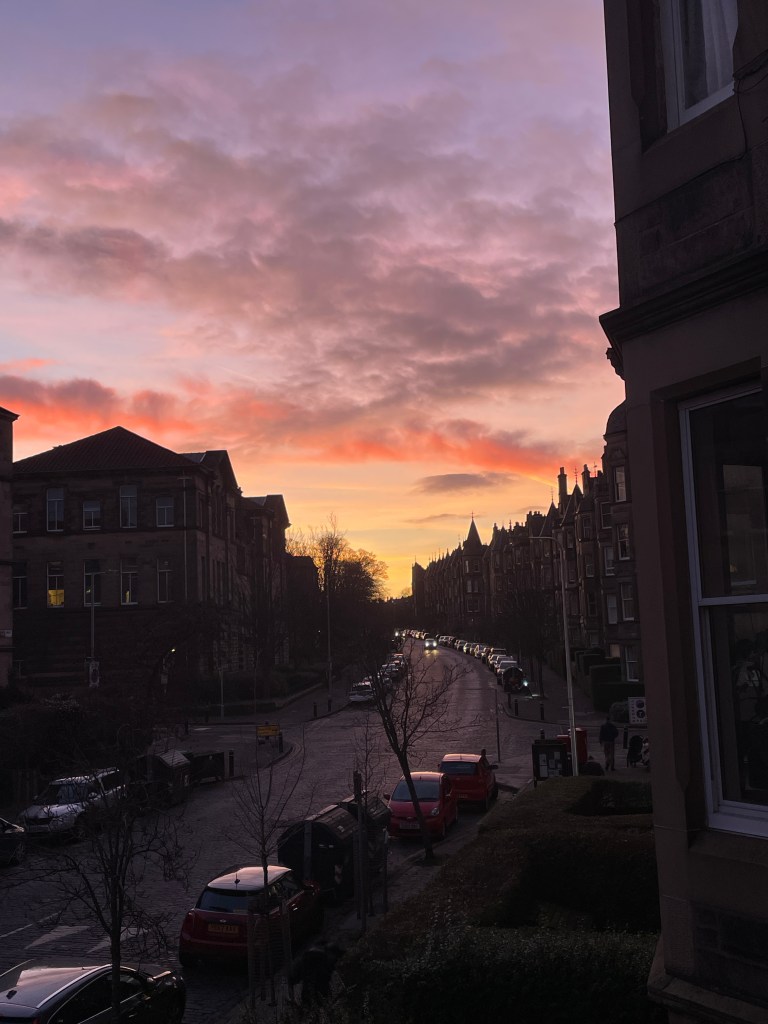
Dimly narrow passages lead to cobbled yards; large green squares encased by great glass restaurant frontages; quaint shops adjoined by speciality coffee shops bustling with students and beachgoers watching swimsuit-clad individuals run into the freezing North Sea, make Edinburgh what it is.

A city. 

But is it really? 

In the few years I’ve been here the same phrase keeps popping up: Edinburgh isn’t a city, it’s a collection of towns. This collection of towns is separated by building types (old to new) or train tracks that crisscross their way out of the city past the greenery of Princes Street Gardens and the scaffold-draped columns of the National Gallery.

From the New Town to the Old Town, from Marchmont to Stockbridge and beyond into the outer regions and the famous Pentland Hills, Edinburgh truly has everything, even if it is a mix and match of different bits. 

I think that’s why I never seem to get bored of being here. Yes, it’s overpriced, as any city is these days, and there’s an unusually yeasty smell that comes with living in the vicinity of a large brewery and oatcake factory which contrastingly just smells like sugary golden syrup. However, it’s the variety of things in this city that brings such charm. There’s an element of every character imaginable. If you fancy old buildings, cobbled streets and the long history of a famous castle there’s plenty. If you prefer quiet walks, beachfront ice cream and quaint shops full of unusually shaped earrings it has that too. If you prefer hills and slopes there’s an entire ski slope to the west. Or even if there’s nothing you enjoy, I’m sure this city could cough something up that you least expect.

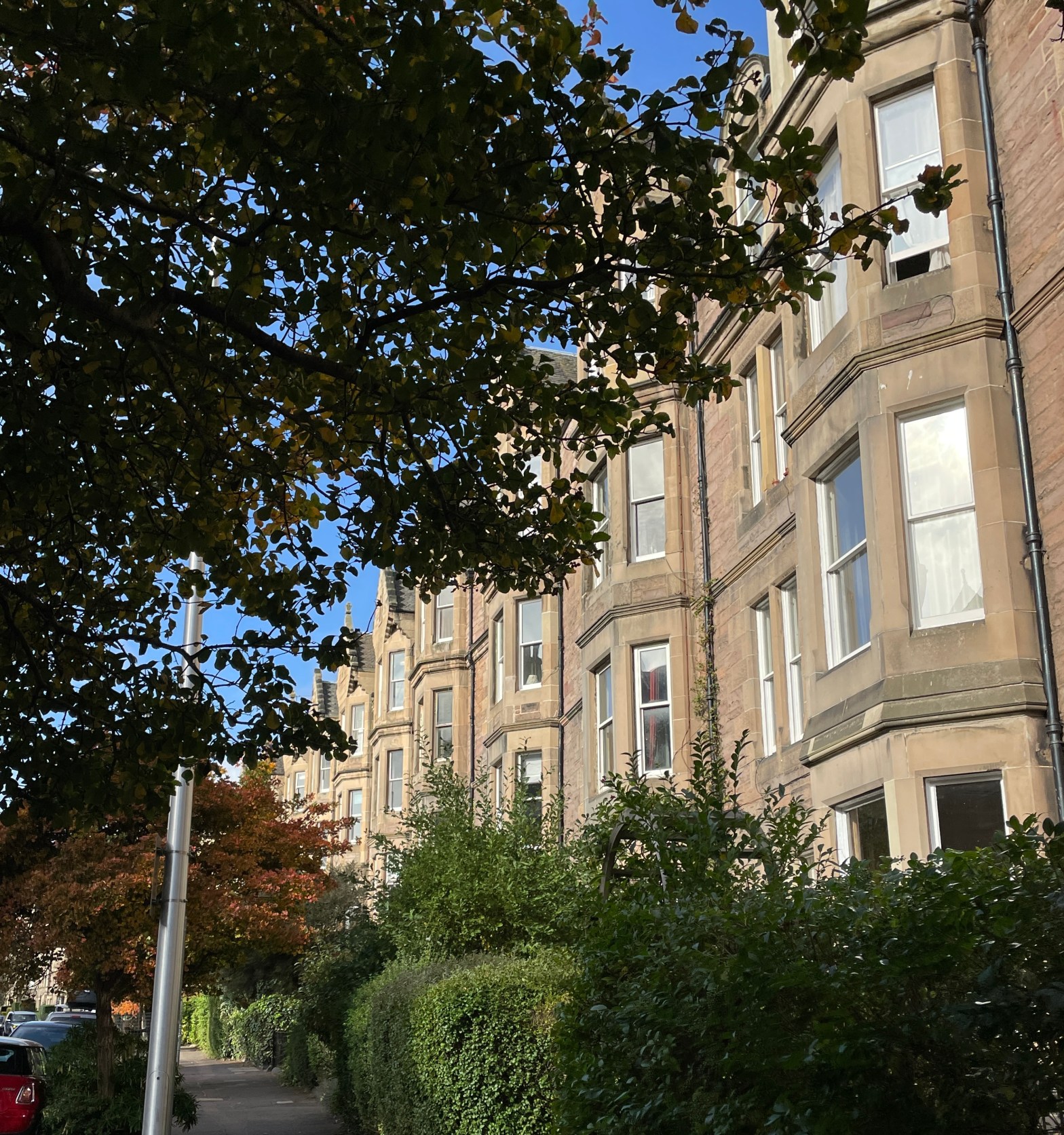
As for the people. I say this about most places I’ve visited but they are the best part. There is a saying that if you are standing at a bus stop with a person from Glasgow, by the time the bus arrives you will have learned their entire life story. If it were someone from Edinburgh you’d be met with stony silence. I honestly can’t attest to this being true as some of the kindest people are those I have encountered from Edinburgh. The city of coffee shops certainly offers some of the friendliest baristas I have ever met and thus some of the best cakes on earth. But mostly I would say the happiness of people in this city can be attributed to the culture of walking here. Everyone walks here and it’s a beautiful thing because the bus system is not to be frowned upon. People seem to just prefer to walk everywhere because there’s just so much beauty to walk past. Take Marchmont as an area for example. The four-storied blocks of flats that stretch on for three or more streets offer wonderful views into the lives of those within, through enormous bay windows dating back to the 19th century. From ceiling-high jungles of plants to impressive desks or cat beds situated at windows, this area feels lived in and gives any newcomer a sizeable but subtle peak into the lives of those who dwell and walk here.

The Old Town is filled with much older buildings that feature smaller windows but instead impressive cathedrals, whiskey distilleries and winding roads like the famous Victoria Street that is said to have provided inspiration for Diagon Alley. Antique-style frontages display the small shops within from Harris Tweed sellers and candle makers to bustling charity shops, where hidden gems are very likely to be found. 

To the north-east lies Portobello and the wide sandy beaches of the same name. The town centre itself (because it really is a collection of towns) is unique with a few bakeries and plant shops as well as a noticeable town clocktower that sits roughly two streets back from the expansive sandy beach. This wonderfully long stretch of coastline is home to older arcades with original painted frontages, window-service pizza places and a beautiful promenade that any runner would enjoy. The best part though, and I may be a little biased, is the lack of rocks and therefore an excellent surface on which to run and jump into the icy waves. The magic of Portobello is that no matter the time of year or the time of day you will see groups of people go for swims into the ocean. If this is where I lose you that’s okay, wild swimming isn’t for everyone. However, if you are ever in the vicinity around the beginning of March, the International Women’s Day sunrise swim attracts hundreds of people to run into the water together in aid of women’s charities in Edinburgh. I have experienced this day twice now and can attest to the energy being the best thing ever. So much positivity, warmth and confidence in one place. 

Now, to narrow Edinburgh down to just a few places would be an injustice as there are so many more areas of the city that are both beautiful and present an interesting history. Also to tell you about places before I have even been to them yet would be untruthful so instead I’ll tell you about my favourite. 

Stockbridge. 

After crossing over the river past The Pantry (definitely a top 5 brunch restaurant) and the I. J. Mellis Deli, you emerge onto a semi-busy street bordered by florists, uniquely named pubs and a Boulangerie. Passing the Rare Bird bookshop dedicated to women’s literature and a few charity shops, you can spot a few small sandwich places and another window selling twisted candle sticks and mugs in all colours. Finally, at the end of the terraced shops you come to a larger building lying further back from the street, that hosts other businesses each with glass covering every inch of the front. From there you can either go buy a plant from the garden centre at the end or shop for bespoke wooden furniture, or as I like to call it, ‘browsing a shop in which I can’t afford anything, but it’s still nice to look at’. 

There are so many elements to this city of towns that make it an incredible place to live. Of course, since it is January, the east wind is no joke. However, in the summer, the masses descend on The Meadows for barbecues, ball games and sunbathing, while others salsa dance or compete fiercely in workout drills. Either way, you’ll likely be greeted by a friendly dog trying to eat your lunch but it won’t matter because it’s sunny and there are no problems when it’s sunny.

No matter the season, there are reasons to love this place. As a student it is possibly one of the best places to live because of the community and the sense of community can be found everywhere. In the groups of dog walkers that congregate in the park for coffee. In the swim groups that run shrieking into cold water every week no matter rain, shine or snow. In the running groups that do laps around the blocks of Scots baronial-style flats in Marchmont. In a book club, I walk past those who sit in a circle of deck chairs in the park to compare their favourite pages this week. In the every day of existing in the beautiful city.

A Short Interlude (that wasn’t very short)

“I visited many places, 
Some of them quite 
Exotic and far away, 
But I always returned to myself.”

― Dejan Stojanovic

Hello again.

I understand it has been just a little over 2 1/2 years since I last wrote anything on this blog which isn’t necessarily something I planned but more or less just happened. No real reason for it. Just life. Life gets in the way a lot these days, or at least I’ve thought so, since we emerged blearily into the daylight after the pandemic. Life seemed to hit the fast forward button and things went into overdrive and it seems all the ideas of slowing down our lives went out the window. So I would say it is fair to assume that we’ve all been coping with that for a while now. At least I certainly have.

There are also many reasons I was grateful for taking time away from writing as for most of my life I’ve felt this urgent need to write everything down before it is forgotten. Before it disappears into the ether. Also the fact that I wanted to write semi-autobiographically about my life but in truth I haven’t lived much of it yet. I recently turned 22 and as lots of people like to remind me, that is still young. Young in the eyes of society but nonetheless young in the scope of life experience. I have lived an interesting life so far but it still hasn’t been a very long one so I decided that some thorough living of said life was needed. So that’s what I’ve been doing. Living life in the present and trying not to look to the past or future too much.
It’s been good. A nice change from the stress of believing that everything needs writing down when in actuality a lot of it just needs to be lived. It also why I’m endeavouring to take less pictures and simply live in the moment. Because I’m much more likely to remember it as a memory that way compared to taking a picture of it which removes the need for my brain to store it. Then I end up scrolling my phone for a glimpse of a scene that could have been memorised instead. Of course, there are limits to the mental capacity of the brain and not every sunset can be mentally immortalised. So, some snaps are necessary. Its learning the balance that I’m still working on.

Recently, since the new year started I feel as though I’ve become a different person. Or maybe I’m finally feeling the effects of a few years long process. Not only did I manage to travel to a new continent last year but I’ve become more secure in my belief in myself and my capacity to achieve my goals. To travel, to see things from different perspectives, to live a life I love and not one where I am simply surviving. Because surviving is exhausting. Living is exhilarating and makes you want to get out of bed in the morning even after knowing that there have been so many times when you didn’t. It’s doing it in spite of how you felt in the past but still acknowledging that you felt that way and that you have now changed. I think that’s called growth.

Whichever way you see it, the main thing I’ve learned from leaving writing behind for a few years, at least on this blog, is that I don’t need to hurry towards my goals so much so that I start to hate the journey and resent these goals I set for myself. I want to enjoy getting to where I’m going. Enjoy watching going on walks with friends, eating good food with less guilt and swimming outdoors to feel alive. These are some that I justify as being ways I enjoy life but there are so many varied ways for others. It could be working that brings you joy or sitting watching a film with the one you love most or it could even be building a complex lego set. Whichever one it turns out to be there are so many ways to feel joy in the world that we sometimes forget to remember which ones suit us; not ones that strangers on the internet tell us to do. We do know ourselves if we give ourselves enough time to do so. Maybe not completely but certainly a little.

Every night I’ve decided to read 10 pages of a book. Even if I hate the contents of the book I read because I know that focussing on one thing for more than 5 minutes can be difficult these days. I relish the challenge of reading now to stave off the small dopamine rush 3 second videos give instead. The interest in a good book can last much longer, and yes can take longer to kick in but just 10 pages and then I can put it down. Then if after 10 pages I’m still interested I keep going until I want to stop. Its small victories like that that I will continue to strive for as we enter 2024.

There are of course other resolutions I’ve given myself. Some specific and some vague enough to warrant trying to accomplish them at a later date but nonetheless something I want to achieve. This list of resolutions of course has become somewhat of a bucket list which I do strive to do each year because I feel like a year is enough of a time frame to achieve something, even if its small. So now I have a bucket list titled ’23 things to do before I’m 23′. Now I won’t be destroyed if I don’t complete this list before my birthday but it’s a good guideline to have things that keep you on track with your long term goals. I have written this list down electronically for the first time since the past 2 years resulted in 2 lost pieces of paper contained meticulously thought out bucket lists. So this time I’m not losing the goals I want to achieve. This year I will try truly living rather than simply surviving.

I have no doubt that there will be good days and days when I don’t want to get out of bed but I know that I’ve grown more to appreciate the former and not dwell on the latter. Because without hope for the future and achieving little victories along the way, what point is there in moving the duvet aside and throwing open the curtains?

So.

I am back to writing this year and thus there are many journeys I have yet to catch you up on. Salsa dancing under disco lights, running into warm and freezing cold oceans, finding new fears and new loves and adding more memories to my brain under the umbrella of ‘best moments of my life so far’.

I hope you’re along for the ride 🙂

Barcelona

Remember, remember,

this is now, and now,

and now.

Live it, feel it, cling to it,

I want to become acutely aware of all I’ve taken for granted.

– Sylvia Plath

There are few times in life where time seems to stop as you enter a place. As you enter this other dimension of living with all its strangers and curling rooftops and sunlit trees and park benches painted white, you think, yes, this is different. This is a different life and it’s beautiful.

My time in Barcelona can only be described as such, since I seemed to forget to care about the rest of the world while I was there. So much of the essence of it all felt as though I was inhaling clear air which left you light headed and forgetting your responsibilities for a while. This was enough to cement this wondrous city into my head and heart for a long time.

The train into the city wasn’t the most comfortable and lacked some clear windows due to the graffiti lavishly decorating the outside. It then went through various backyard areas where only walls could be seen with equal amounts of colourful, sprawling spray paint. However, once arriving into Barcelona-Sants Estácio, I emerged into a clean, white marbled, bustling station filled with the friendly, yet masked, faces of people waiting for trains; destinations from Madrid to Paris. The air conditioning also made for a nice welcome in contrast to the sweltering platforms below.

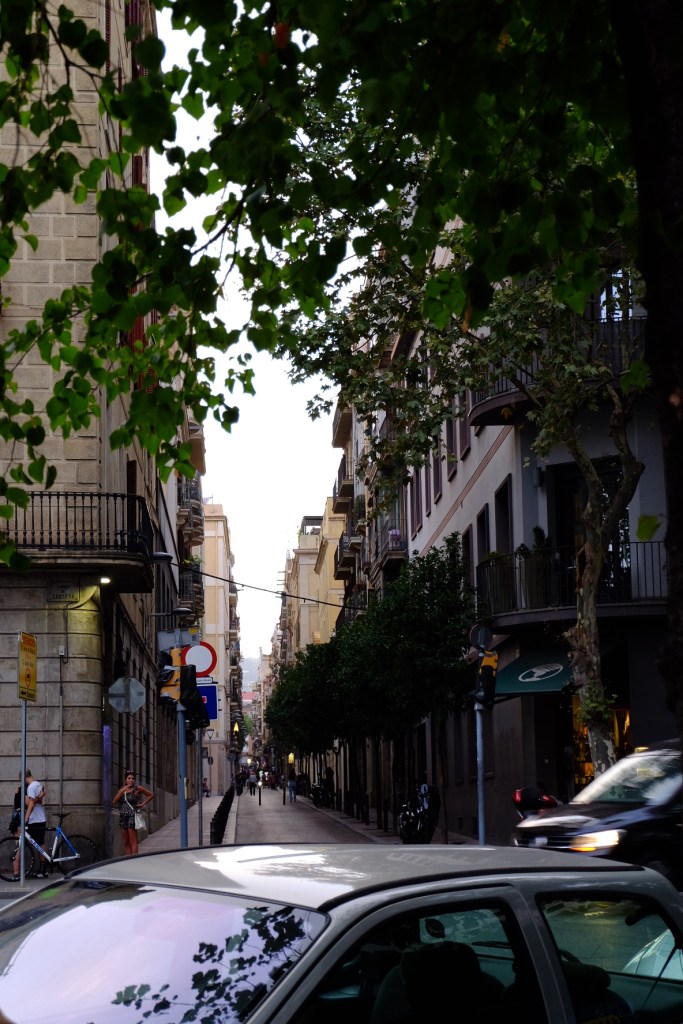
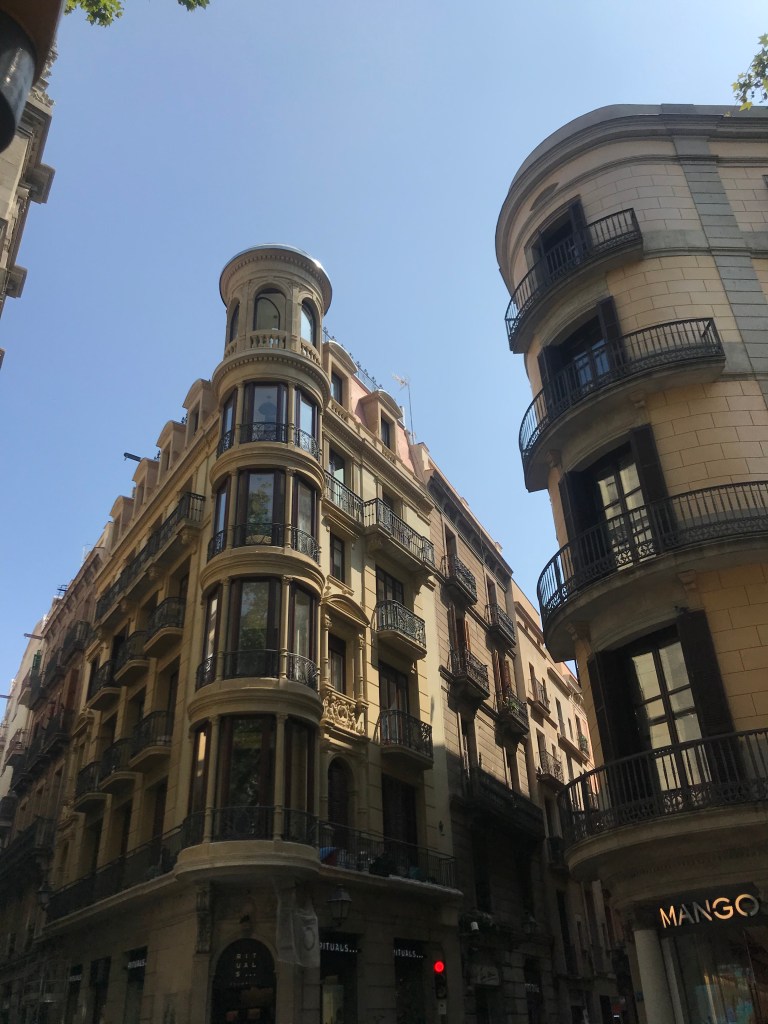
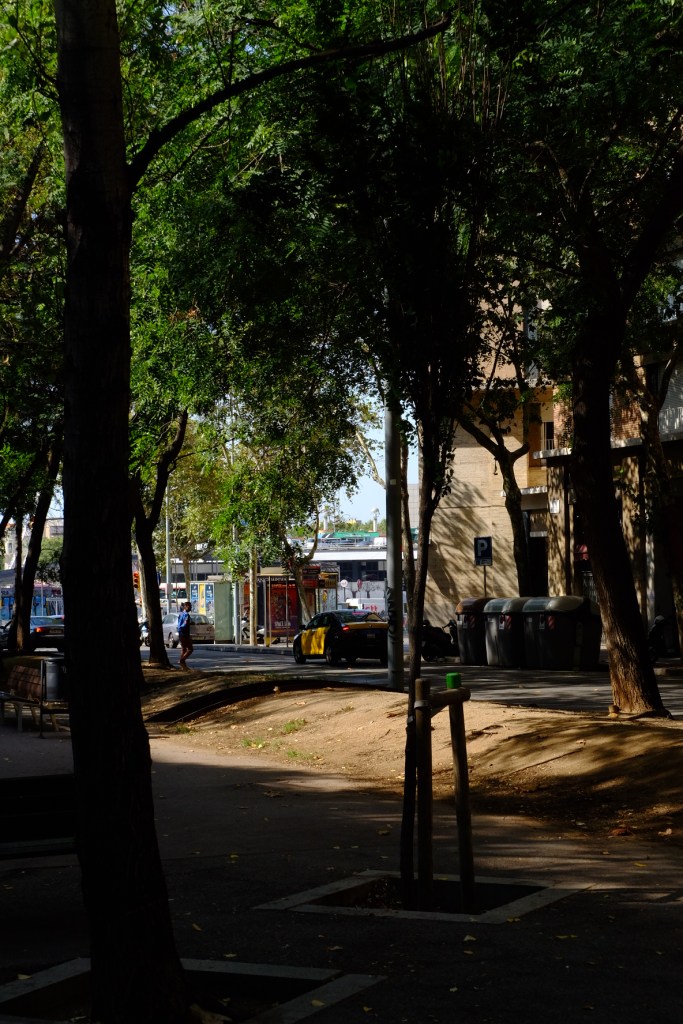
Then, a short trip on metro later, I walked up the stairs of the Vedaguer metro stop onto the most beautiful sun-dappled street, complete with high-storied, renaissance style blocks of flats and wide streets overshadowed by European Nettle and Privet trees. The wide, almost three lane, street gave this atmosphere as I set off walking to the Youth Hostel I’d booked for the night, of peace and beauty all at once. The trees offset the car traffic and the yellowy-green of the buildings gave everything this kind of olive hue in the sunlight that reminded me more of walking into the setting of a romance novel rather than a Spanish coastal city. The six, sometimes seven, storey buildings climbed high above into the blue sky and were accentuated by the beautifully curling and ornate balconies shuttered and draped in house plants and drying clothes.

The whole thing reminded me vaguely of Paris.

Some streets were even cobbled as I walked further towards the La Vila de Gracia District.

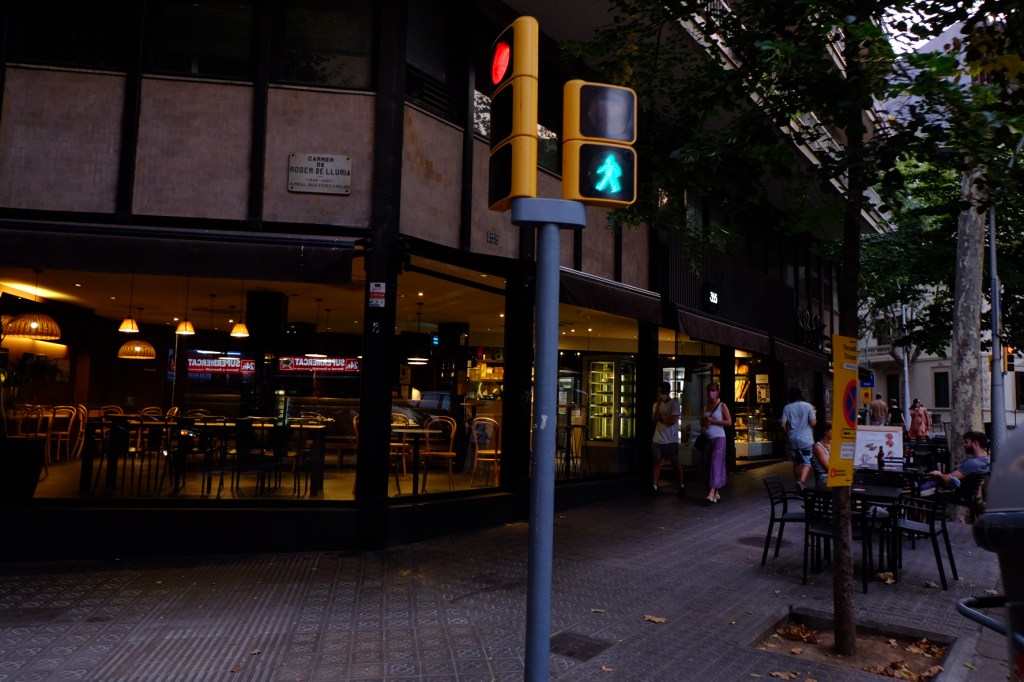
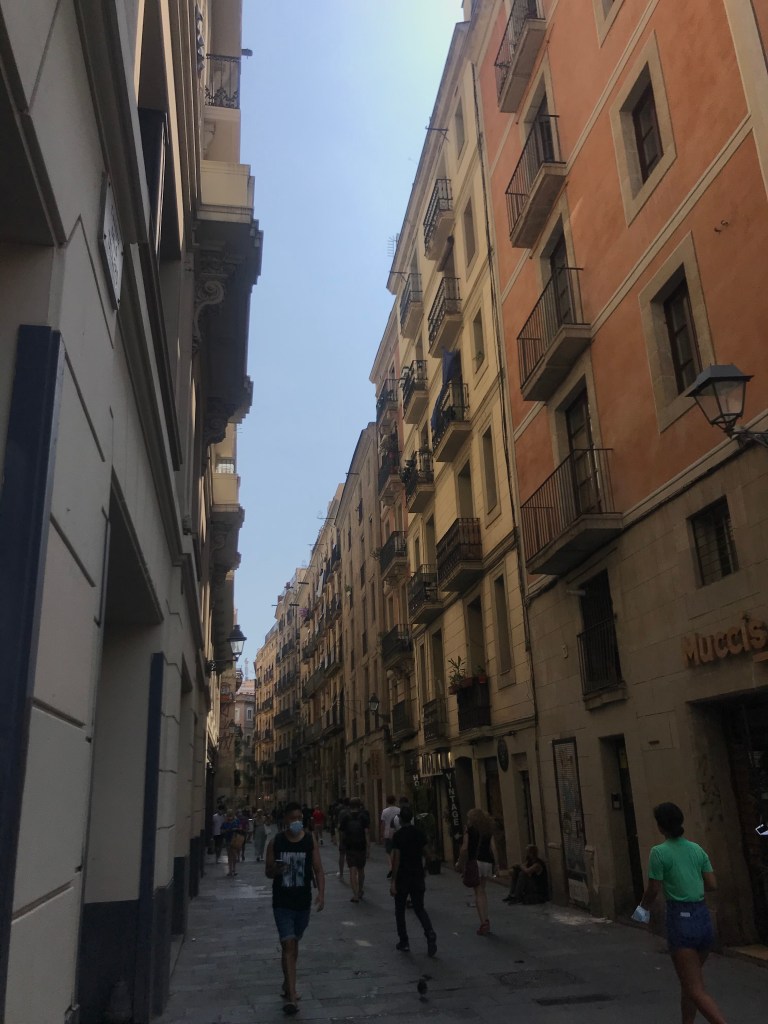
That evening around 8, as that’s when most people have dinner, wandering the streets of the Gracia area was completely enthralling. With it’s miniature streets, overhanging trees that obscure most balconies and metal cafe tables sprawling across squares. The light on an August night means that it’s mostly dark by around 9:30pm so the orange glow of streetlights on the well-dressed groups that traipse from wine bars to fluorescently-lit 24 hr supermercados is fun to observe while music from a lone accordion player drifts into candellit restaurants.

We ate in a older restaurant that more closely resembled a wine cellar, with high ceiling, wooden bar counter and wooden-chaired tables backed by a feature wall of wine barrel lids dating back to the early 20th century. It was beautiful. We ate bravas, honeyed artichokes, calamari and russian salad and finished the evening off with a walk down streets lit by twilight where street lamps had stopped working and people laughed while walking past ice cream parlours open late and electric scooters whizzed away into the night. Past large leafy squares where fountains splashed away and loud groups of laughing people made their way underground again, since the underground runs late into the night, the atmosphere of Barcelona at night in incomperable. It’s all orange light, cheery faces, overhanging greenery and warmth.

It’s one of the few cities I’ve felt safe walking around at night in.

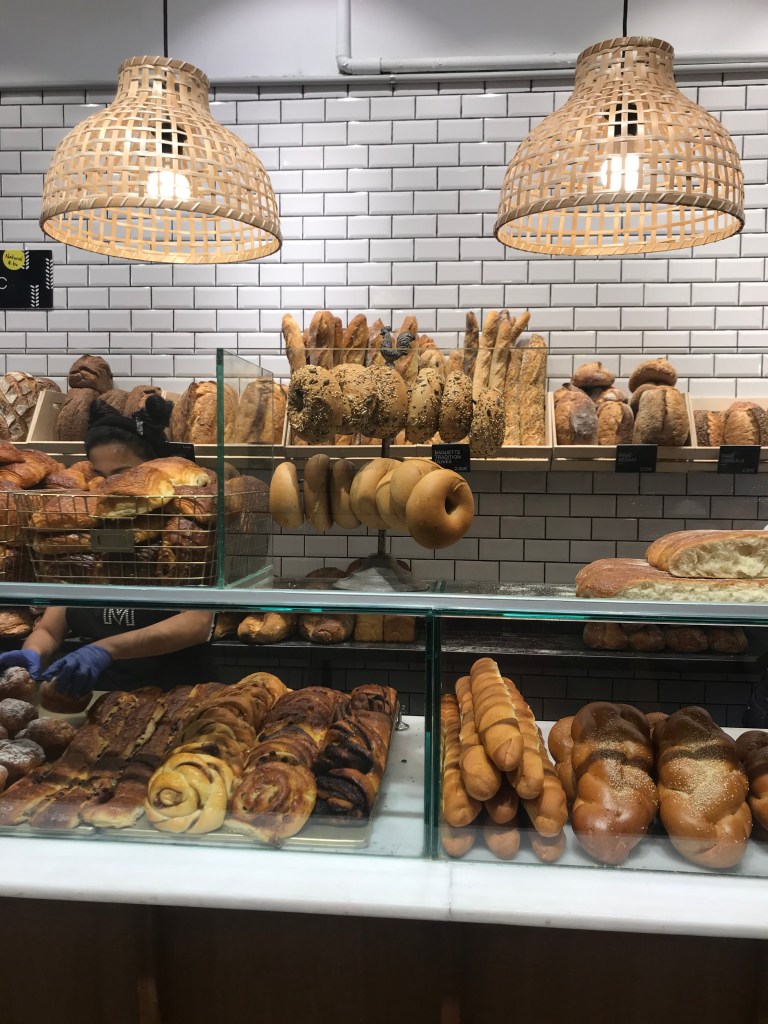
The next morning was spent searching for breakfast in the same, narrow street area before finding a stunning French bakery that served an array of croissants, loaves decorating the back wall, braided challah and an army of Viennoiserie lining the front counter so much so that its almost too much to choose from. But I’d go back any day just for the fresh bread and the smell on walking through the door.

The Mayer Bakery

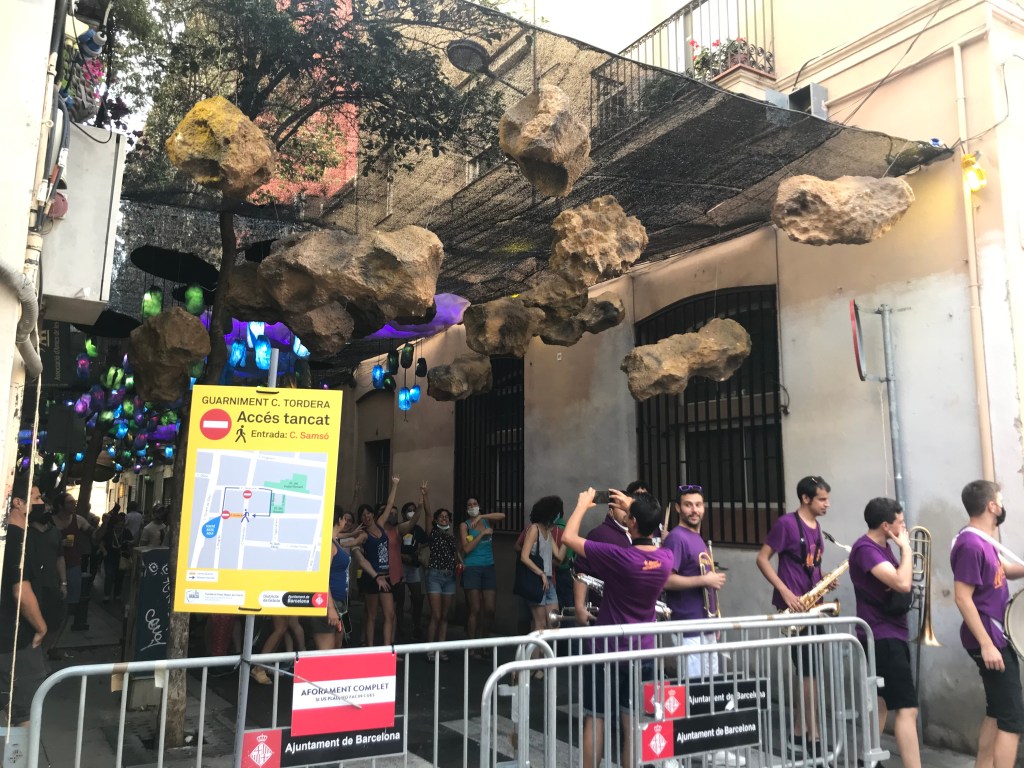
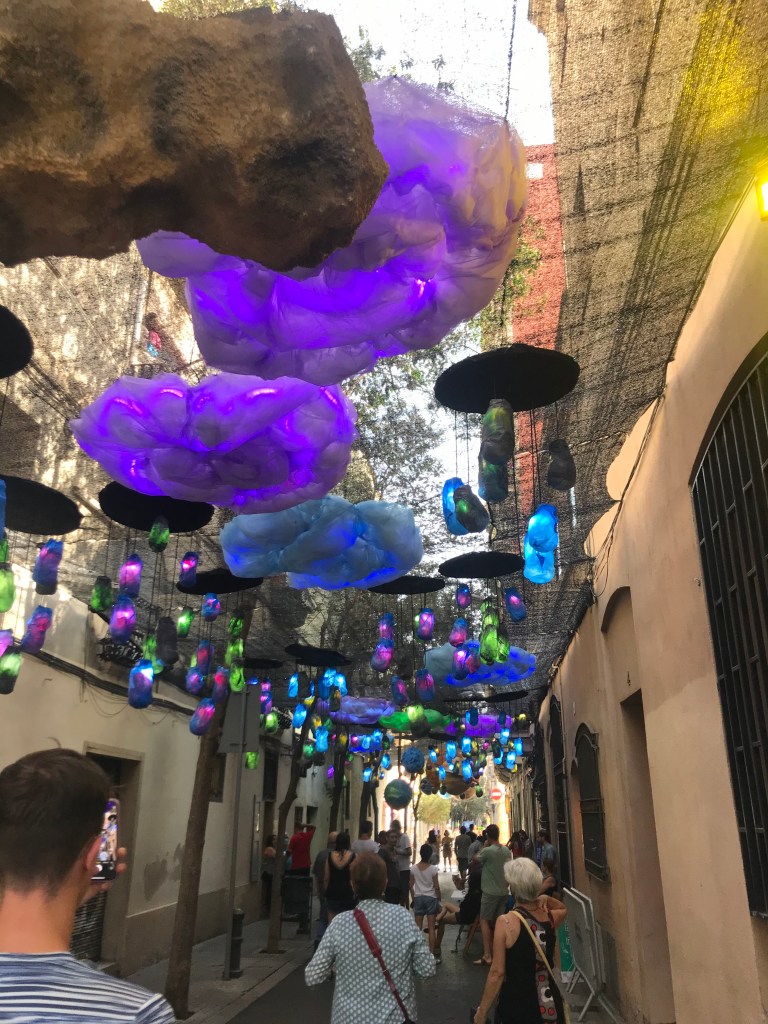
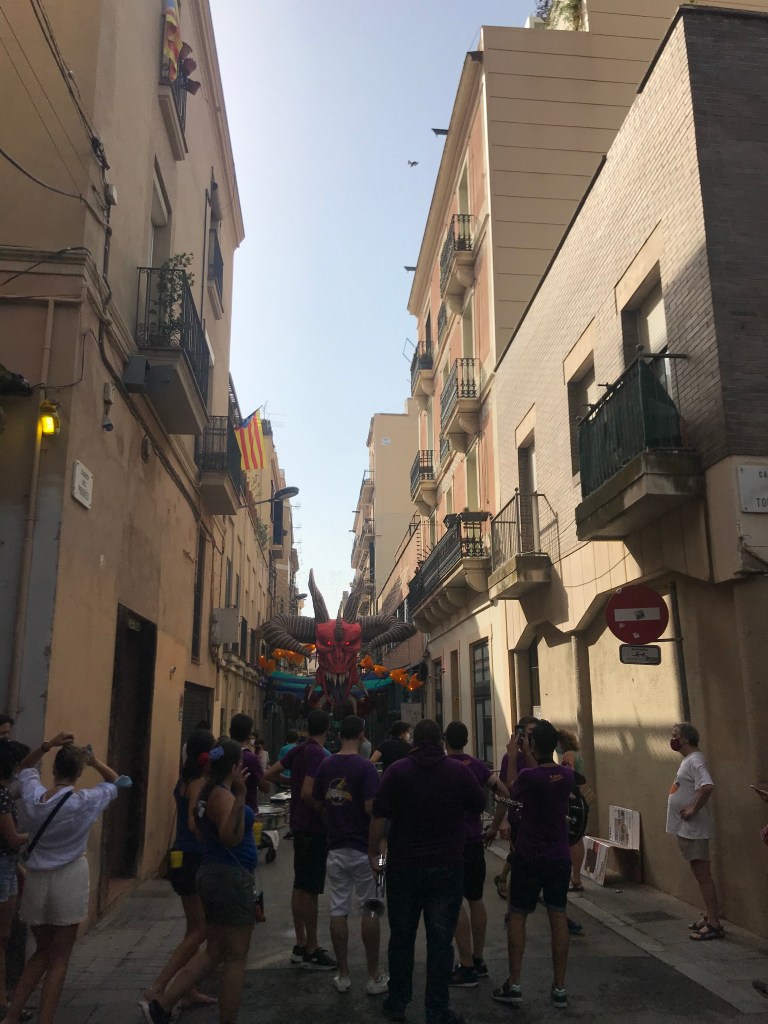
The streets that morning were warm and as sun-dappled as ever with the exception of a quiet that can only be found at this time of year during the Assumption of Mary. This incapacitates the city for a few days and instead paves the way for colourfully decorated avenues, music and street parties from morning to night. It was on this particular religious holiday that I happened to be in Barcelona and I had the privilege of walking through some of the most stunning street artwork I have ever witnessed.

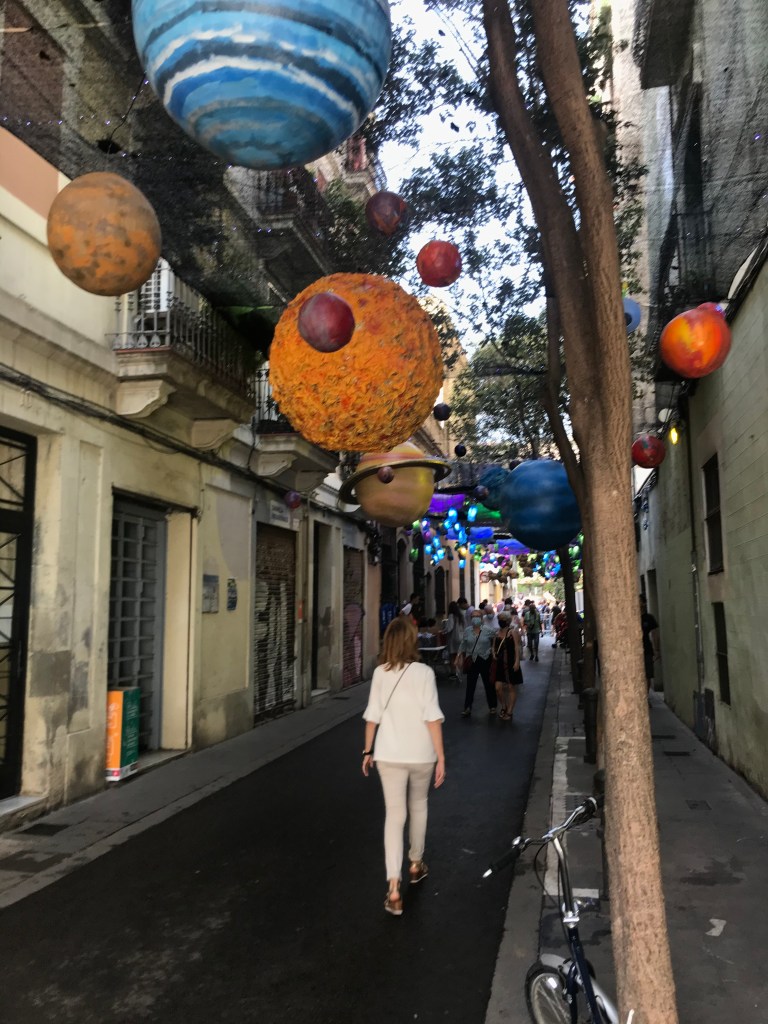
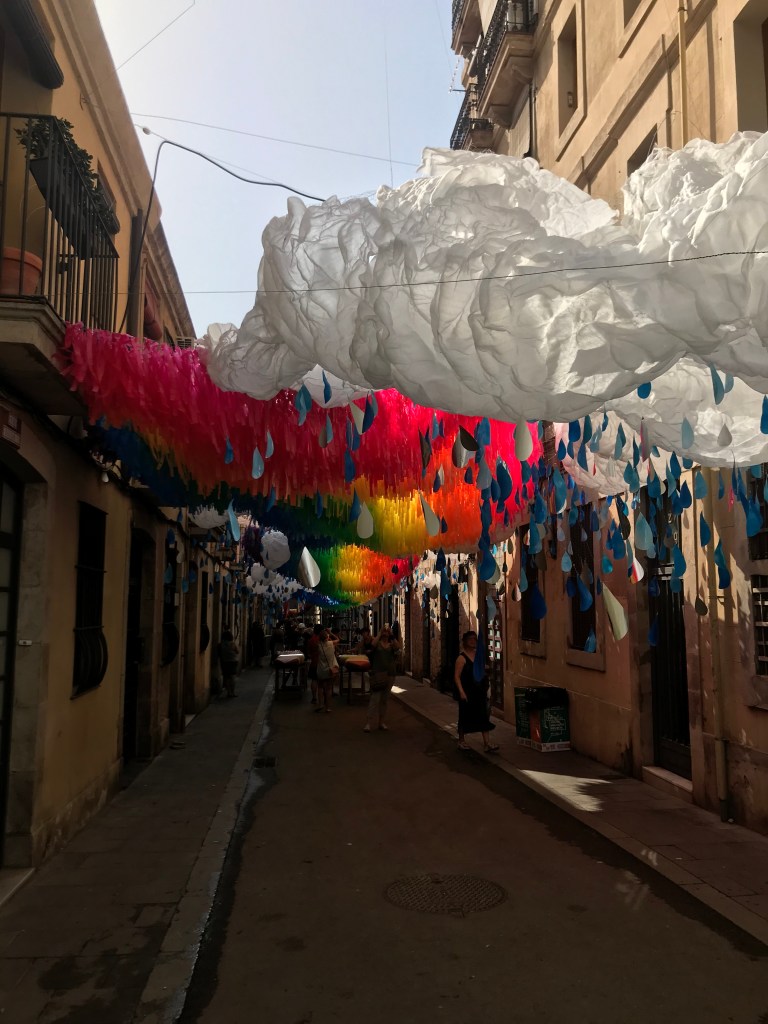
Special themes decorated some of the narrower roads with rainbows, rainclouds, comets, solar systems, stars and devils heads. Loud music from small orchestras was danced to on intersections and people smiled more as we walked through the middle of it all.

The next part of the day though, we spent finding cold water after a morning of exploring in the heat and preparing for the possible highlight of my time in this city so far.

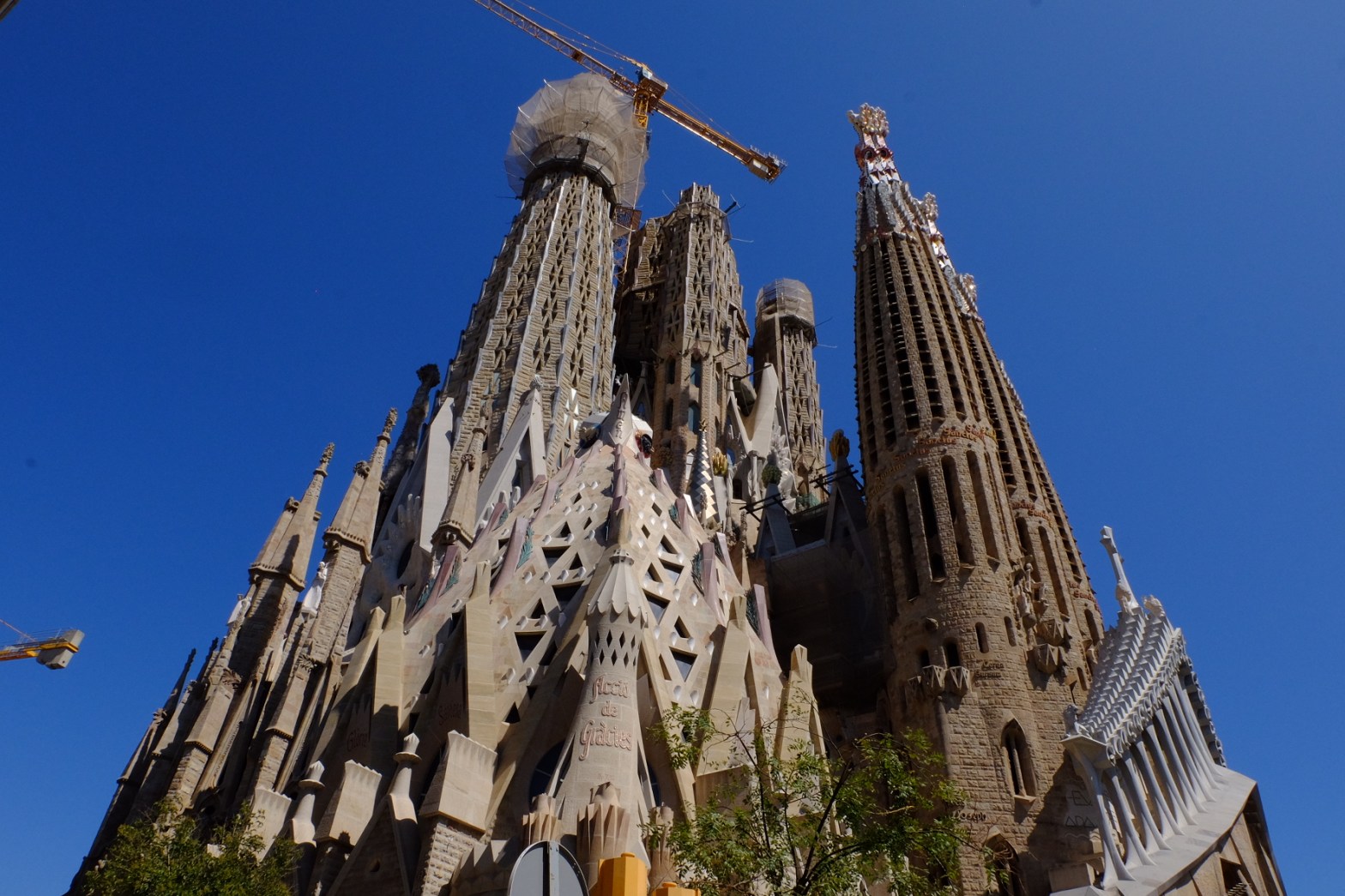
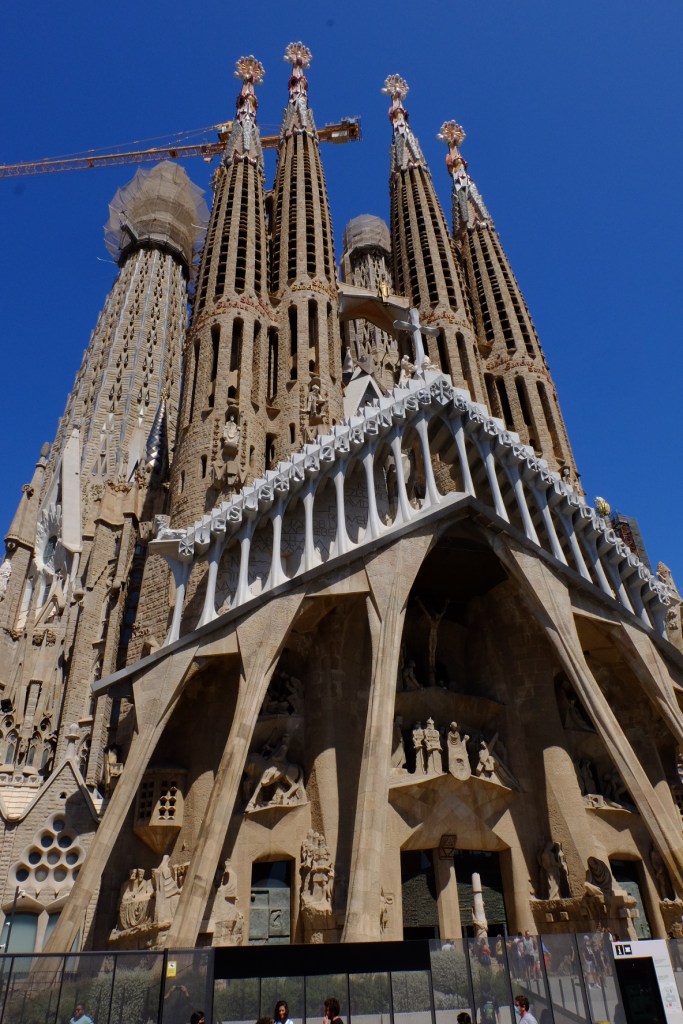
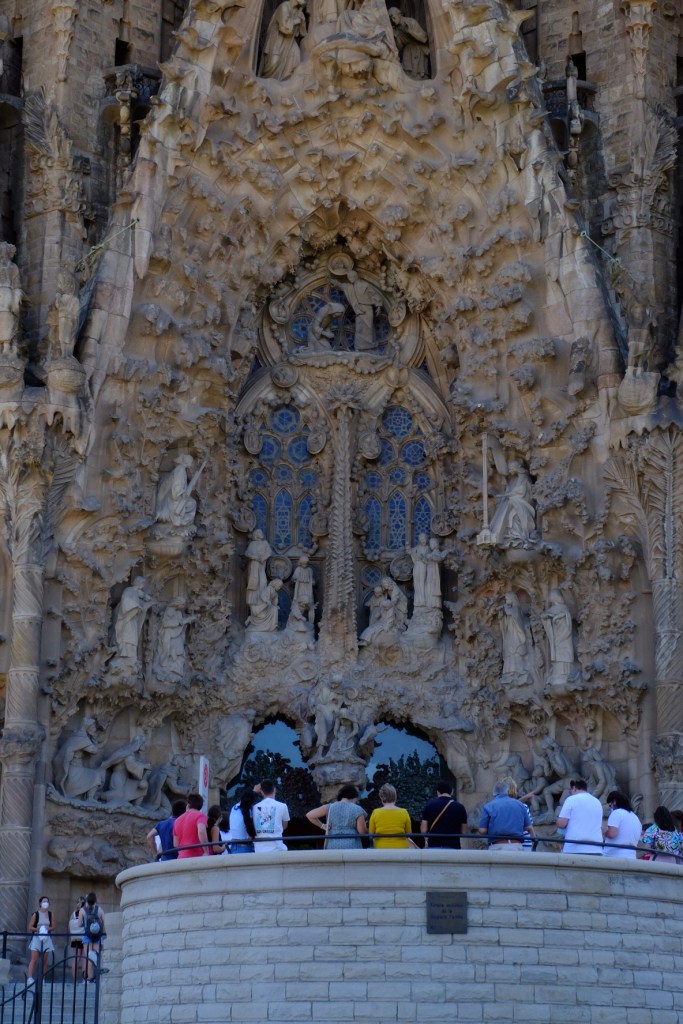
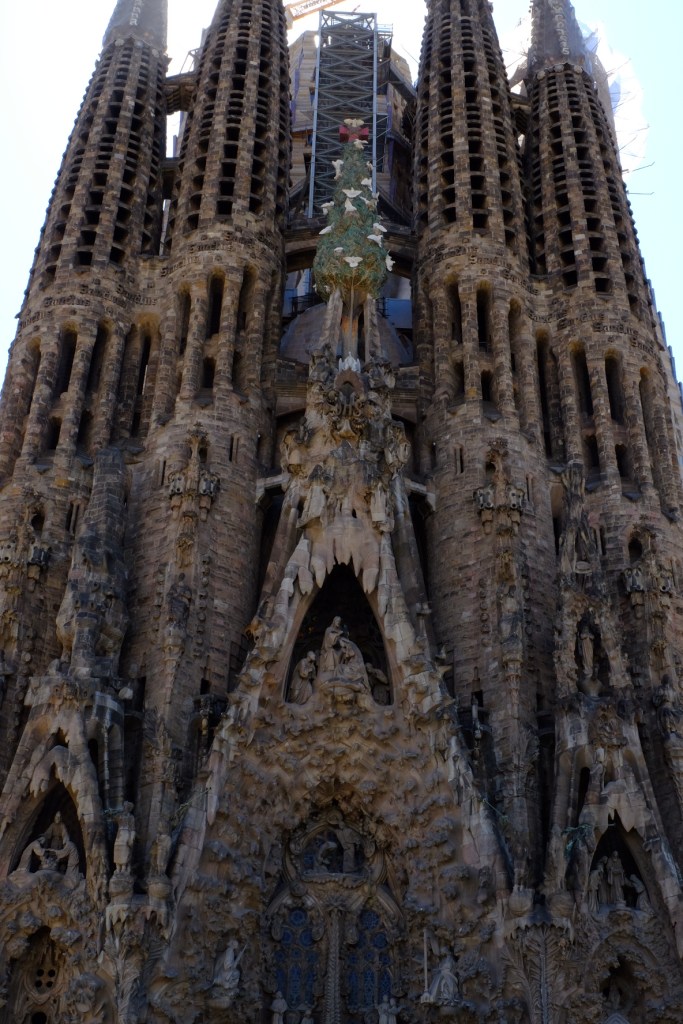
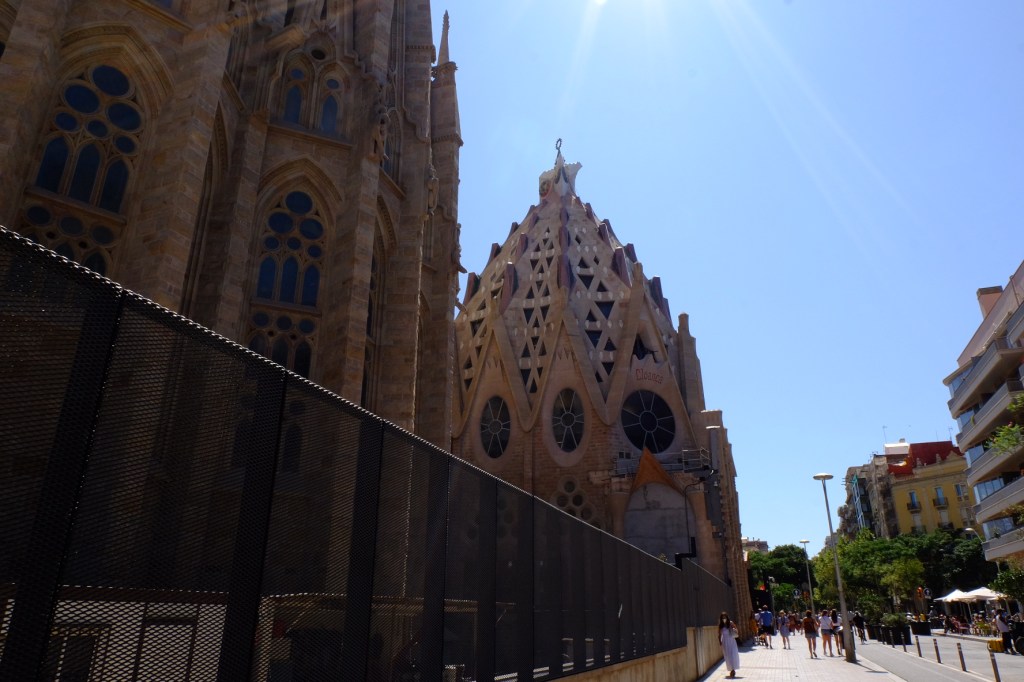
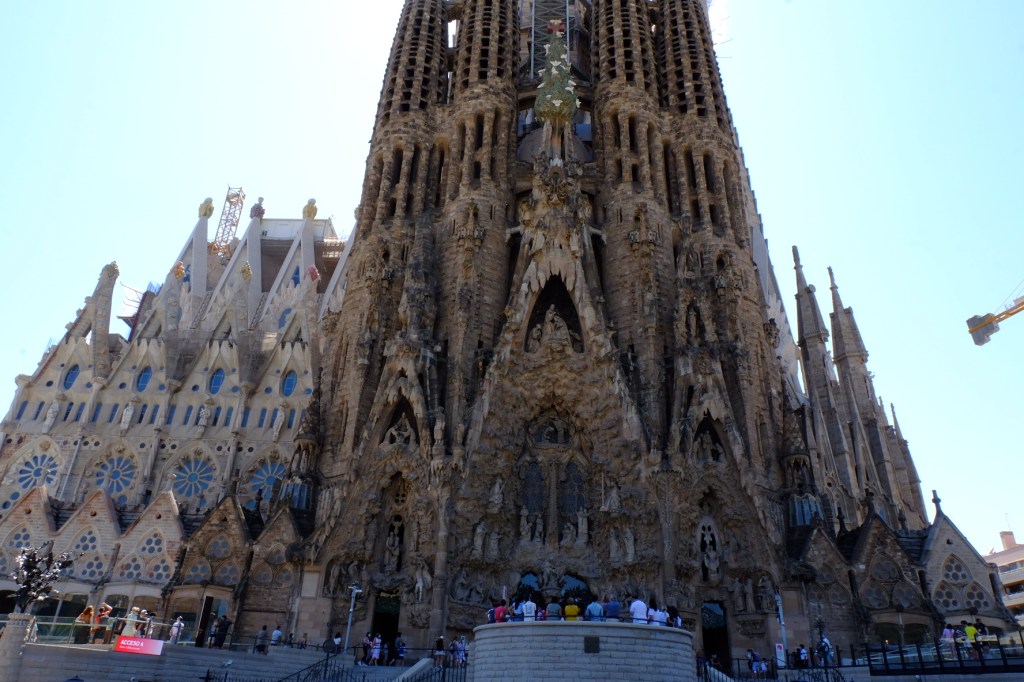
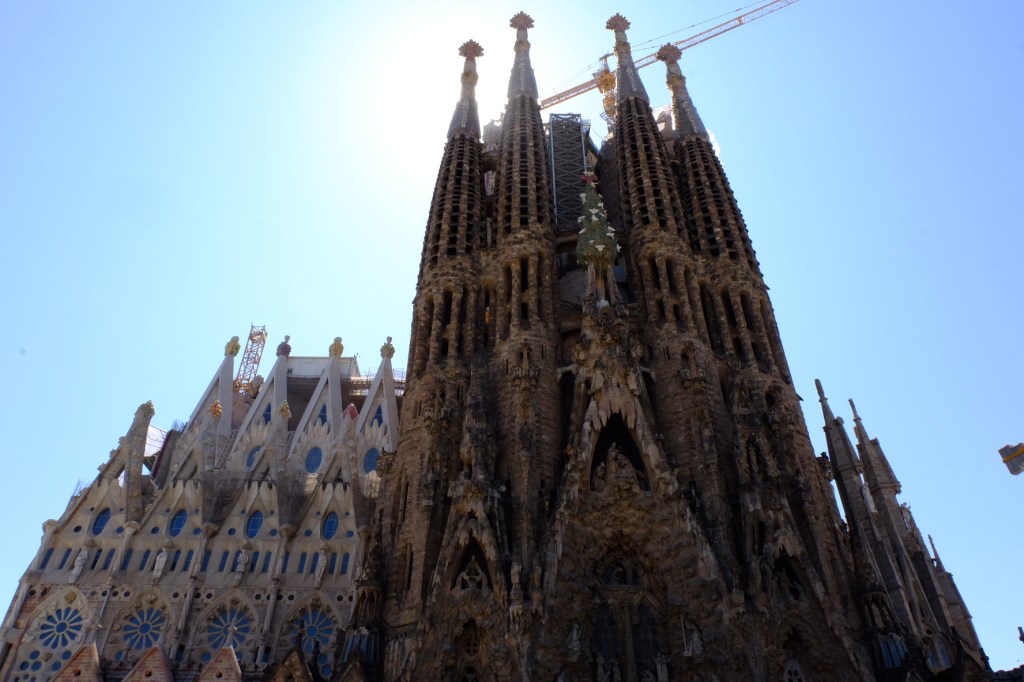
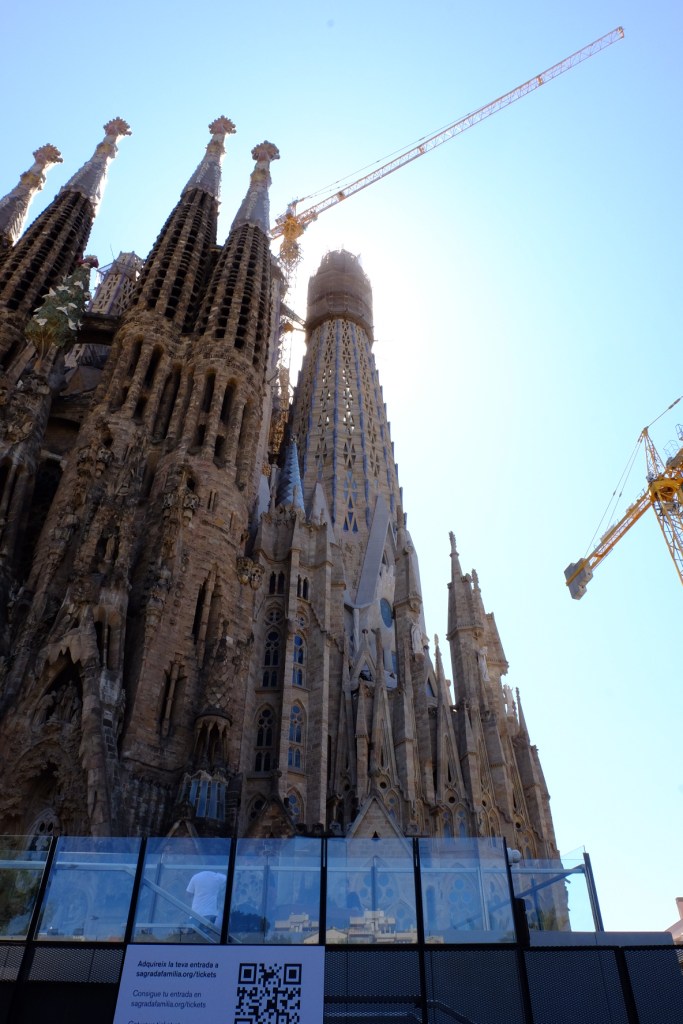
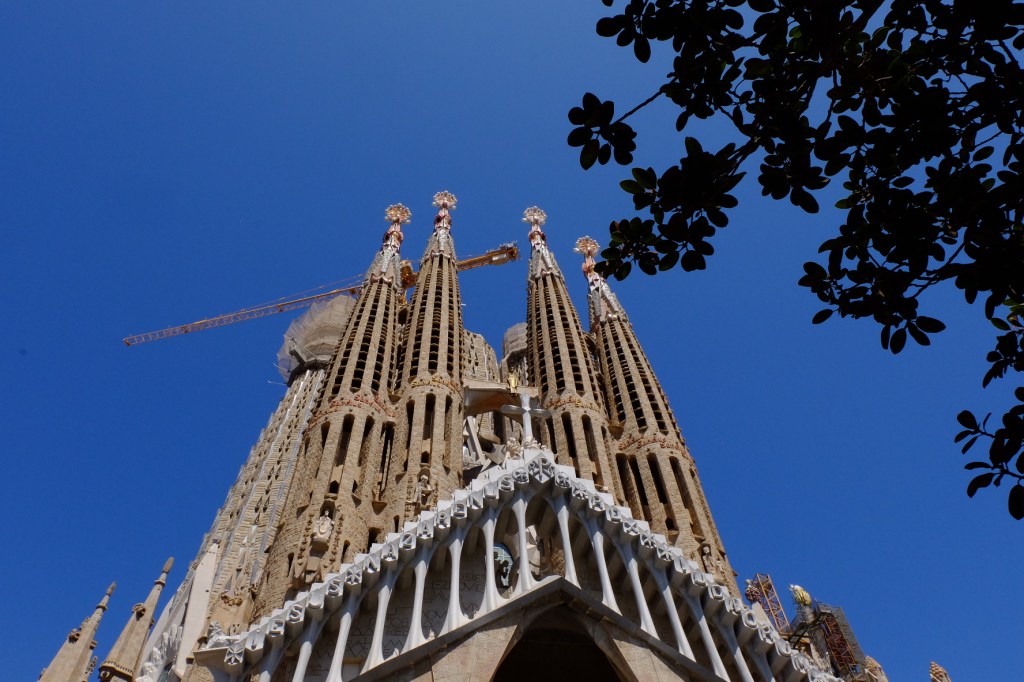
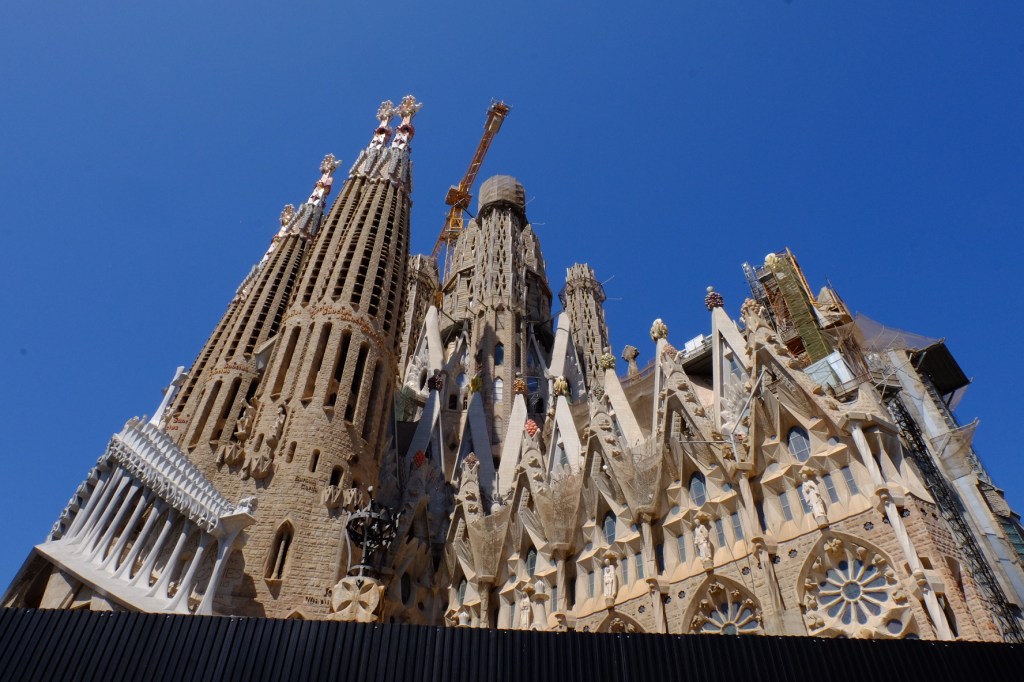
The Basílica de la Sagrada Família. Antoni Gaudí’s most famous project.

On emerging from the metro station of the same name I walked up, turned around and there it was, in all of its tall, colourful glory.

The structure is all the more impressive up close as I wandered to the south-western side and observed the impressive Passion façade with it’s bare, bone-like appearance and the enormous columns that support it with the immense spires towering up into the blue above. They somehow capture both elegance and oddity in their art-nouveau iconic style with bulbous and curved flair. Not a single straight line could be seen. It was all rocky sinews, colourful blue and white bulbous domes and curvascious windows in every wall. The amount of detail was breathtaking and that was even without having seen the Nativity façade yet. This façade, built between 1894 and 1930 at the time that Gaudí was still alive, in perhaps the most impressive as the entire thing is so intricate you can’t possibly believe it’s made out of stone. With statues and figures moulded to life-like perfection and the tendrils of flowers and window frames moulded as though water were flowing from every corner, the entire side of the Basílica is stunning and serves as the entrance to this breathtaking work of historical art.

There is truly nothing on earth like the Sagrada Família and I finally had the privilege of visiting it’s incredible exterior on a sunny August day with it’s architecture still in tact even after nearly 140 years of construction. I can only hope that I’m alive to see it’s completion.

The rest of the day was spent at the beach on Barcelona’s stunning Passeig Marítim de la Barceloneta which acts as a lengthy promenade linking a white sandy beach front to the Olympic Park area of the city. It sports wide avenues and huge buildings with stunning artworks of architecture texturing the beachfront if you look back.

And in 32 degree heat, being at the beach isn’t so bad.

Barcelona, as a place, is unlike any other city. Despite it’s similarities in architecture to Paris and Italy with it’s renaissance curling balconies and baroque-style blocks of flats to the extensive european metro system and french boulangeries. It’s narrow, leafy streets filled with vintage re-sellers, local artist craft shops, tattoo nooks and late-night gelato joints, make it unique.

The people are also a huge selling-point as I don’t think I ever saw one unhappy face the whole time I was there. The friendly and welcoming, “bon dia!” and “moltes gràcies” on entering anywhere is unmissable and there is no shame to those who cannot speak Catalan or Spanish because everyone tries to help in one way or another. Although, it’s not too hard to pick up either and gives you a sense of pride when you can finally understand a little more than ‘thank you’ and ‘good day’.

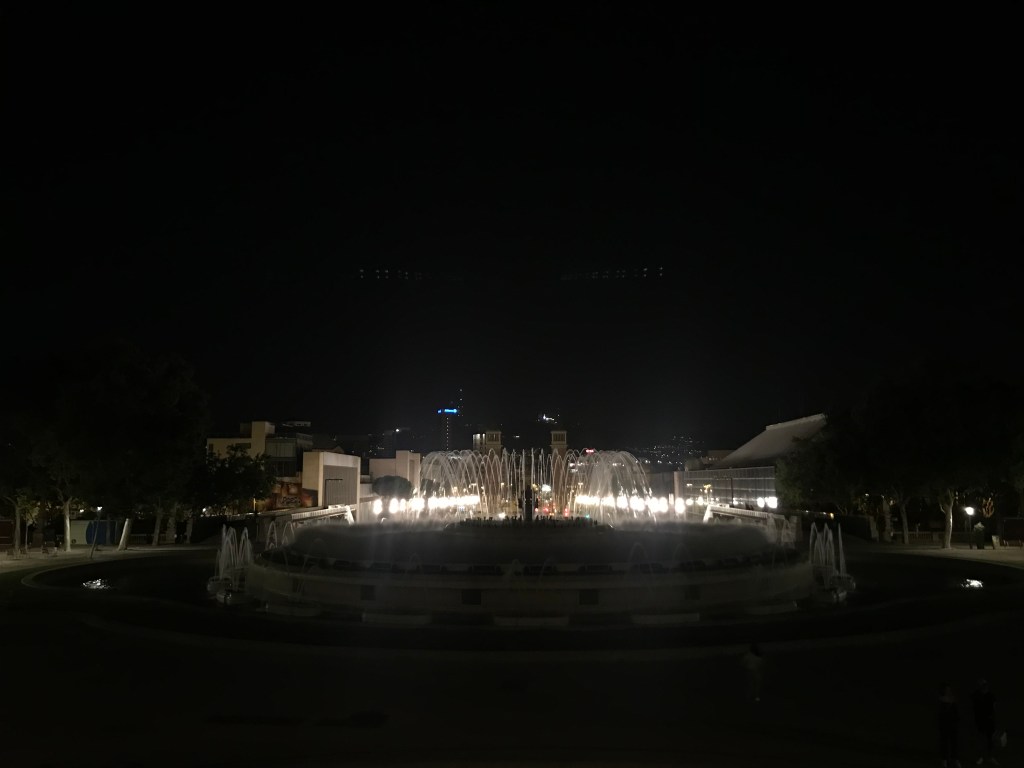
Another must-see, if you can spare the time, is the Magic Fountain of Montjuïc which sits at the foot of the stunning National Museum of Art. With outside escalators that take you up the multiple levels to the top where the museum stands as tall as any royal palace, it’s well worth the trip at night, past all the cascading waterfall fountains on the way up to the most incredible view of the whole city. At night, it’s truly the best city view in the world. To the right sits the Sagrada Família all lit up as a break in the skyline and to the left, the mountains rise up in glorious waves away to the west.

Never again will I forget my time in Barcelona, not only because of the stunning architecture or the people or the food, but simply because once they all combine you could honestly forget about life all together and live forever in this dream-state of a city without a care.

Maybe it’s staring out into the trees from your own romantic balcony contemplating whether to go swimming in the ocean. Or buy bread and walk the streets until you find another one of Gaudí’s masterpieces on a random street corner.

Just like that.

Agra

“Certain things catch your eye, but pursue only those that capture the heart.”

– Ancient Indian proverb

There are few Indian cities that boast the delights that Agra seems to have been bestowed with over the centuries. With its forts, endlessly interesting ancient ruins and one of the seven great wonders of the world, within the centre, it’s not only a place full of once-in-a-lifetime sights but also a city that doesn’t feel closed in or too overcrowded in comparison to the other great cities of Rajasthan. 

So it’s only natural to feel incredibly excited when going.

Among the death-defying motorcycles and lumbering cows that sit on the sides of the highway on entry to Agra, the next best thing is the ancient city of Fatehpur Sikri; a World Heritage Site of epic proportions. 

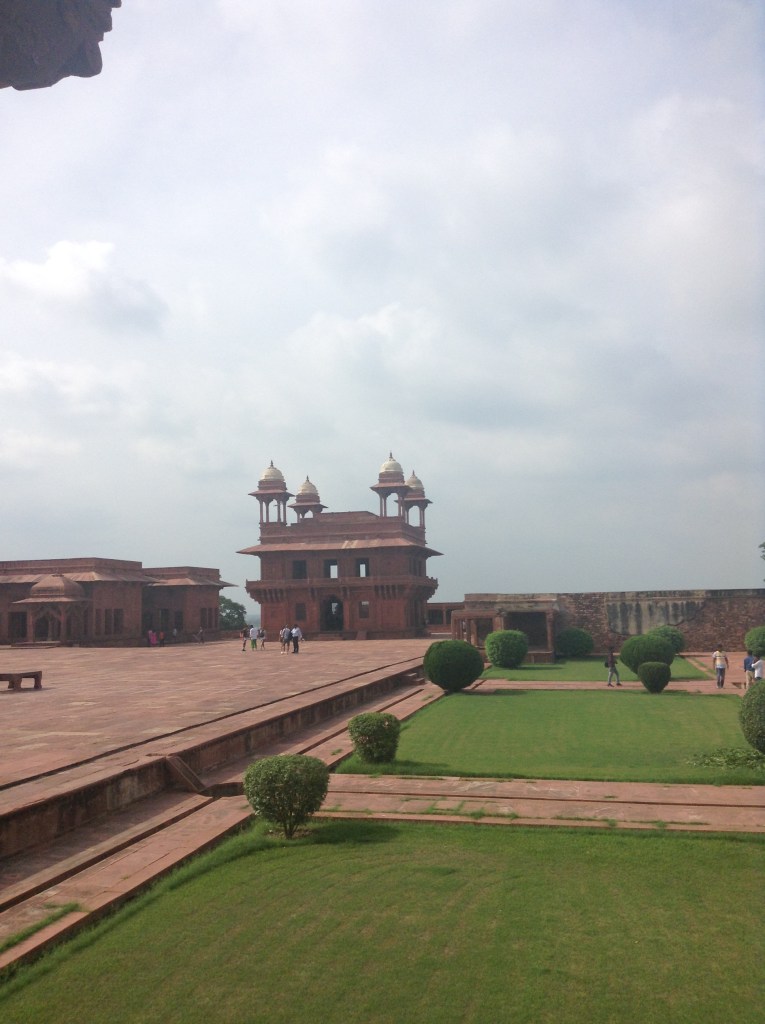
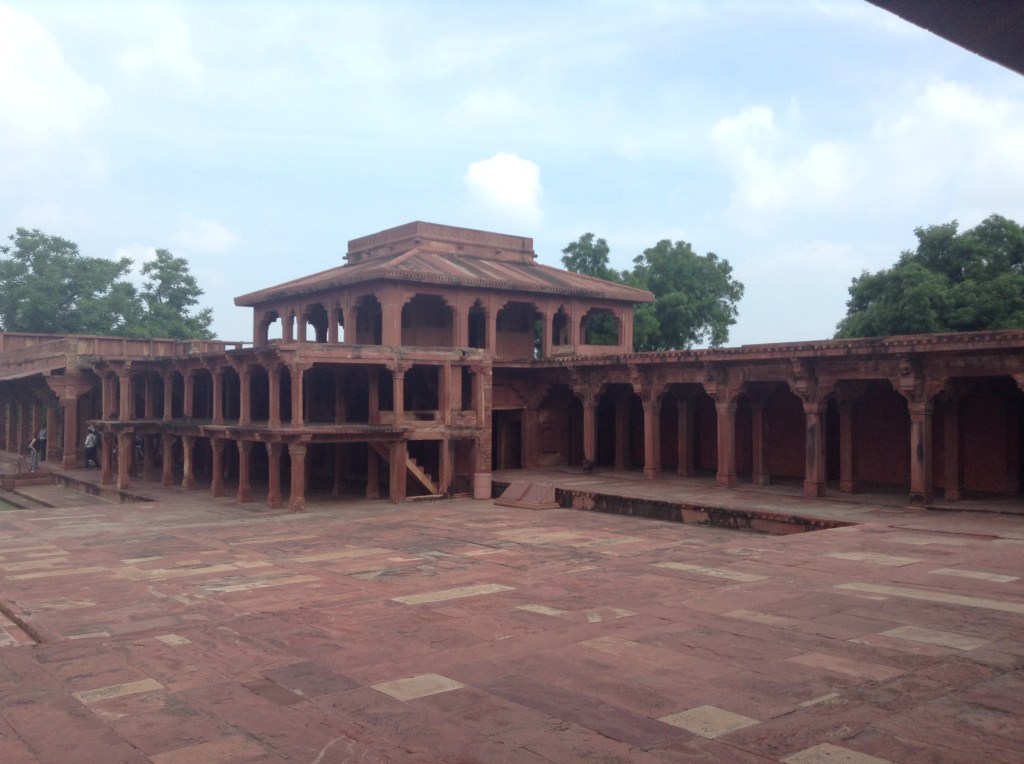
It sits a half an hour drive from the main city but is no less incredible a location to visit, with its red sandstone walls and endless procession of temples and palaces that catered to, not only the Muhgal Emporer at the time, but also his three wives. Each of which were of different religions so as to encourage inclusivity and diversity hundreds of years ago, among the people. 

On walking around, despite the stifling August sun, the city was incredible to witness in person. Clever architectural design allowed for wind flow through the buildings so it stayed cool in the hot summer but still insulated in the colder winters and towers meant that it stayed well-fortified but stylish, with intricate gargoyles and flourished stone edges. 

Despite this incredible sight, though, it’s unreal to discover that this ancient city was abandoned hundreds of years ago due to a water supply shortage and left to ruin at the mercy of graffiti over the years, up until it was recently granted World Heritage status. 


So, on leaving the high, red, stony walls and wide palace gardens for the lighter city walls of Agra itself, we entered into the chaotic, yet colourful streets of the outer regions until suddenly, upon entering the inner city, the traffic and noise and bustle of cows and verspas carrying four people, disappeared. It was replaced by calm, clean streets lined with simple streetlights and flanked by beautiful hotels and artistic entryways, as if lining a strong central promenade.

The only downside to this lack of cars and emergence into the world or rickshaws and bicycles, was that we had to carry our larger bags a few hundred metres along the large paved road to our hotel which stood, surprisingly close to the outer walls of the Taj Mahal.

Yes. One of the seven wonders of the world was high on the list of things I wanted to visit before I die, so it was assured that we were going, the second we entered Agra.

After the long, hot walk to the hotel we spent an hour or so wandering the markets that lined the clean cobbled road. From silk scarves to small marble elephants, there was a plethora of things to buy and with the right amount of haggling, could be bought for the right price. Colourful patterend trousers hung from every hook, people bustled around glass cabinets filled with jewellery and t-shirts with ‘I heart Agra’ billowed in the evening breeze.

The quiet of the area is attributed to the fact that no polluting vehicles are allowed near the Taj Mahal due to past pollution affecting the structure through acid rain or air pollution that led to a need to restore the white colour of the Taj. This made, then, for an incredibly peaceful atmosphere walking the streets as the sun set to an orange sky and monkeys lumbered their way across the cobbles.

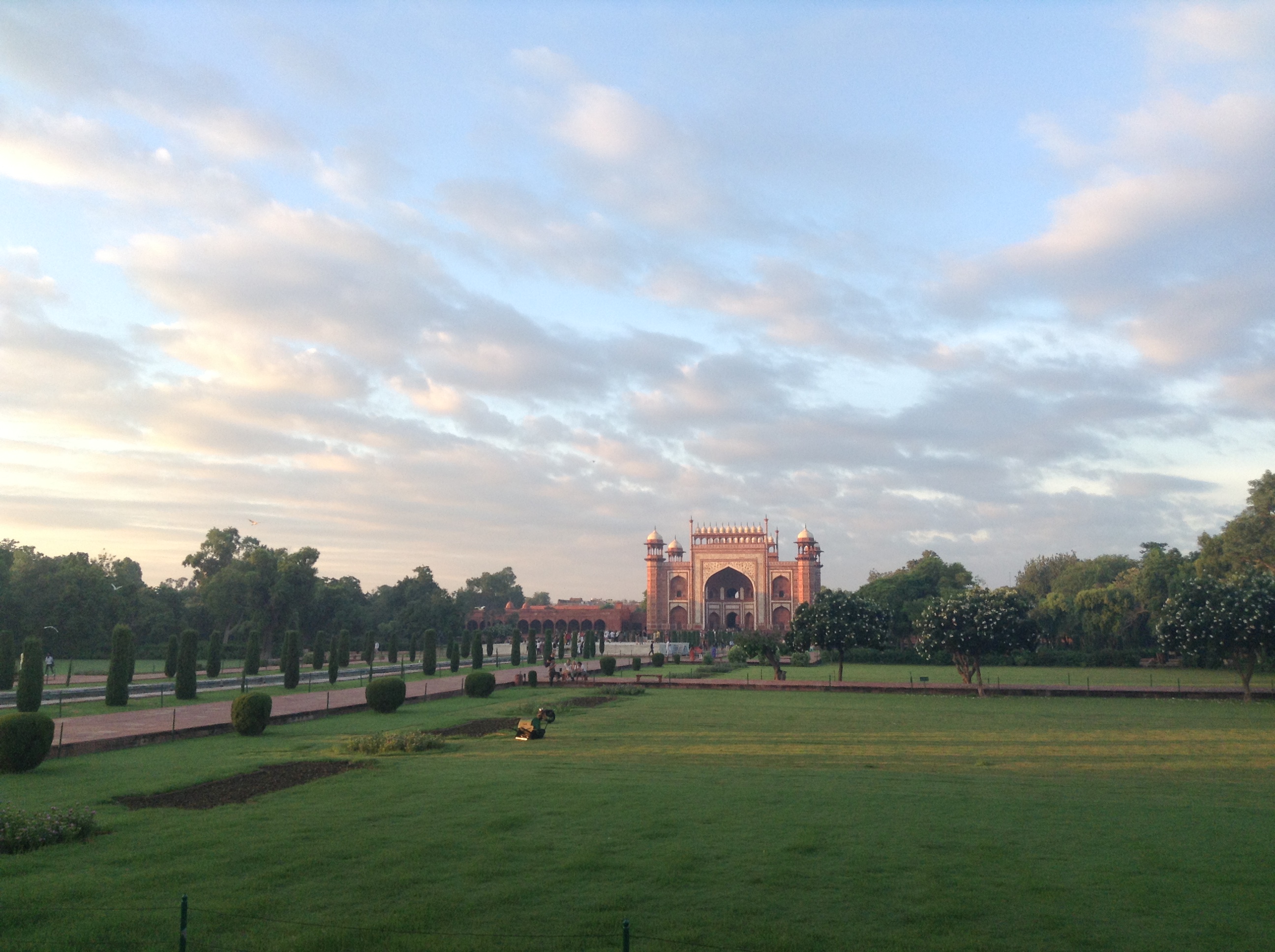
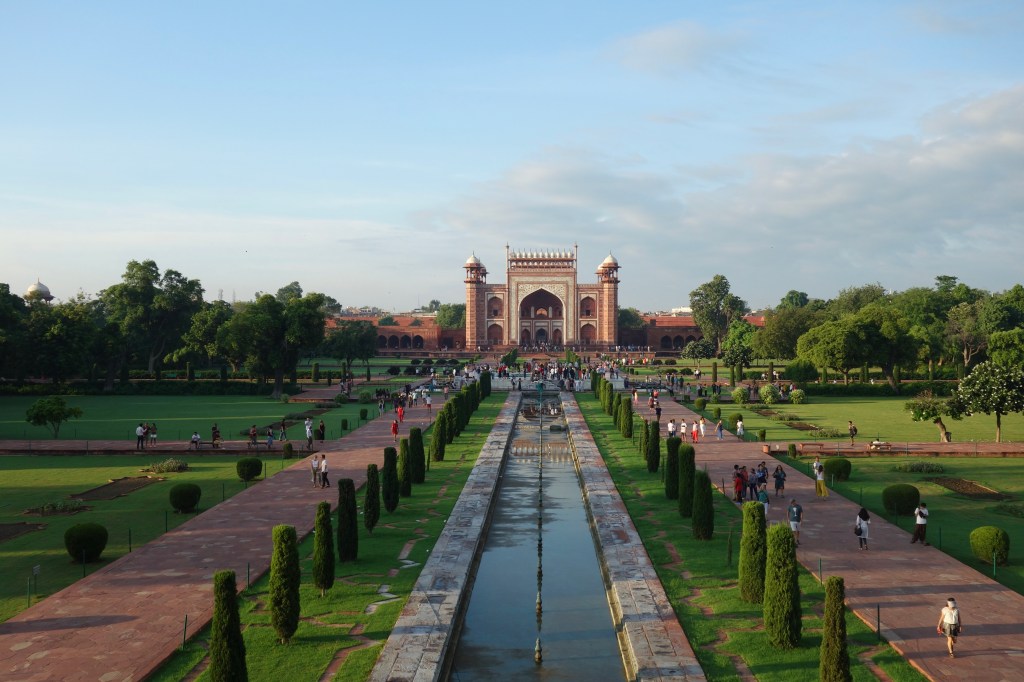
The next morning was an early, but necessary, wake up to stand in line outside the entrance to one of the seven wonders of the world. And several security protocols later, I was walking through the outer gardens towards the Darwaza (main gateway).

It was funny really how, after walking through a doorway barely big enough for two people, you emerge, to one of the most incredible sights you’ll ever see.

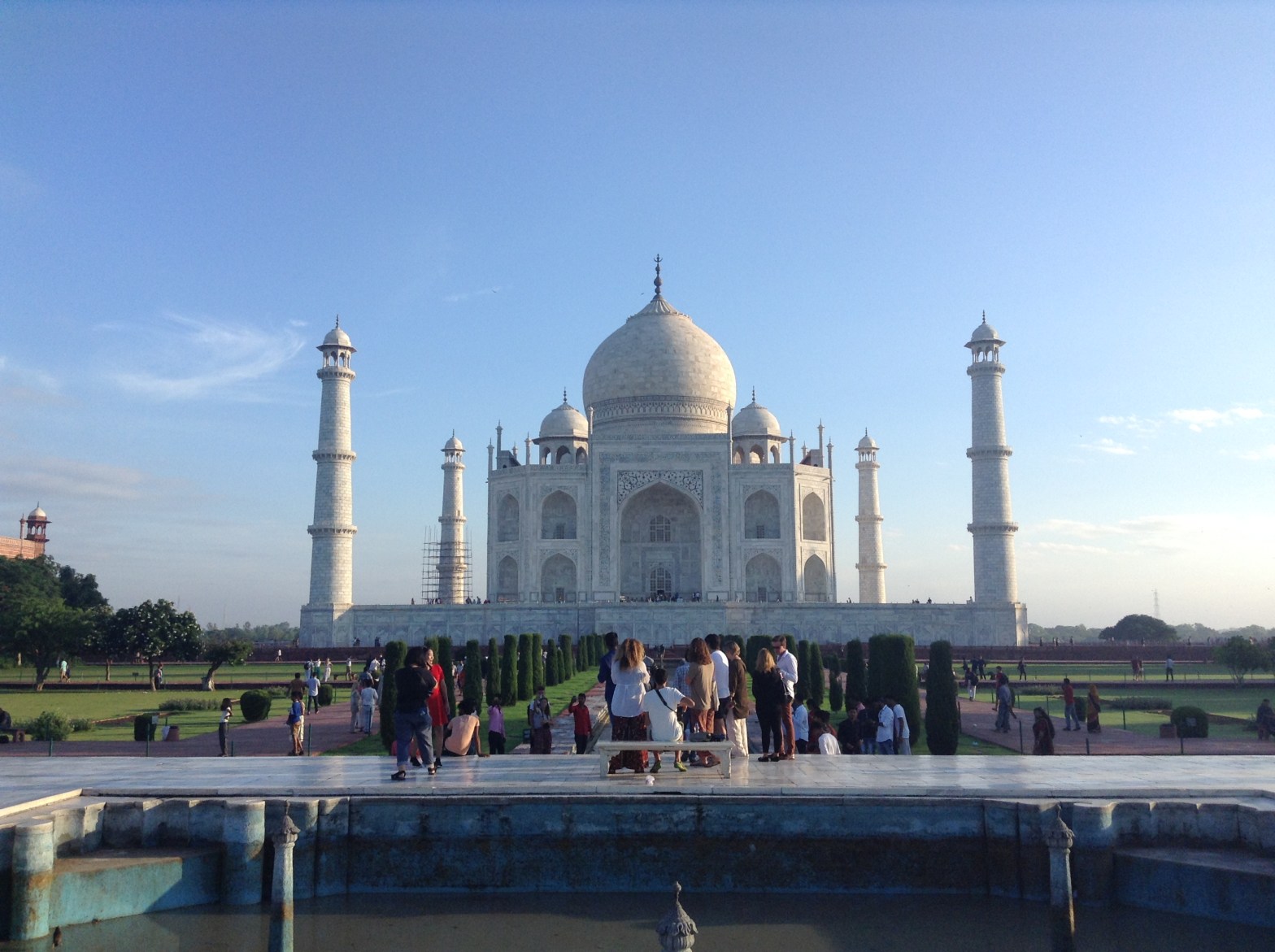
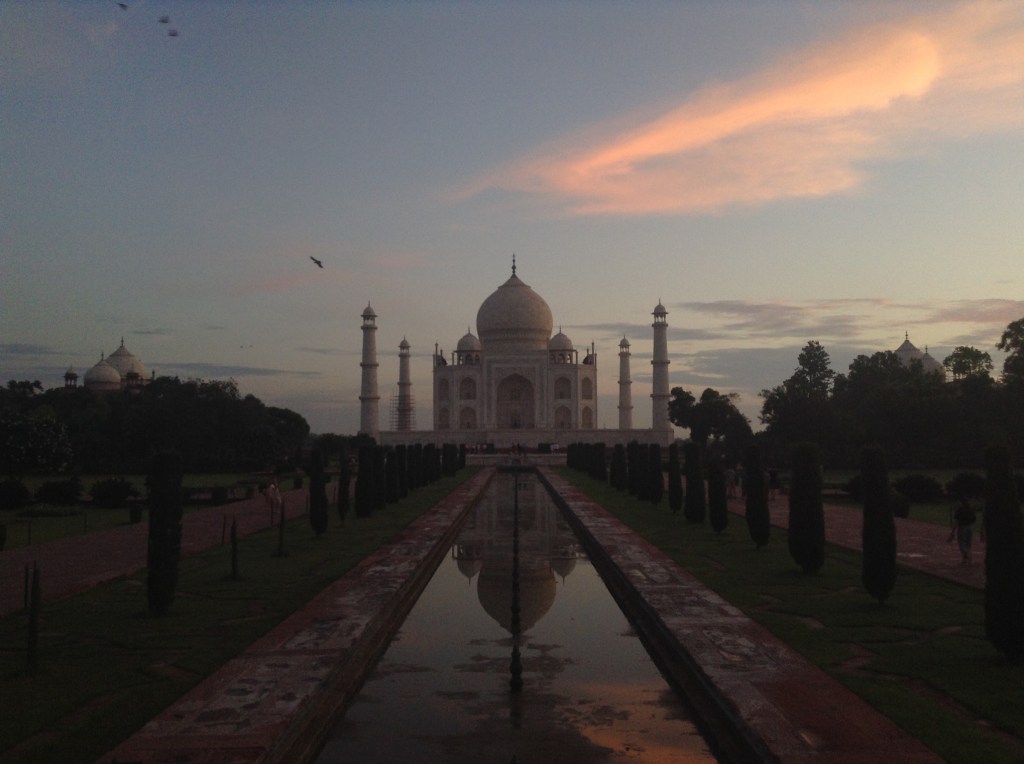
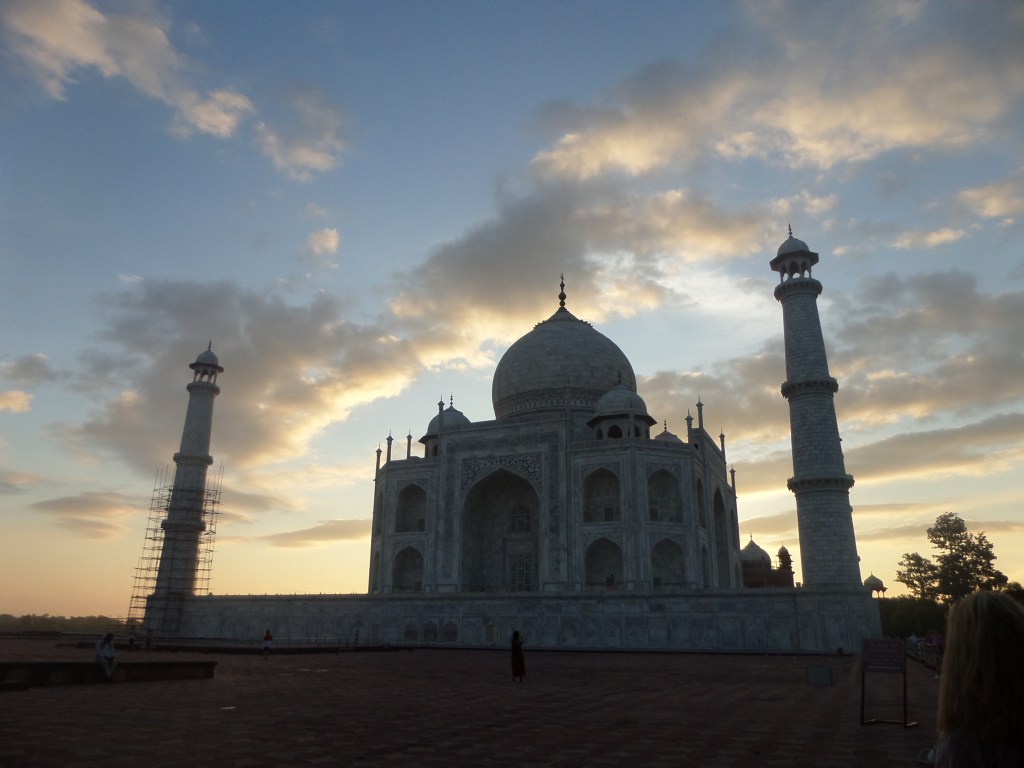
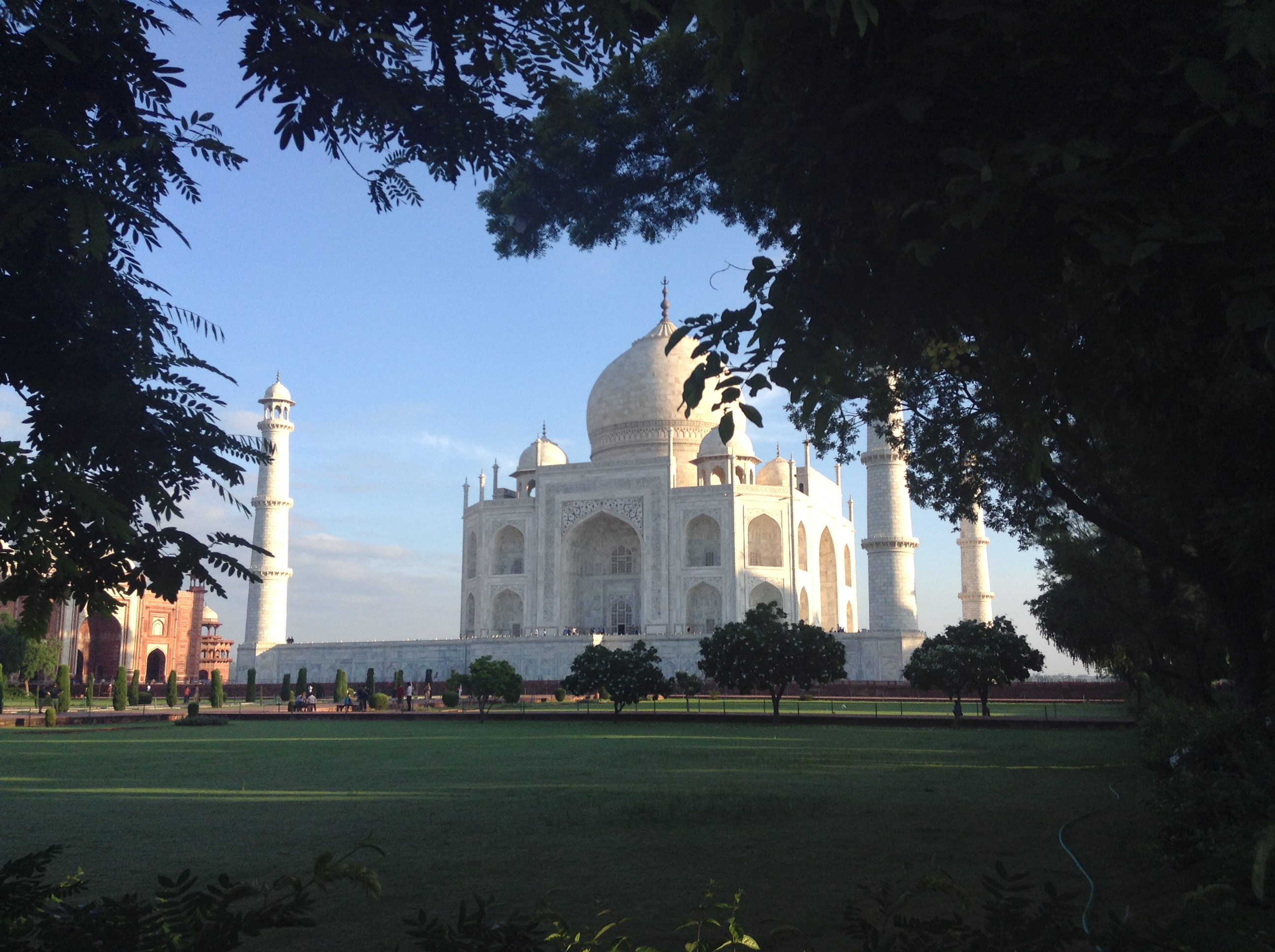
The Taj Mahal in all its glory, with towering white minarets and dome stretching skywards against the red-hued morning sky.

It was breathtaking.

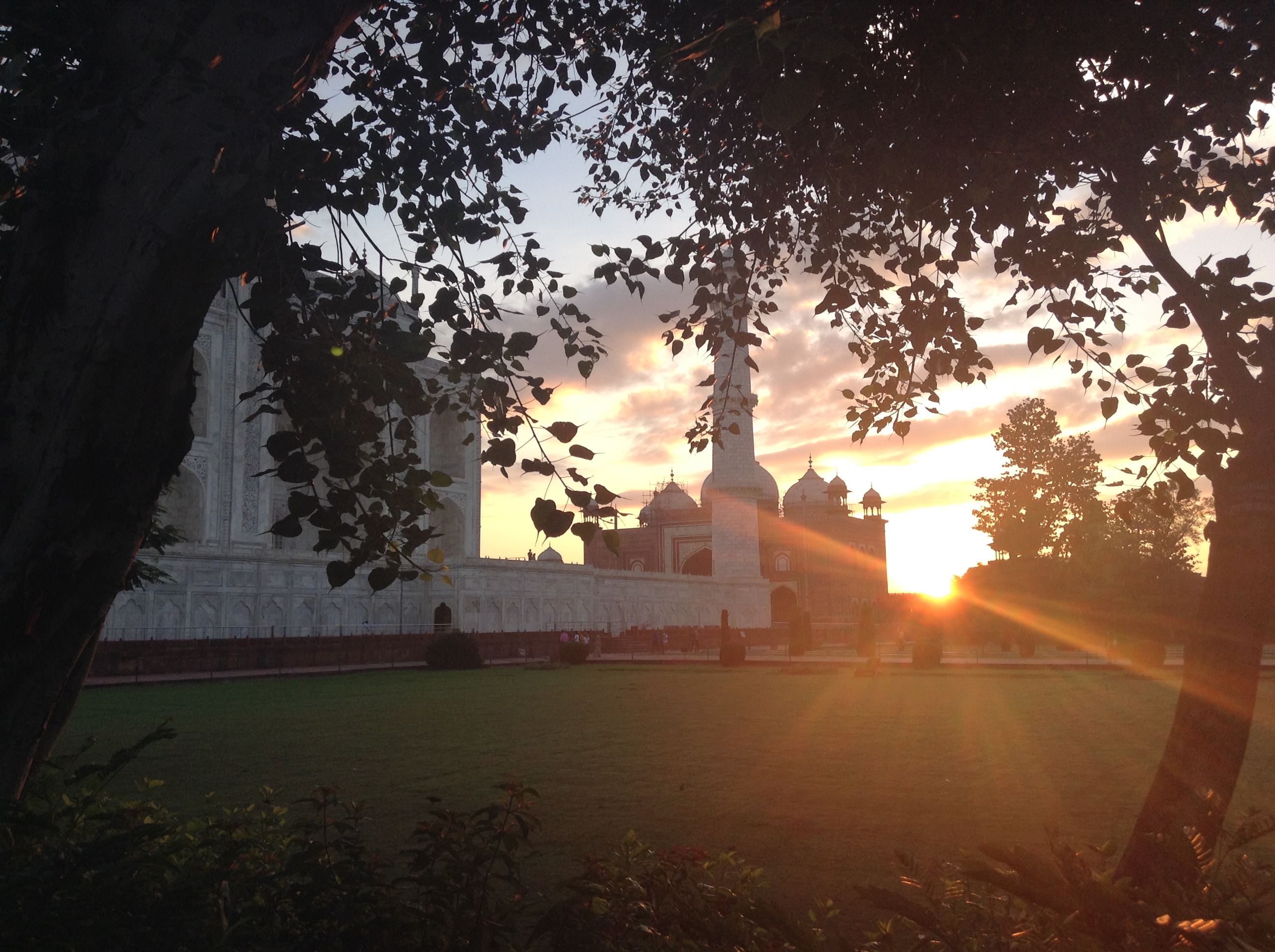
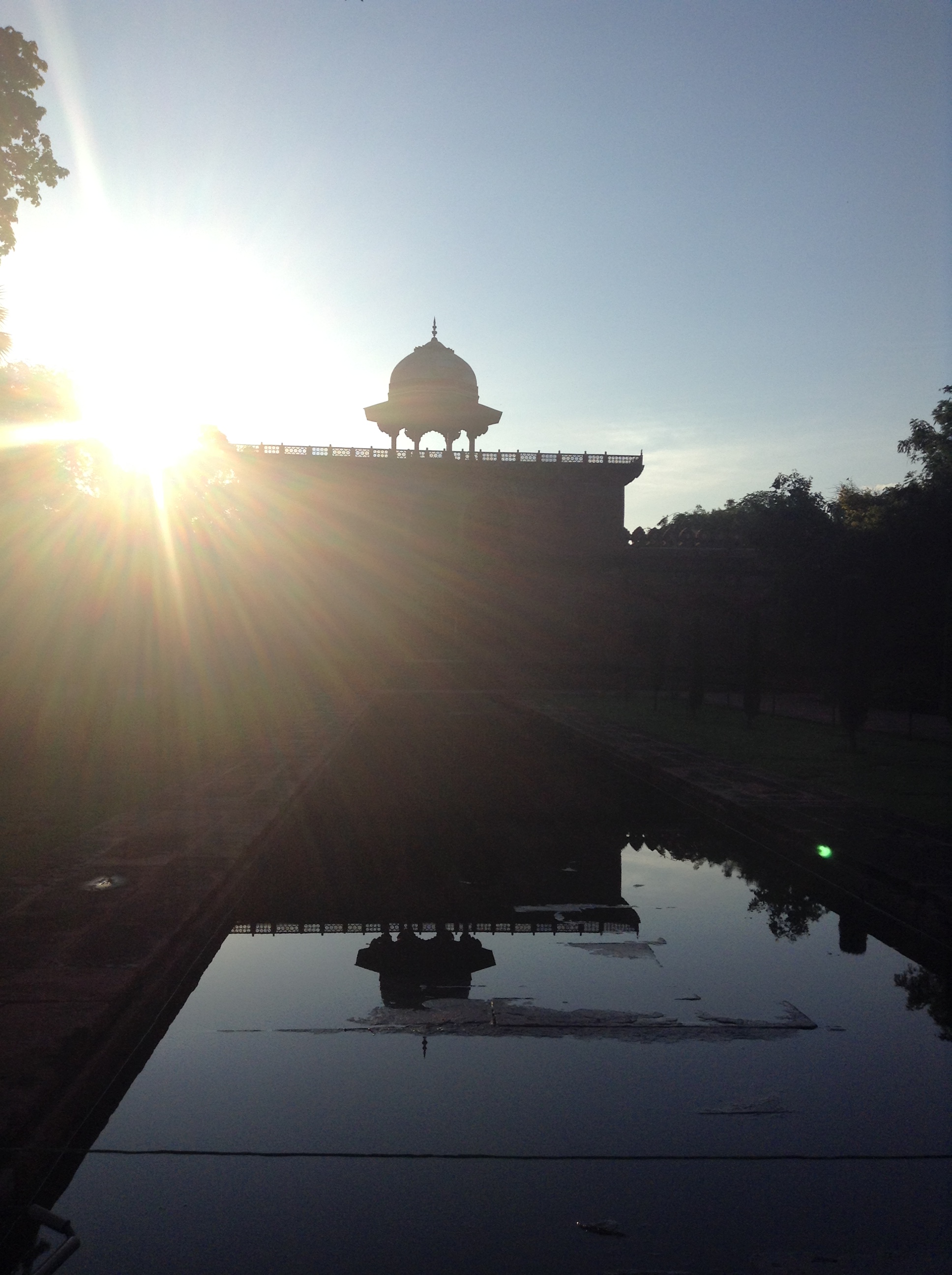
After taking a few photos, we followed a guide around the inner gardens which were rimmed with beautiful flowers and ornate benches. Trees emerged on path corners but nothing could distract from the enormous structure ahead that towered above us as we neared the entry into the Taj Mahal. At this point, the sun also decided to rise, illuminating the back of the domed structure, halo-ing the minarets and small towers of the mausoleum; it shone against the brightening sky.

Upon entering – with shoe coverings worn – the inside was almost as impressive as the outside. We entered into a high-domed, circular room made of stunning white marble in which small rhinestones were inlaid; sapphires and emeralds. It was surreal being inside such an immense symbol of love; built over 400 years ago by the Mughal Emporer, Shah Jahan, for his wife as a tomb for her after her death and then it later ending up being his own final resting place.

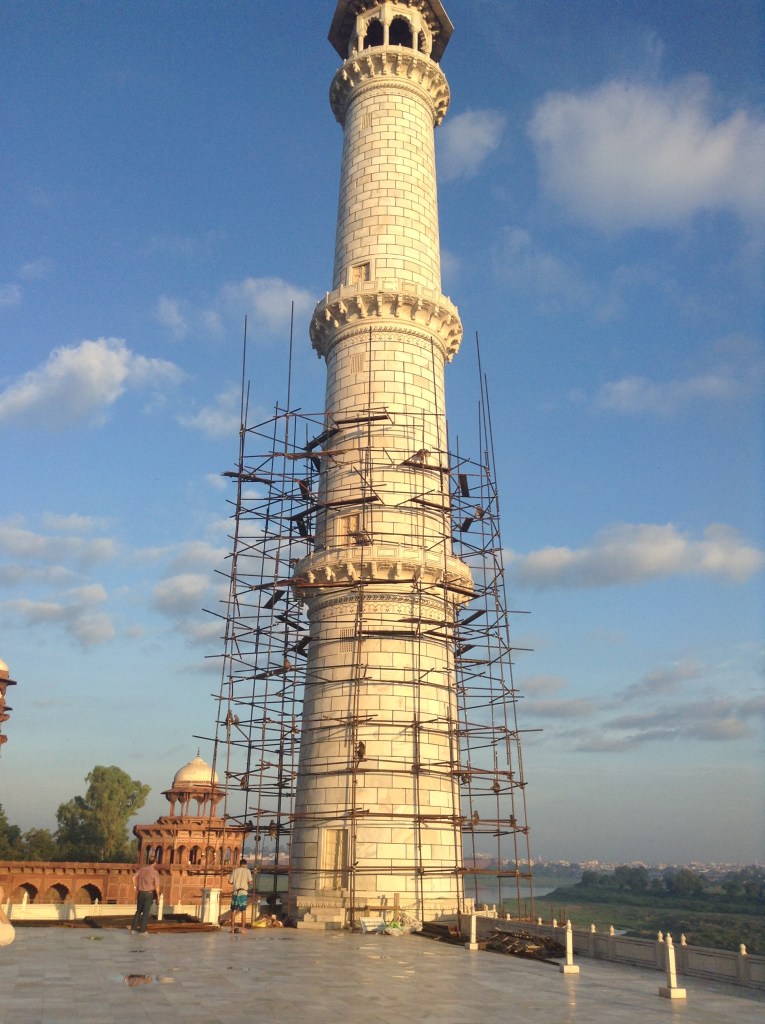
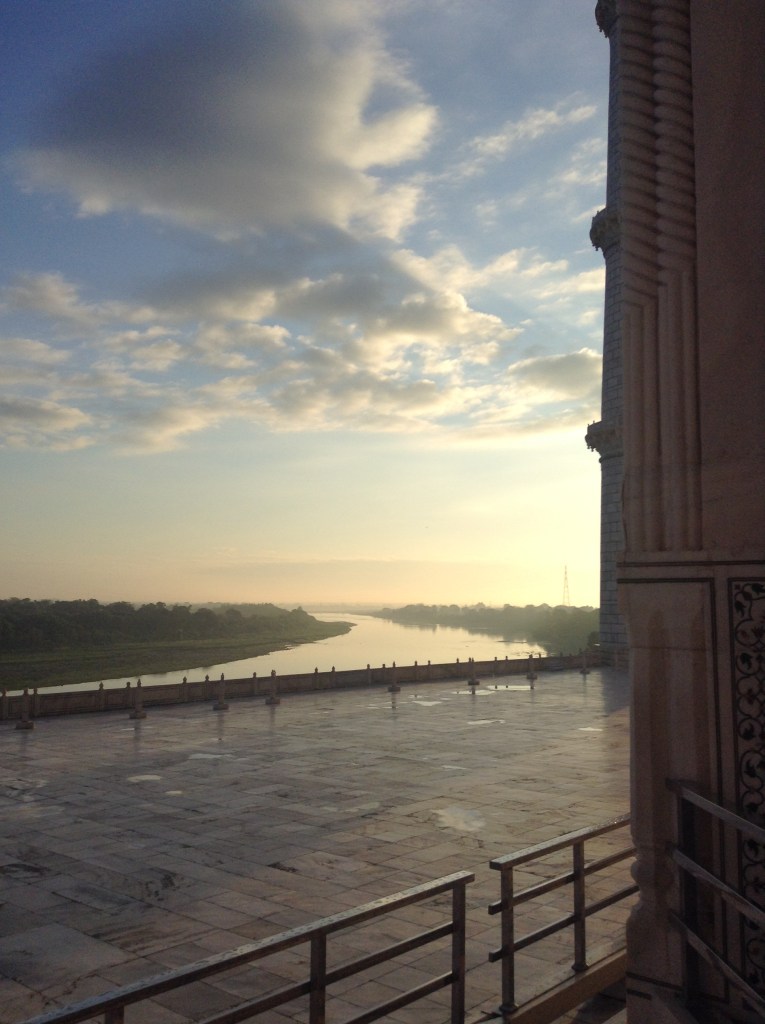
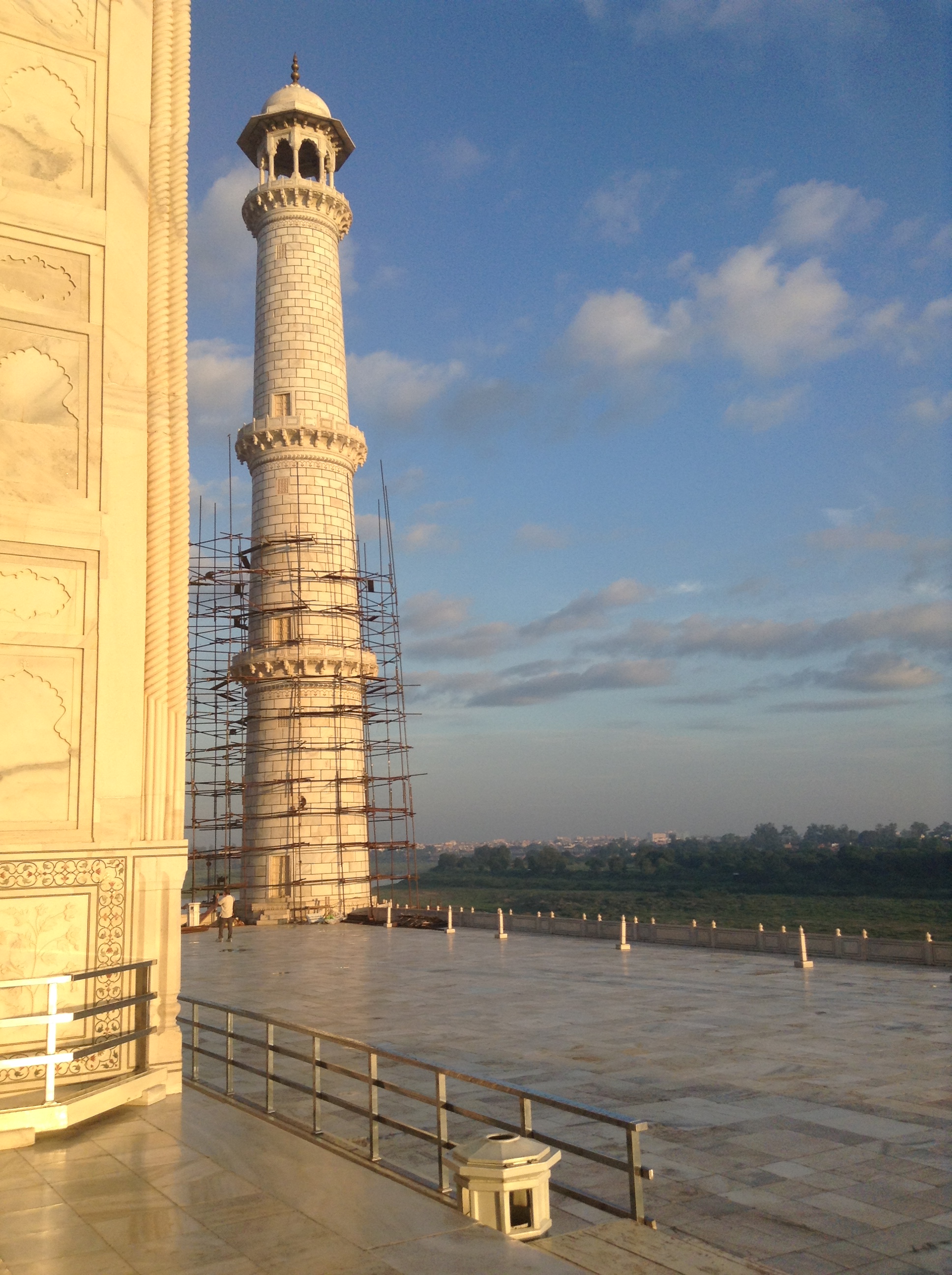
The sky appeared brighter once we’d left the inner space and headed outside to view the sun glinting off the Yamuna River while monkeys chattered away high up in the scaffolding of one of the minarets.

Just sitting there, in that moment, made me realise how lucky I was to experience this at such a young age. This monumental, architectural feat that is so old yet no less incredible, felt surreal to be sitting on at daybreak on an August morning.

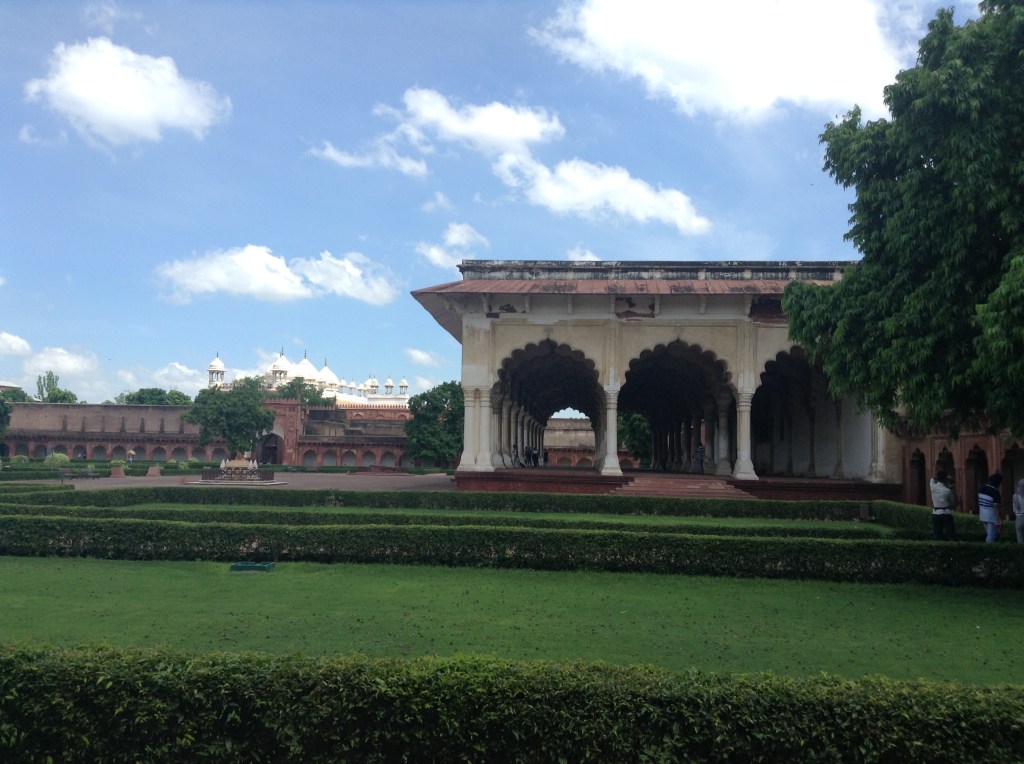
The rest of the day in Agra was spent witnessing the other main attraction of the inner city; The Agra Fort. Home of the emperors of India before Delhi became India’s new capital and which more closely resembles a walled city rather than a ‘fort’, the Agra Fort was also home to the luxurious prison that kept the Taj’s creator until his death once he was deposed after the structures’ completion.

The impressive red sandstone walls and inner palaces and gardens were incredible to walk through, with their grandeur, height, intricate carvings and details, and the fact that you could see the Taj Mahal from the parapet across the vast Yamuna River to the south-west.

Once the day had ended however, it was time to seek out newer experiences after seeing so much of the past; which was how I happened upon Sheroes Cafe.

Sheroes, or ‘she-heroes’, was created as a charity safe-space for women who are survivors of acid attacks. These attacks often lead to facial deformities and injuries that cripple women for life, however, Sheroes is a place these women can find happiness and work again after being ostracised from their families or even from society itself.

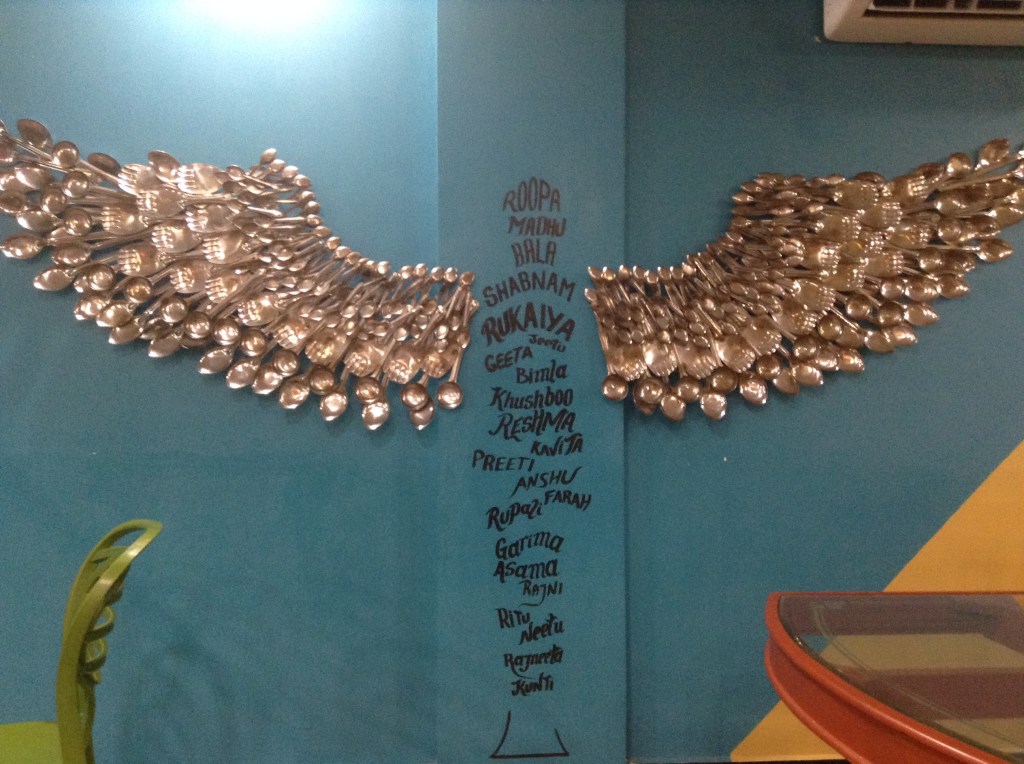
On entering the colourful cafe, which had been restored recently with new bookshelves and tables, it was clear this was a unique hub of activism, creativity and a new lease of life to those who need it most. With it’s racks of t-shirts, brightly coloured walls filled with art and pictures of the women who had made this ‘hangout’ as welcoming as it is inspiring. The shelves were filled with books of all sorts from british classics to manuals on how to craft, while the upper levels sported beautiful hand-crafted earrings made from paper with cards to gift or small broaches, all hand made by the heroes themselves as a way to make money and explore their passions. This hub was an incredible place to discover and after a night of sandwiches (all from a menu with no prices because Sheroes believes in paying what you can), laughter and even dancing, as the women we’d met blasted local pop music from the radio and danced aimlessly for hours; it was truly an experience I will never forget.

The names of the ‘she-heroes’ themselves.

The positivity and inspiring courage of these women who have been so brutally attacked, have not only survived but thrived in a place created by them, for them so they can feel safe and earn a living in spite of a society that chooses to shame them as if they are responsible for their attacks. It is a true testament to the strength women can summon when they work together against injustice.

This cafe was possibly the best part of Agra (a very close challenge to the Taj Mahal) because it was a wonderful thing these women had created, and it is the creativity and welcoming attitude of the people here that makes Agra well wortha visit. It’s beauty, diversity, inspiring people and architectural wonders make it unlike any place I’ve visited in India.

And visiting one of the seven wonders of the world is pretty cool too.

Santa Cruz

I could never, in a hundred summers, get tired of this.

– susan branch

This seaside city is one I will forever endeavour to return to.

It’s essence is something that cannot be found anywhere else, which makes it one of the most memorable places I’ve had the privilege of passing through.

From the famous seafront boardwalk, dating back to the early twentieth century; the green and colourful inner city and beautiful clarinet solos emanating from a jazz band sat playing on the corner opposite the beautifully old Delmar cinema; there is truly a sense that you get a taste for a bit of everything when visiting Santa Cruz.

I visited this beautiful place in July which meant that the day started well in terms of the weather; sunshine and warmth without a cloud in sight. It began, then, with a wander around the inland city area, stepping into various local vintage and second-hand shops which sold all manner of clothes, jewellery and cowboy boots in bright pink. On observing the scenery, it was clear to notice the beauty in the abundance of street art found on most, if not all, corners and intersections. It ranged from words to great murals dedicated to the very city they were painted on, often reflecting the strong skateboaring culture that has developed here over time.

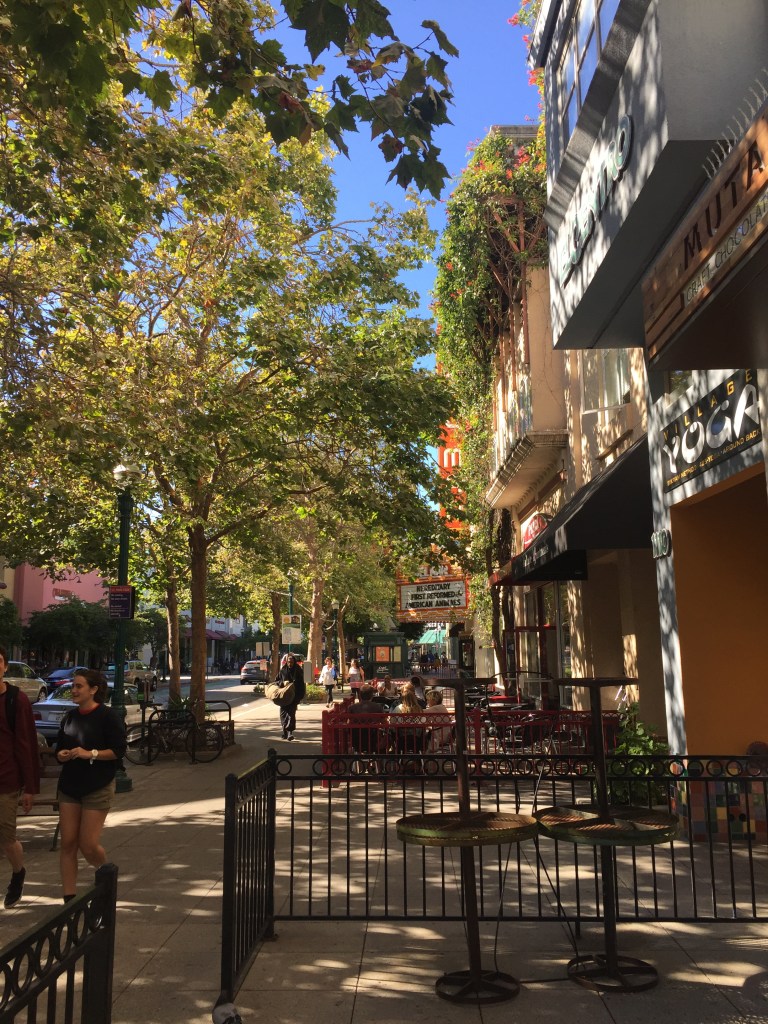
Wide streets then morphed into narrower ones as we entered into the Downtown area with it’s luscious urban planters lining the roads and ivy crawling up restaurant walls, hanging its green tendrils over into the street. Then, walking further you could begin to notice the common theme to the shop fronts as they ranged from clothing brands to local restaurants, fifties-style theatres with block letters advertising the latest films and yoga studios offering classes. It was vastly different from other places I’d visited because there seemed to be this alternative more relaxed aspect to living, that the people here had adopted and that the rest of the world hadn’t caught up with yet.

The peeling posters on the lampposts didn’t advertise rock concerts or clothing sales but wellness retreats, indie music events, food markets and adult softball tournaments.

On the next corner I was met with the beautiful jazz tones of a clarinet, bass, trumpet and guitar ensemble with a lady dressed in red singing along to the likes of Frank Sinatra and Nina Simone. Watching them play beside the green, rusty-red and blue buildings was unlike anything because the atmosphere seemed to exude calm and good vibes. There wasn’t anything to be sad about here.

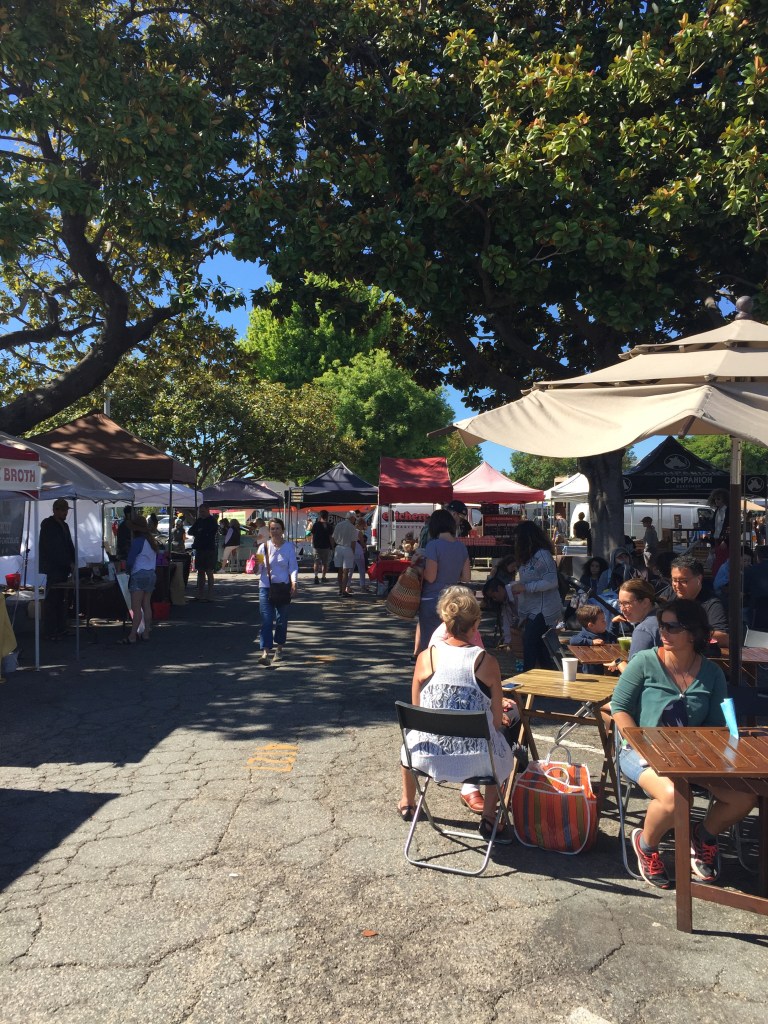
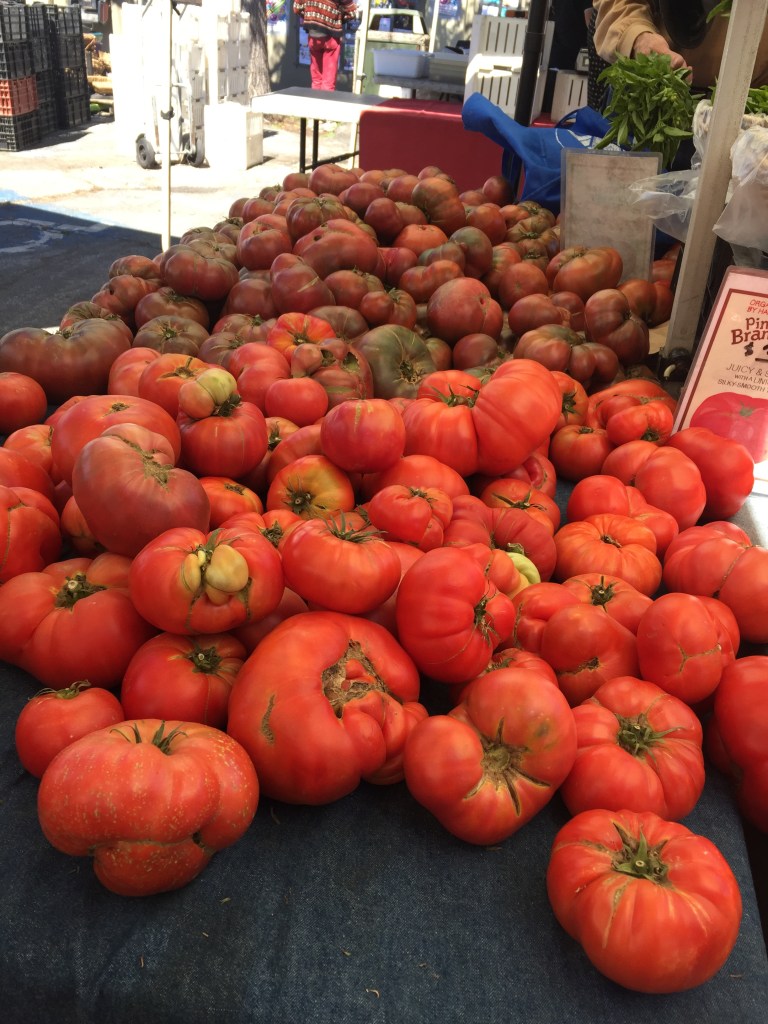
Next I followed the block along until I heard louder music from a radio station, playing from speakers located by the local market – the Santa Cruz Farmers Market- which was shaded under some twisted trees in a quaint little square. The marquees colourfully brought, what would normally be a dingier area, to life and the bustle of people drew you in when they chatted about cooking herbs, which soap is best and the quality of tomatos that were the larger than my head!

It was all-consuming, this atmosphere of people coming together to celebrate food and craft and nature healing remedies which, you could tell, brought comfort to locals and outsiders alike. I know I certainly felt welcomed.

Wandering on, I found my way to the Museum of Art History and the Abbot Square Market which revealed itself as a vast indoor food court catering for all tastes from coffee to fresh bread from the Companion Bakeshop (a born and bred Santa Cruz bakery) and amazing vegetarian alternatives from other vendors; most of which began just around the corner.

From there I then walked past blue, wavy colour schemes to emerge suddenly onto a corner where street performers were performing death-defying flame throwing tricks that lit up the bright faces of the gathering onlookers as the sun-set behind.

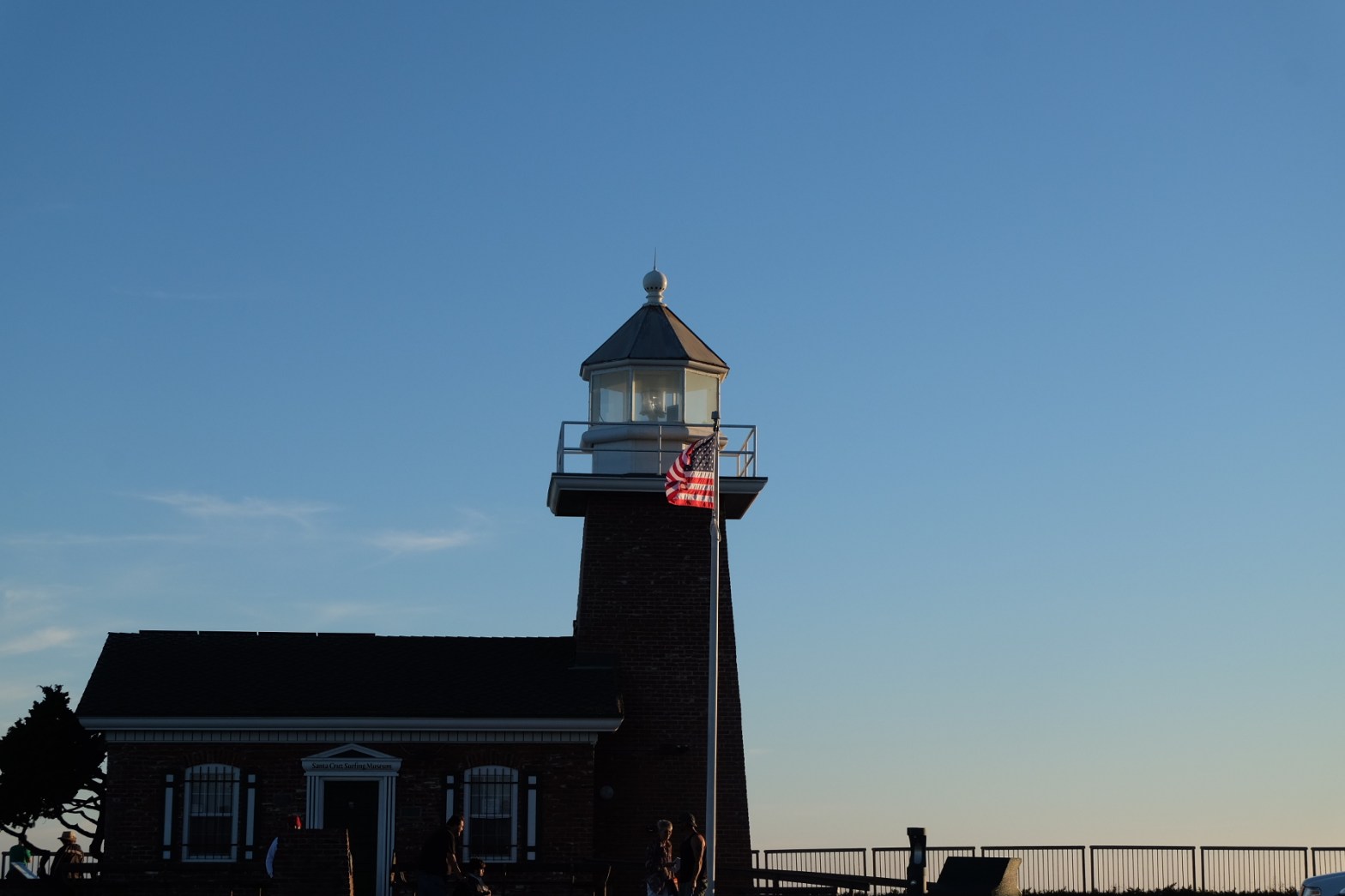
The drive back to the promenade and beach was intriguing, as the streets widened and tall palms replaced the creeping vines of the Downtown for the spacious, picturesque flats of Monterey Bay. It felt like something out of a photographers catalogue, walking along the top promenade after a round of crazy golf in the vintage arcades of the Santa Cruz Beach Boardwalk and a fish dinner on one of the pier restaurants looking out over the marina.

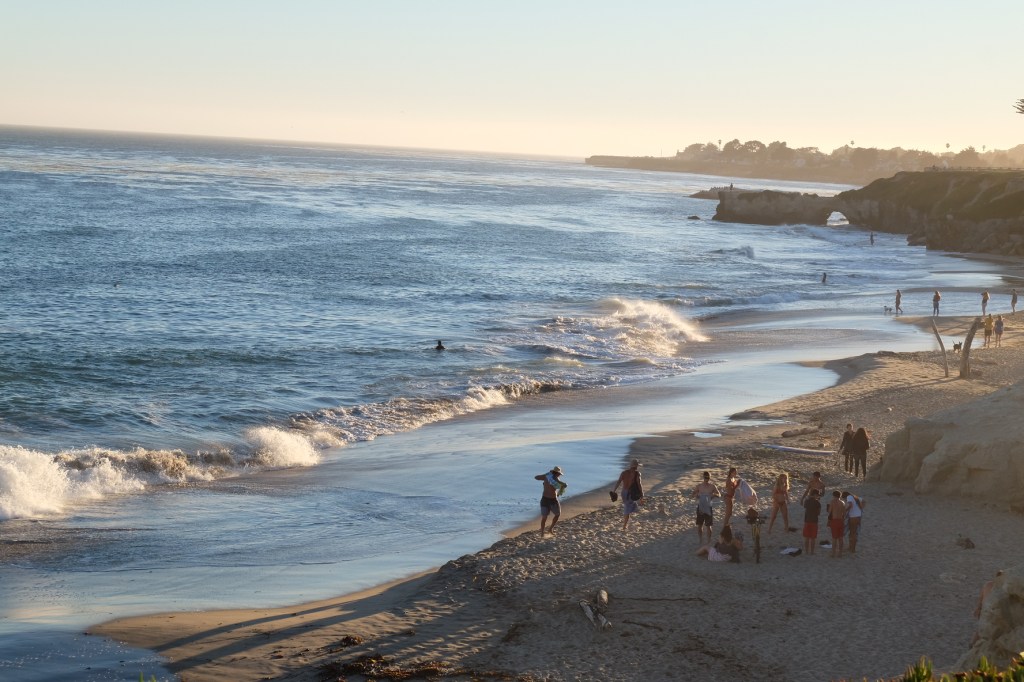
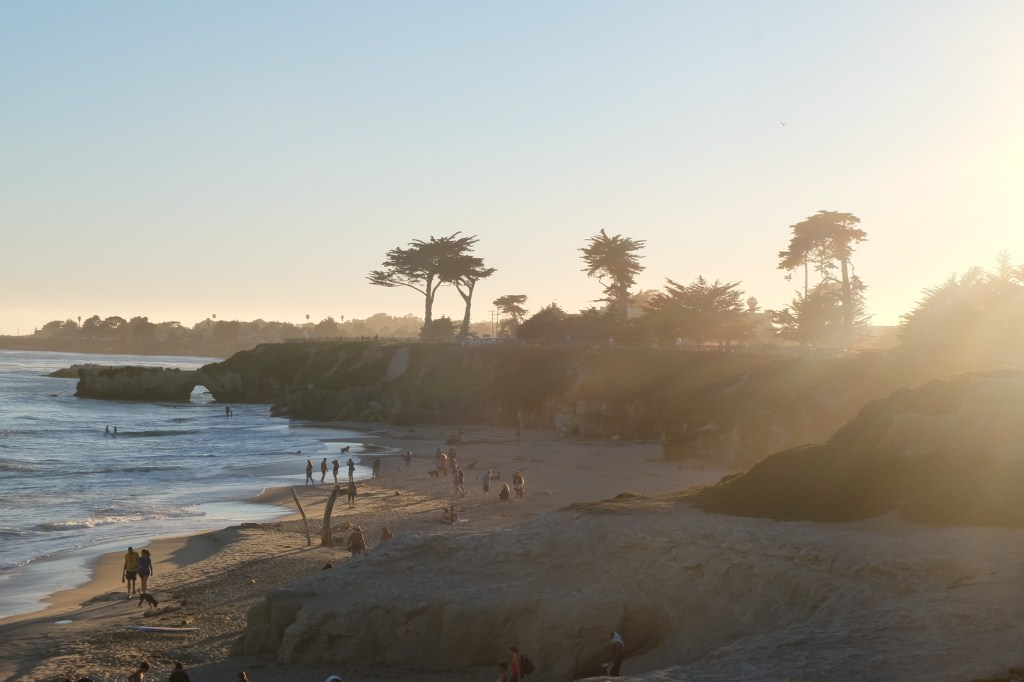
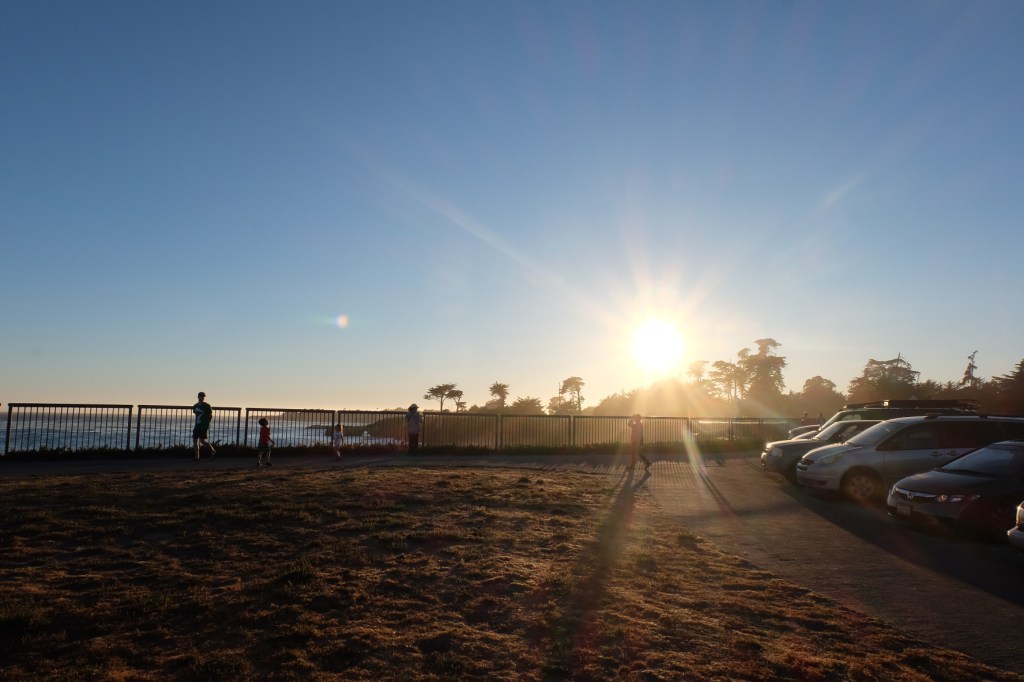
Despite its rich skate culture, Santa Cruz is also one of the homes of surfing and boasts some of the greatest surfing beaches in the USA. Which was why, walking along one at sunset is still one of the greatest things I’ve ever done. The sun, the sea, the sky and the people jumping into the waves was enough for many many mental photographs, memorialising the whole thing.

From the beach it was then time to head inland to the great forests of Southern California and with it, the Redwoods.

I’ve known, since I was about three feet tall and I saw a BBC documentary about the infamous trees that grew so high you couldn’t even see where they ended, that I needed to visit the trees in person some day. So, in mid-July I finally got that chance.

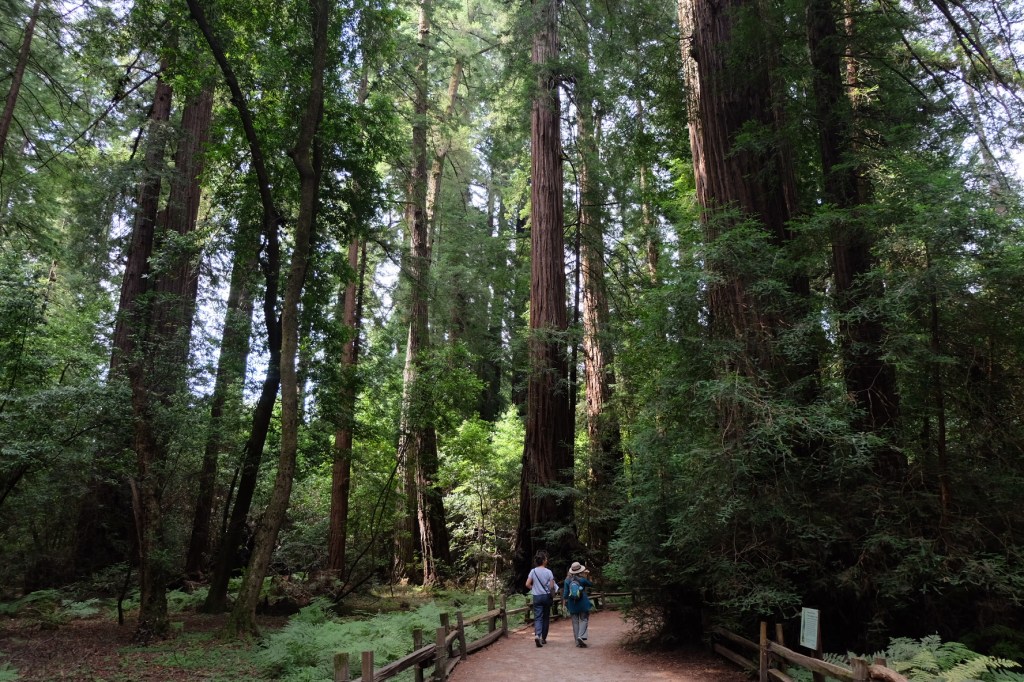
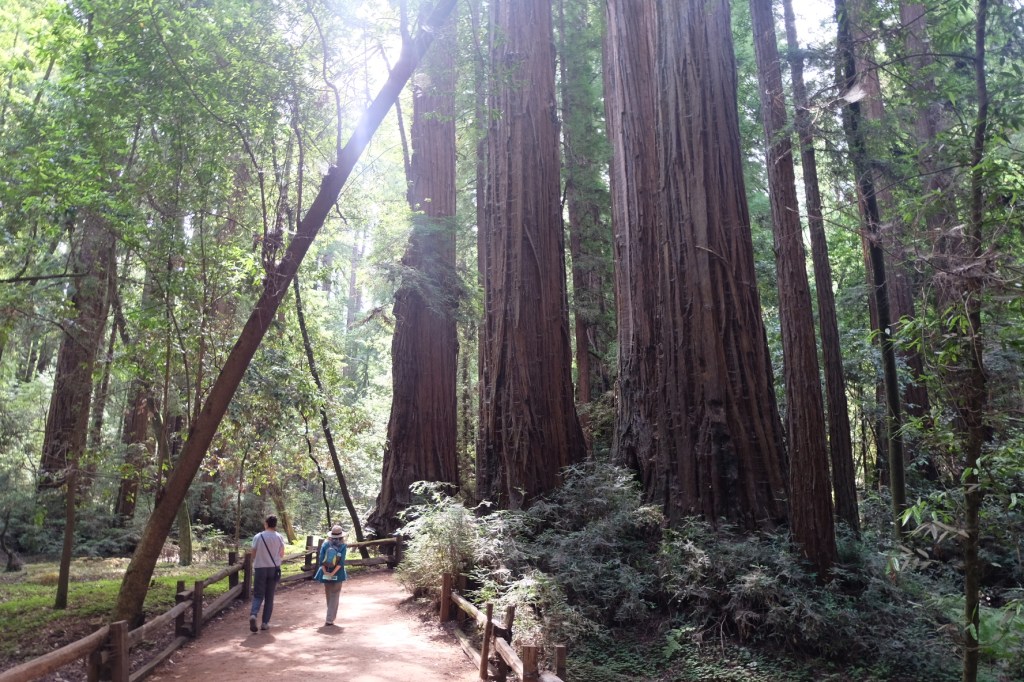
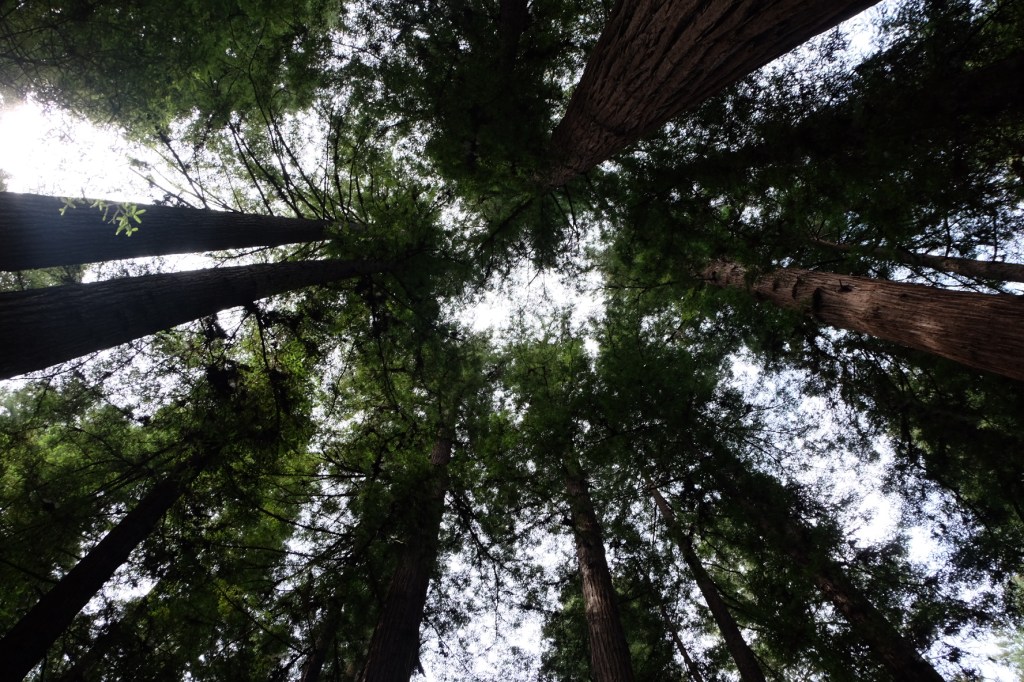
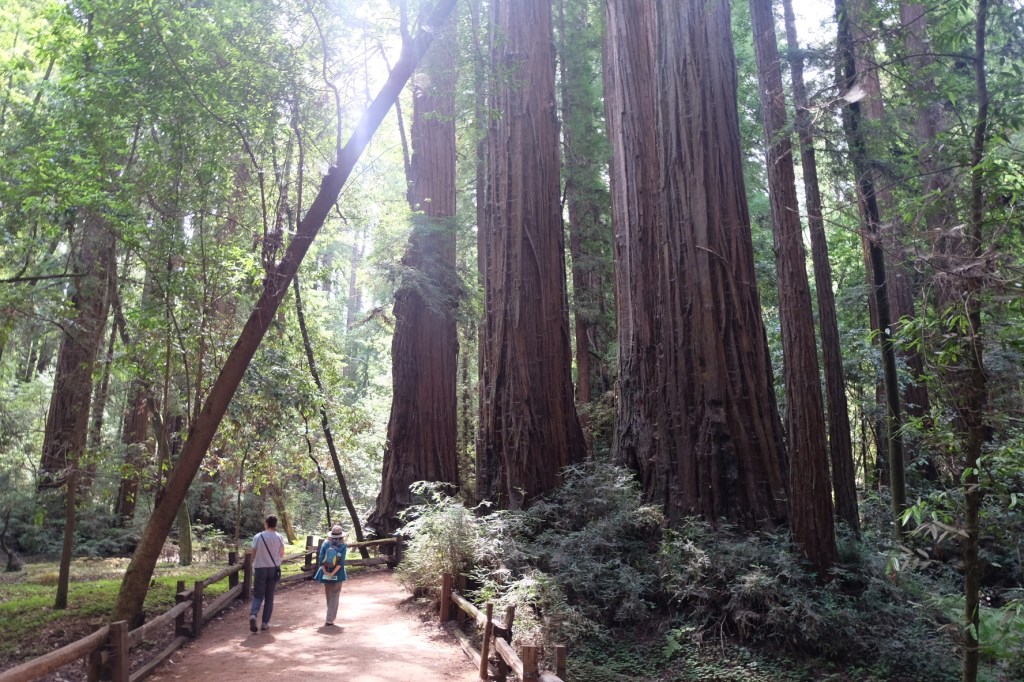
Passing the visitor centre and general information, the entrance to the forest was fairly underwhelming until you walked further in and came face to face with trees so different, yet so magnificent it stole my breath.

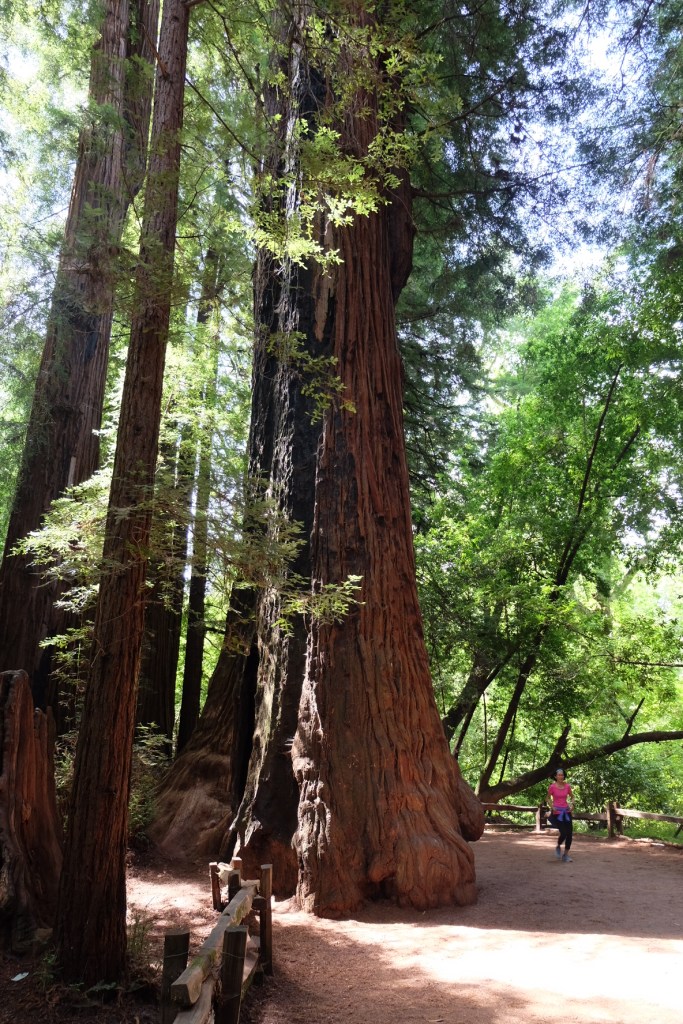
Red bark and enormous trunks stretched skyward in a gnarly mess of knots and roots but strong as steel and thick as double-decker busses. The sheer scale of these trees cannot be accurately written about because only seeing them in person can explain how, you really couldn’t see much of where the trees ended and then exploded into rich, green canopies above. Some of the thicker bases had twisted enough for a cave to emerge in the wood which any group of three or more could comfortably stand in, with head room to spare. It felt like walking as an Ant among regular trees.

Santa Cruz is unlike anywhere I’ve been because it is the perfect mixture of old and new. It is the old cinemas and theatres with the farmers markets and the new modern food halls teeming with international cuisine. Its the old industrial warehouses converted into bars and restaurants that welcome students from the University down for an evening of drinks, bright interiors and funky bar stools. It’s the age-old redwoods, stretching towards the outer-atmosphere and the new era of people taking up surfing, skateboarding, windsurfing and roller-skating. It’s the old, bright lights of the boardwalk arcade and the new marine conservation areas keeping wildlife safe for the future.

It’s all these things rolled into one incredible city, filled with incredible people. People who smile as they walk past and strike up conversations about music, art and life that leave a smile on your face, as they welcome you, and a promise on your lips to return as soon as possible.

Jaipur

In a few words or less, Jaipur is unlike any city on the planet.

From the reddish hues of the buildings to the bustle of over 3.1 million inhabitants moving every which way, dodging roadside fruit-sellers and cows alike, this place is one that is easy to lose yourself within.

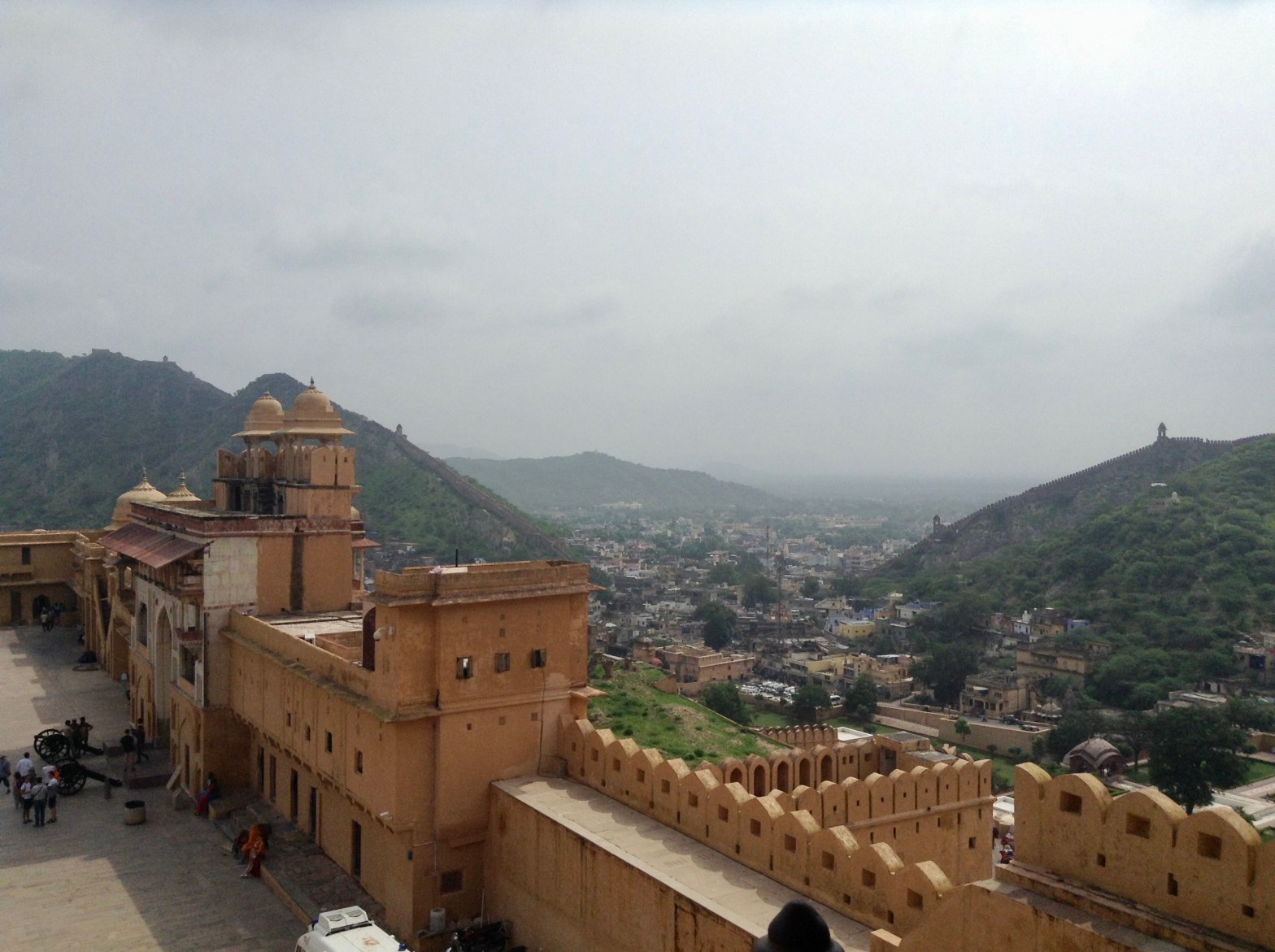
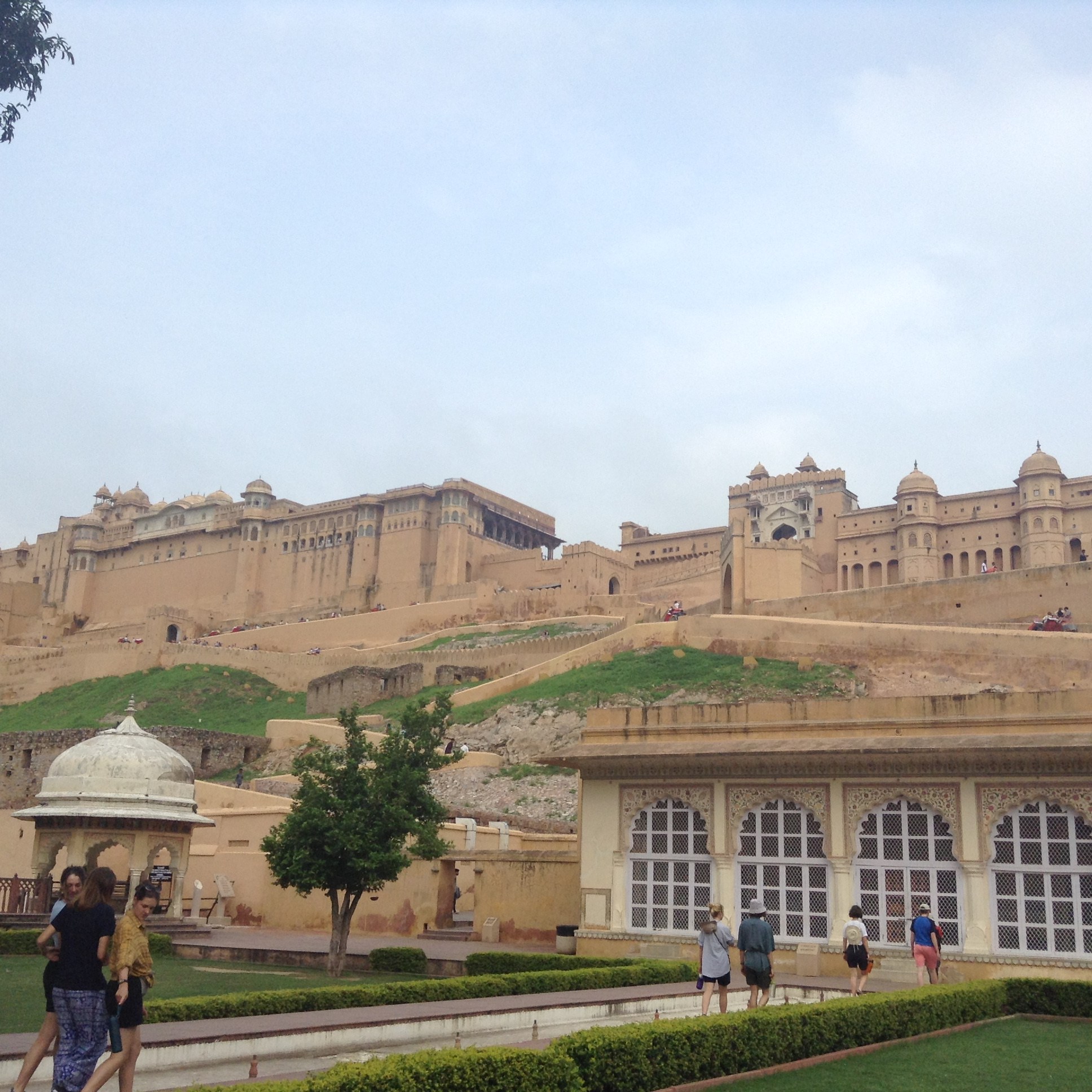
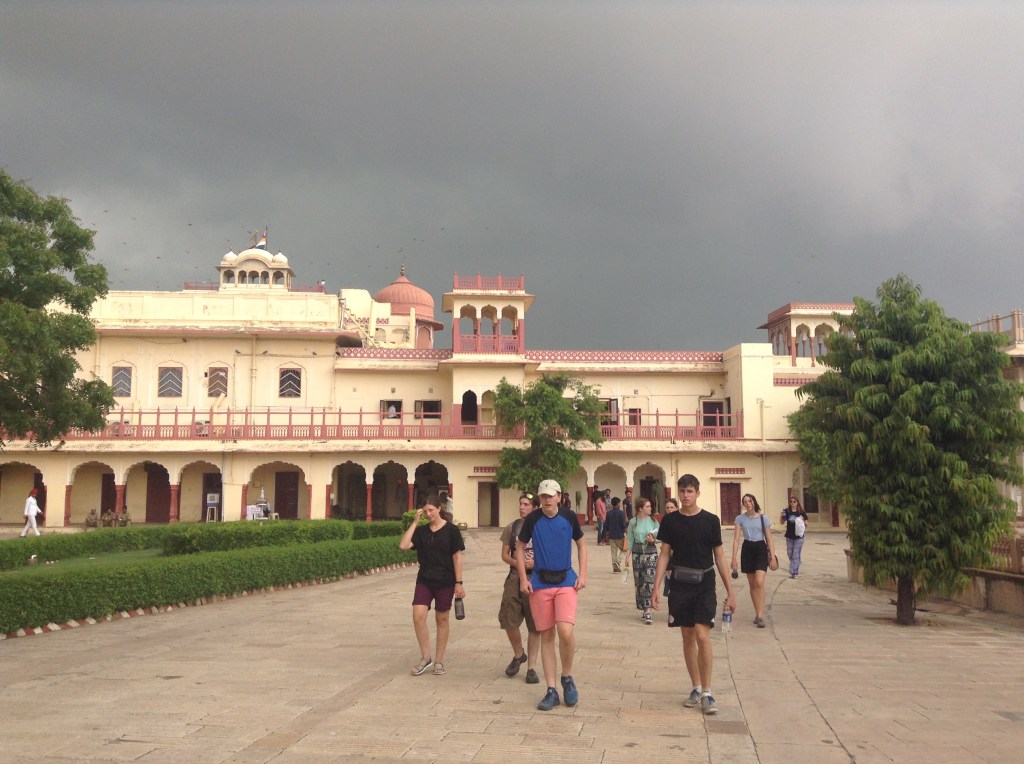
On the first leg of my day in the hot air of the city, I ventured a visit to the Amber (pronounced Amer) Fort; sitting as a regal reminder of the power this city holds throughout India with its amber, reddish hues that starkly contrasted the blue August sky I visited it under. This magnificent example of Rajput architecture actually sits around 11km from the city itself but is nonetheless worth the bus ride since once you’ve left behind the crowded, dusty streets, the landscapes give way to massive, rolling, green hills covered in trees as far as the eyes can see.

Another attraction you may witness on the way to this spectacular hillside fort is the stunning Jal Mahal (floating palace) which sits on the Man Sagar Lake near the centre of the city. This beautiful yet mysterious converted palace has five floors, four of which sit underwater, which conceal much of the perceived size of the palace. Unfortunately, the inner workings of this floating palace aren’t open to the public but there is hope for its future since it centres around a larger project to promote visits to the palace and de-pollute the surrounding lake.

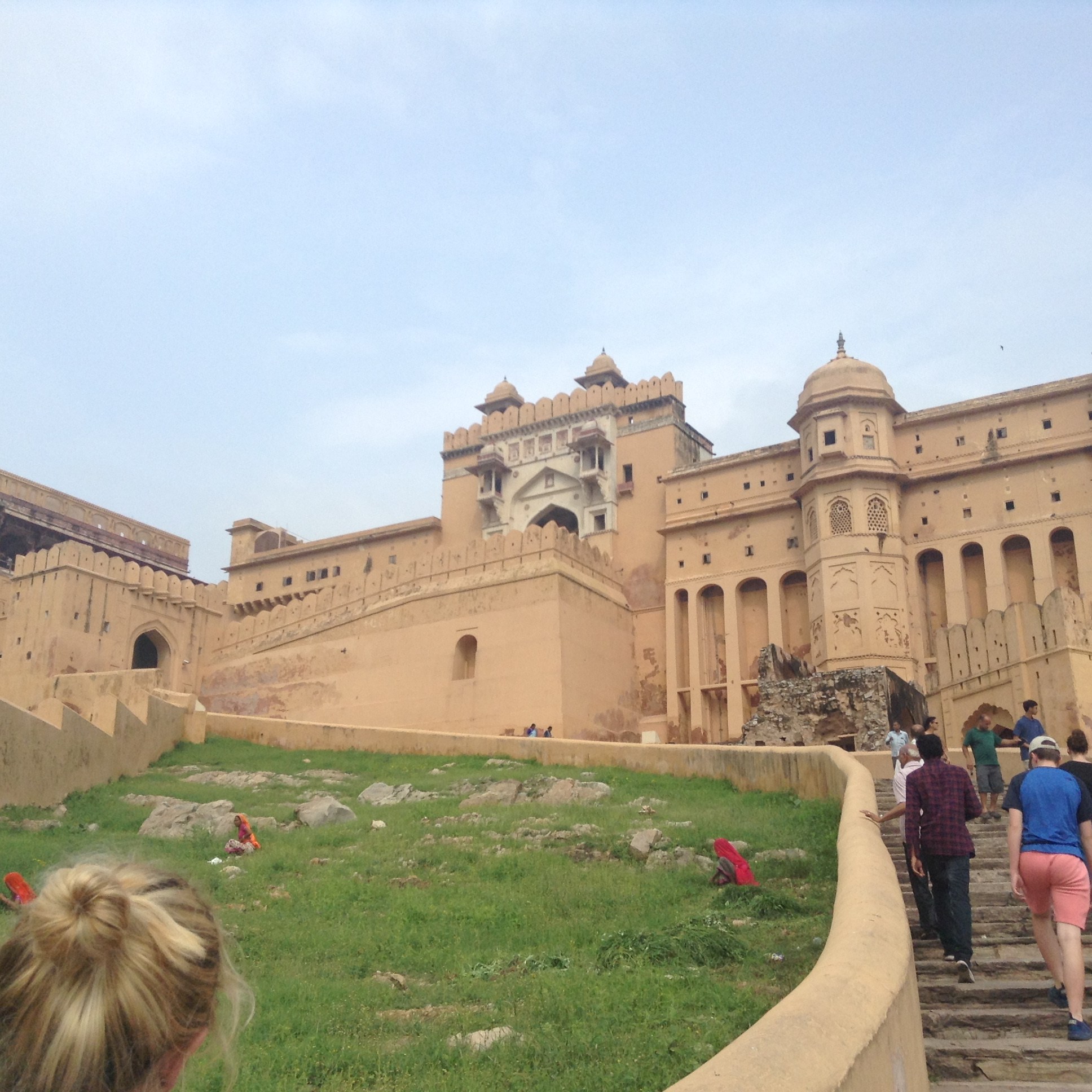
On arrival in the shadow of the great Amber Fort, I set off up the steps past various smaller walled gardens and beautiful fountains, forged with the same pink and yellow sandstone that gives the fort its signature colour; blending nicely with the surrounding greenery and hill-covered trees. It’s a short walk to the Suraj Pol (sun gate), through which most people pass on foot while those in cars usually pass through the Chad Pol (moon gate) into the impressive Jaleb Chowk (main courtyard). The space around me was incredibly flat and bustling with foreigners and locals alike, all in awe of the grandeur of the curling copper roofs and regimented rows of smaller trees bringing the courtyard to life.

This entry into another part of history, however, was interrupted by my first up-close encounter with Indian elephants in all their glory. Trunks swinging in the wind, the elephants themselves were beautiful to witness up close for the first time but it also hit me then how wrong it was to see these beautiful animals in this stony and dusty setting, the harsh sun beating down onto their backs and their cracked feet being made to carry (mainly white) tourists up the zig-zagging road to the Suraj Pol. It was heartbreaking to watch the industry up close since I hadn’t been exposed to its reality until then.

So before I go further with the beautiful setting I had walked into, remember to refuse to ride. The damage being done to these elephants and elephants all across India in the tourism industry should not be ignored for the sake of riding somewhere that could easily be walked. Elephants shouldn’t be ridden but instead be given the freedom to live healthy lives, un-damaged by hot asphalt, a rider’s whip or the strain of performing to, or carrying, others.

They are animals that should be protected.

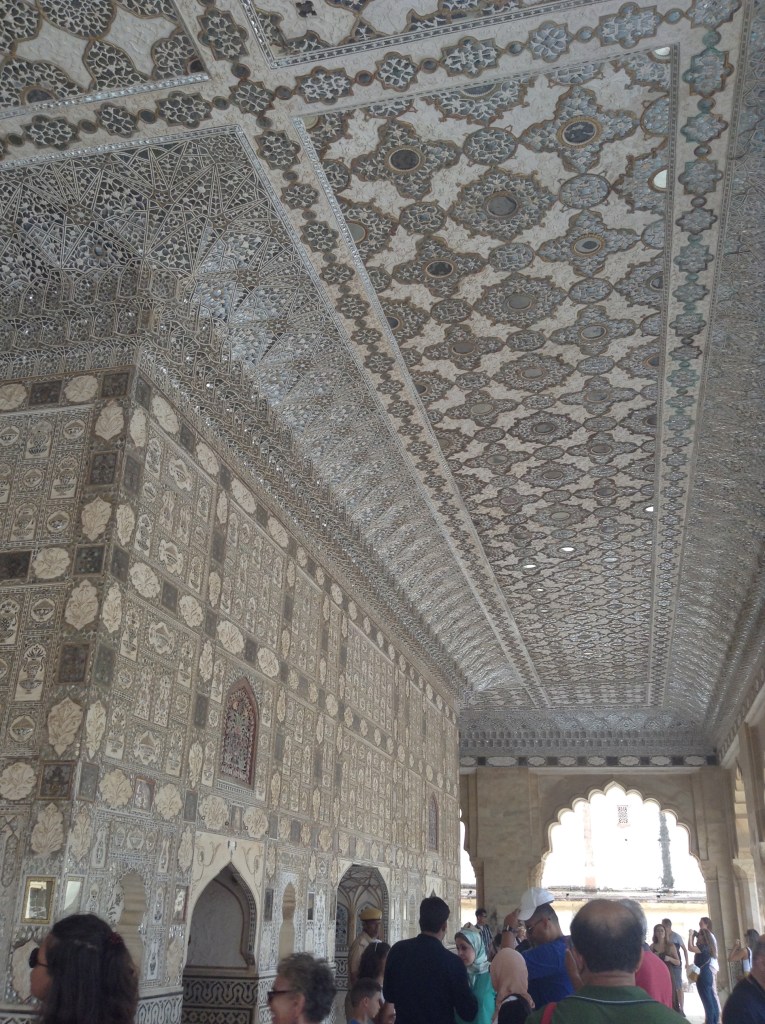
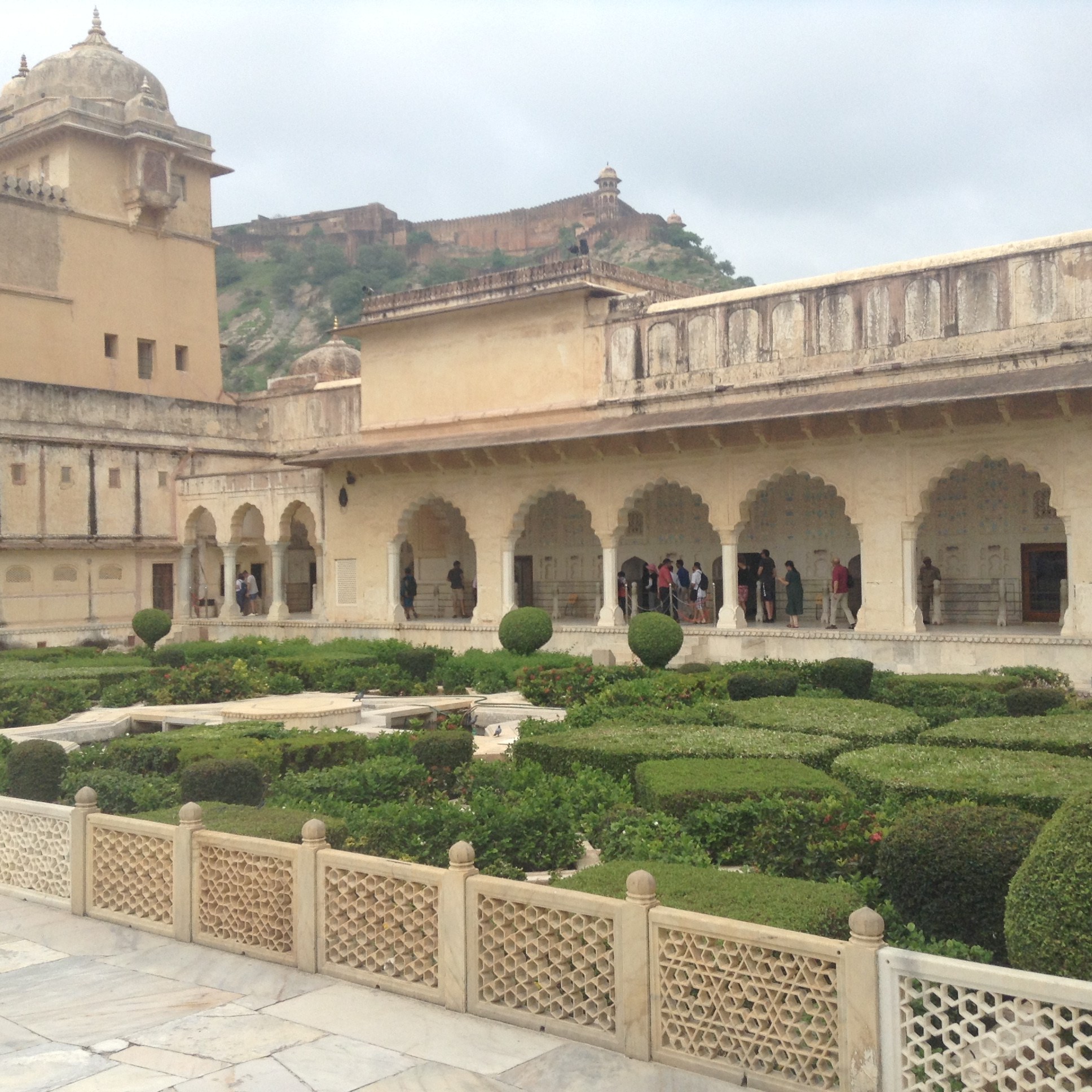
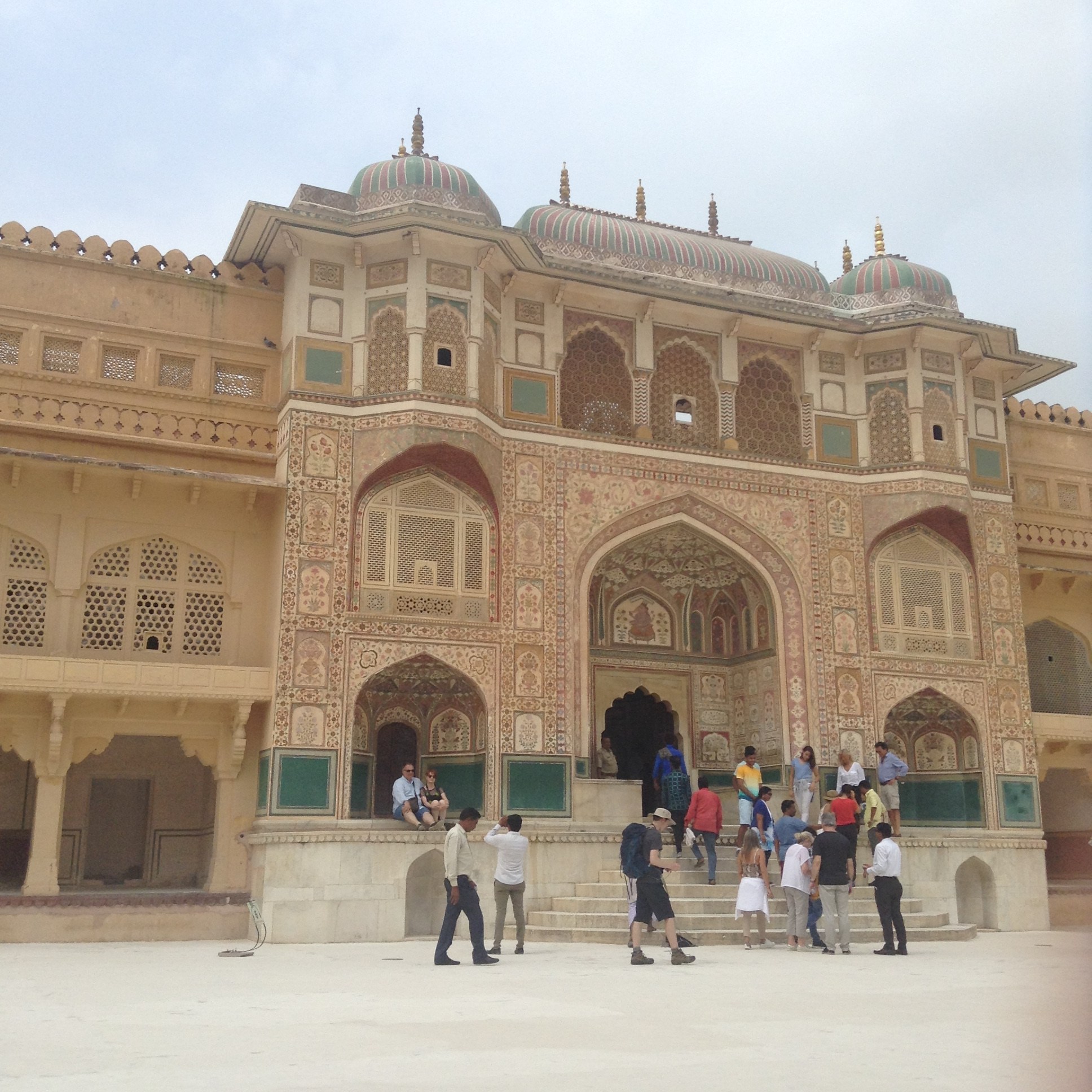
After I’d wandered through the main courtyard of trees and passageways on the side-alleys to shield from the dry heat, I found a guide to show me every wonderful crevasse of this beautiful fortress. After three courtyards that got smaller the closer to the mountaintop we got, I was entirely speechless at the sandstone architecture, the painted walls, frescoed arches of the Ganesh Pol and multiple smaller palaces that decorated these courtyards, courtesy of the Maharajah Man Singh in 1592. The most impressive, though, is the Jai Mandir or Hall of Victory which is also known as the Palace of Mirrors. Every inlaid stone or surface displayed a mirror that shone in the blistering August sunshine.

The roof and walls of the Jai Mandir

In total, the four courtyards of the Amber Fort beautifully showed the fort throughout the ages, from its first and oldest courtyard housing the Maharajah himself to the main, more modern courtyard which welcomed visitors and warriors alike to the gates of one of Indias greatest landmarks.

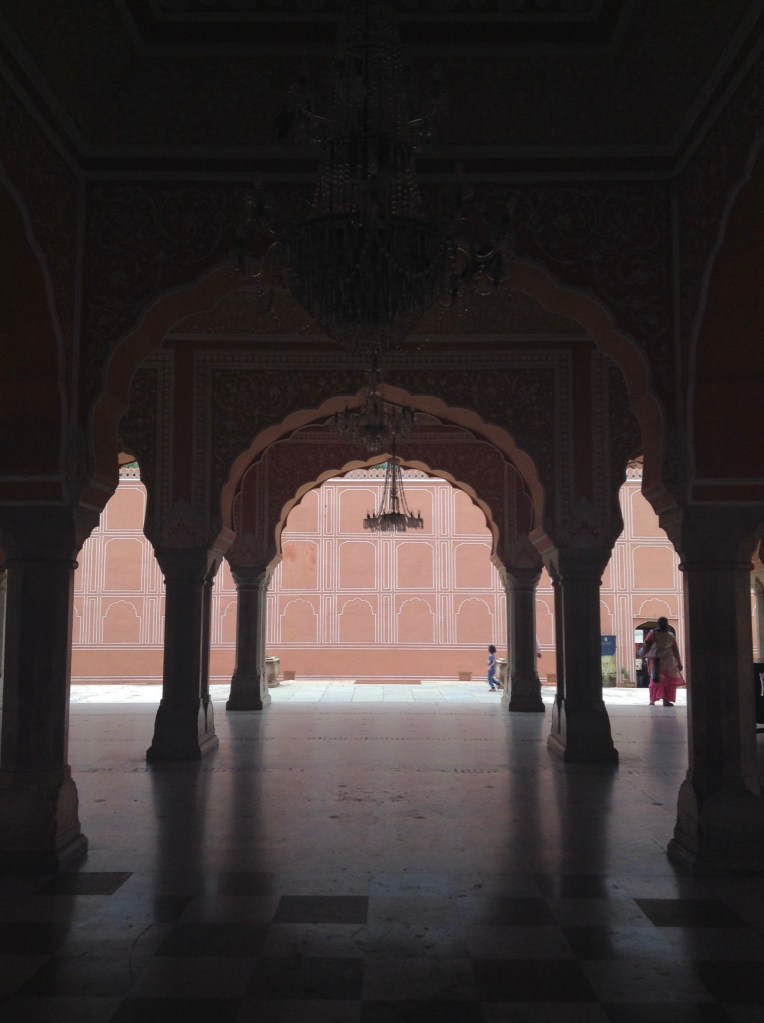
By midday, it was time to re-hydrate and head back to the city for a glimpse into the heart of the bustling and chaotic atmosphere of Rajasthan’s state capitol and with it, the City Palace. Once we’d entered the palace’s coppery red gates under a grandiose white detailed archway (at a considerably higher price as such is the burden of being a foreign tourist in India is paying a higher entry fee) we visited both the textile museum and armoury which boasted the greatest in through-the-ages fashion worn by the Maharajah’s, to the impressive knife and sword collection displayed in great wheels of metal and gold handles.

At that moment, on exiting one of the many buildings that made up the City Palace, the sky turned black and after the first few enormous droplets started to fall from the sky it really hit home that we were in the height of monsoon season in India.

The heavens, literally, opened and it began to pour in bucketfuls so that you were soaked from your head to the base of your sandals in moments. Quickly, I sought shelter in the nearby gift shop and was greeted with welcoming smiles and the familiar chill of the air-conditioning. The shop itself was unlike your average gift shop though, as plastic nick-nacks were replaced by beautiful clay paint sets, colourful Sari cloth and scarves of silk and cashmere. Then, upon wandering around, I was pulled into a painting demonstration by one of the staff who showed us how long the paint could last on one brush strong before, free-handing an elephant and handing it to me as a gift.

To this day it is still one of my most prized possessions.

After exiting though, the rain still hadn’t let up so instead I decided to embrace the moment, ran out into the deluge – sans my bag of course – and danced in the rain while other tourists looked on as though we were crazy. The sky had since lightened and the rain was just as heavy but that didn’t matter because here I was, in Jaipur, in August, dancing under the warm monsoon rain with my eyes closed not caring who stared but instead basking in the moment of just being alive. That’s also when I decided to lie on the cobbled ground and just enjoyed the feeling of the rain falling.

It was one of those moments you know you’ll remember for the rest of your life because while it was happening all I could think was, there’s nowhere on earth I would rather be right now than here.

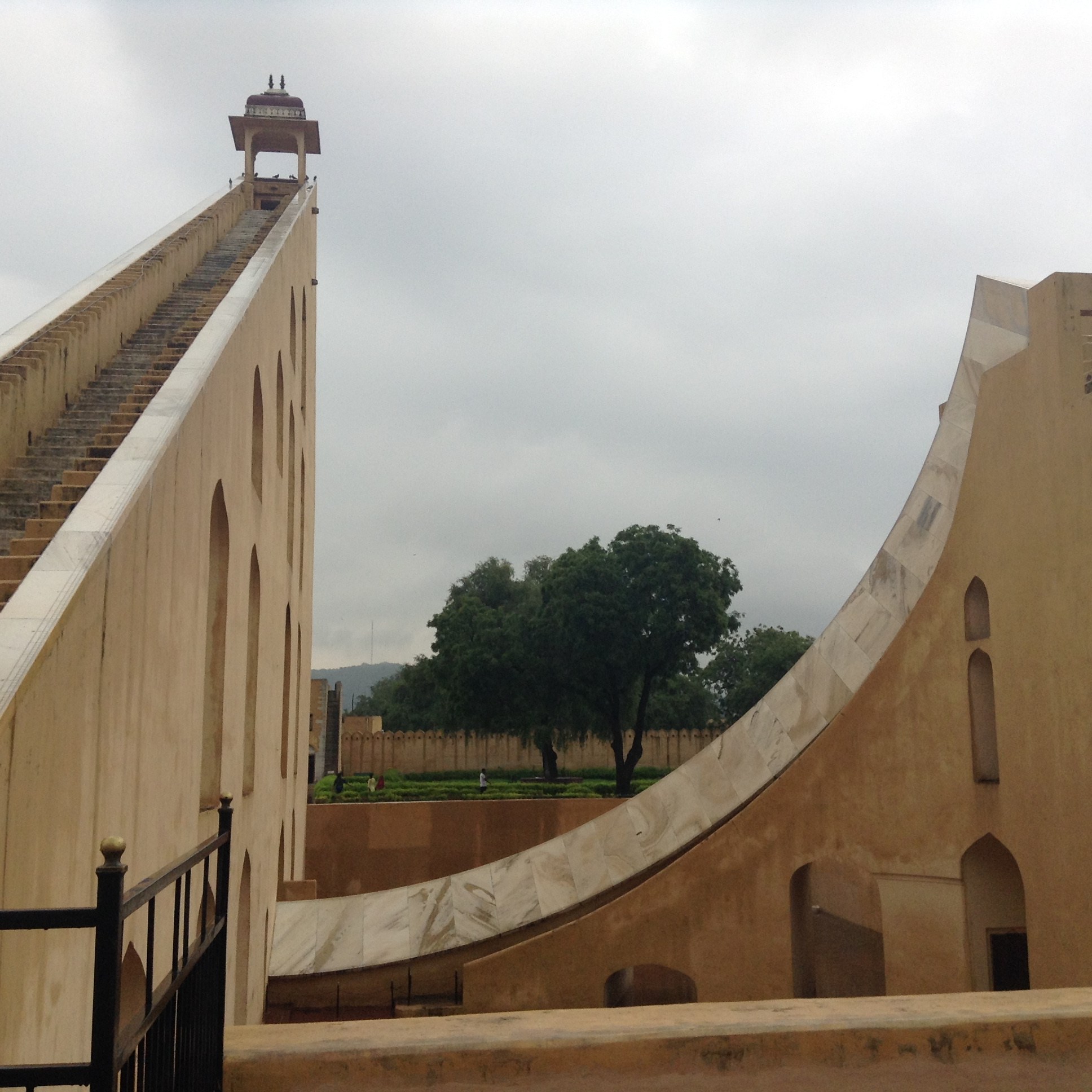
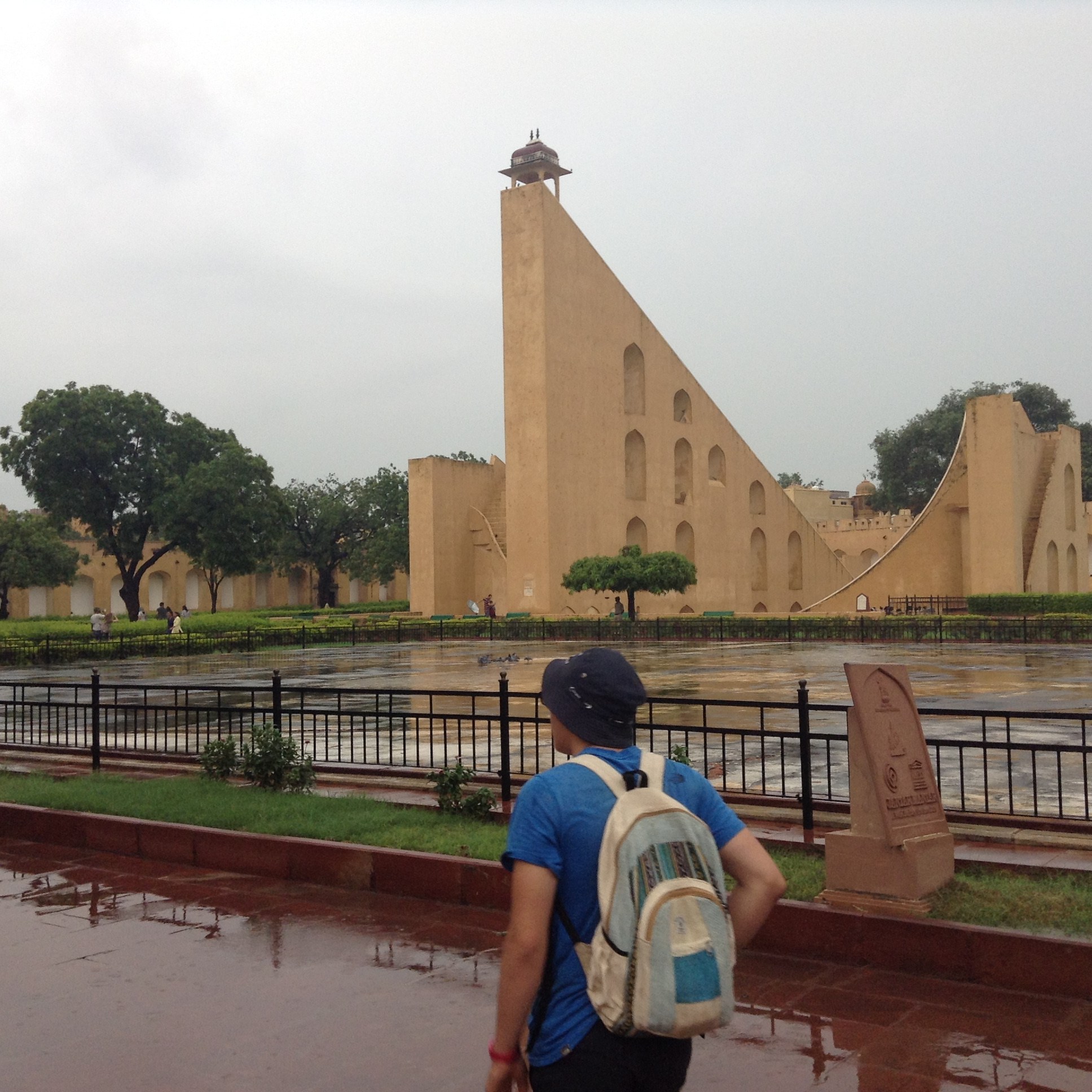
So, still soaking wet, I left the copper arches and full armouries of the City Palace and walked a short distance to one of Jaipur’s other, one-in-a-million, attractions: the Jantar Mantar.

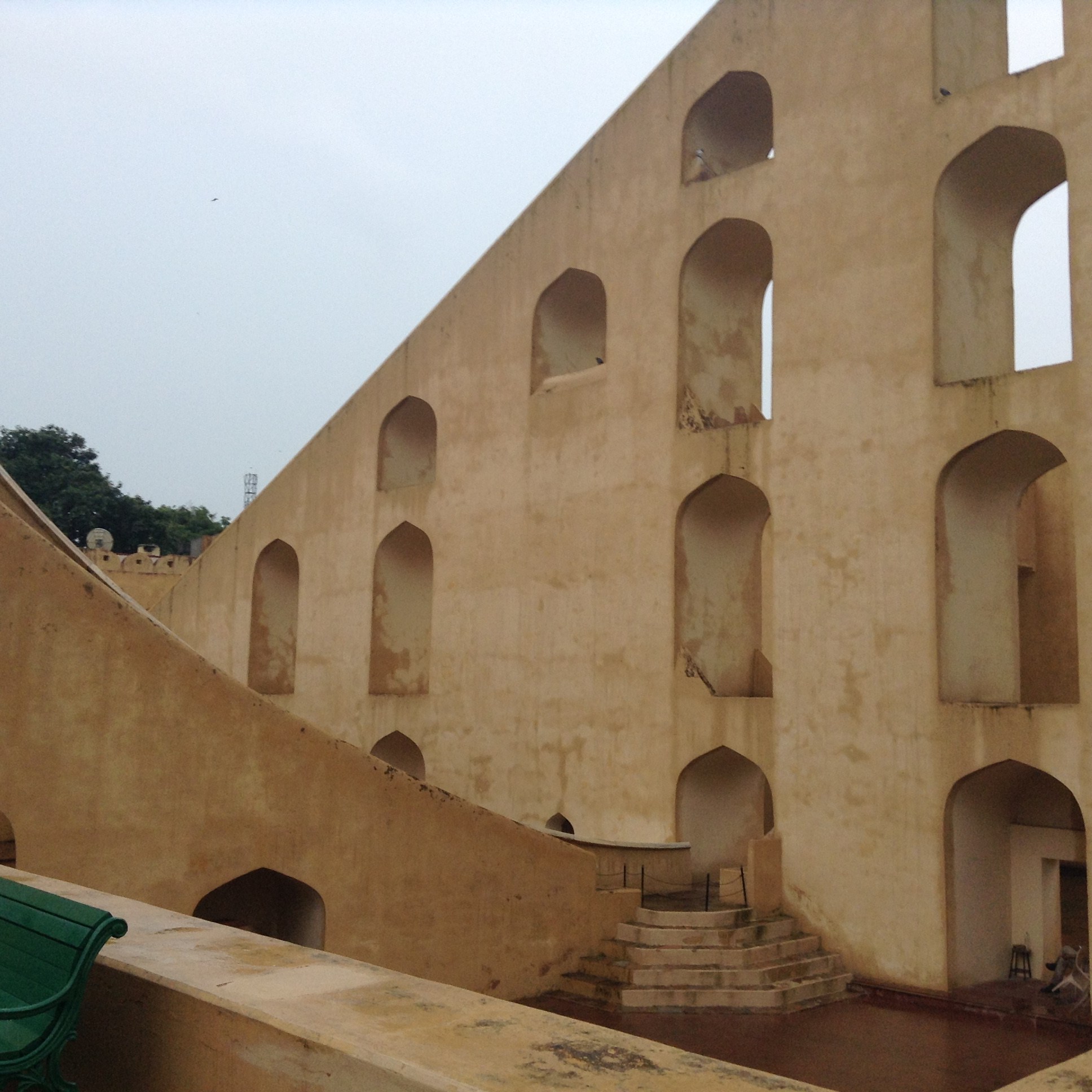
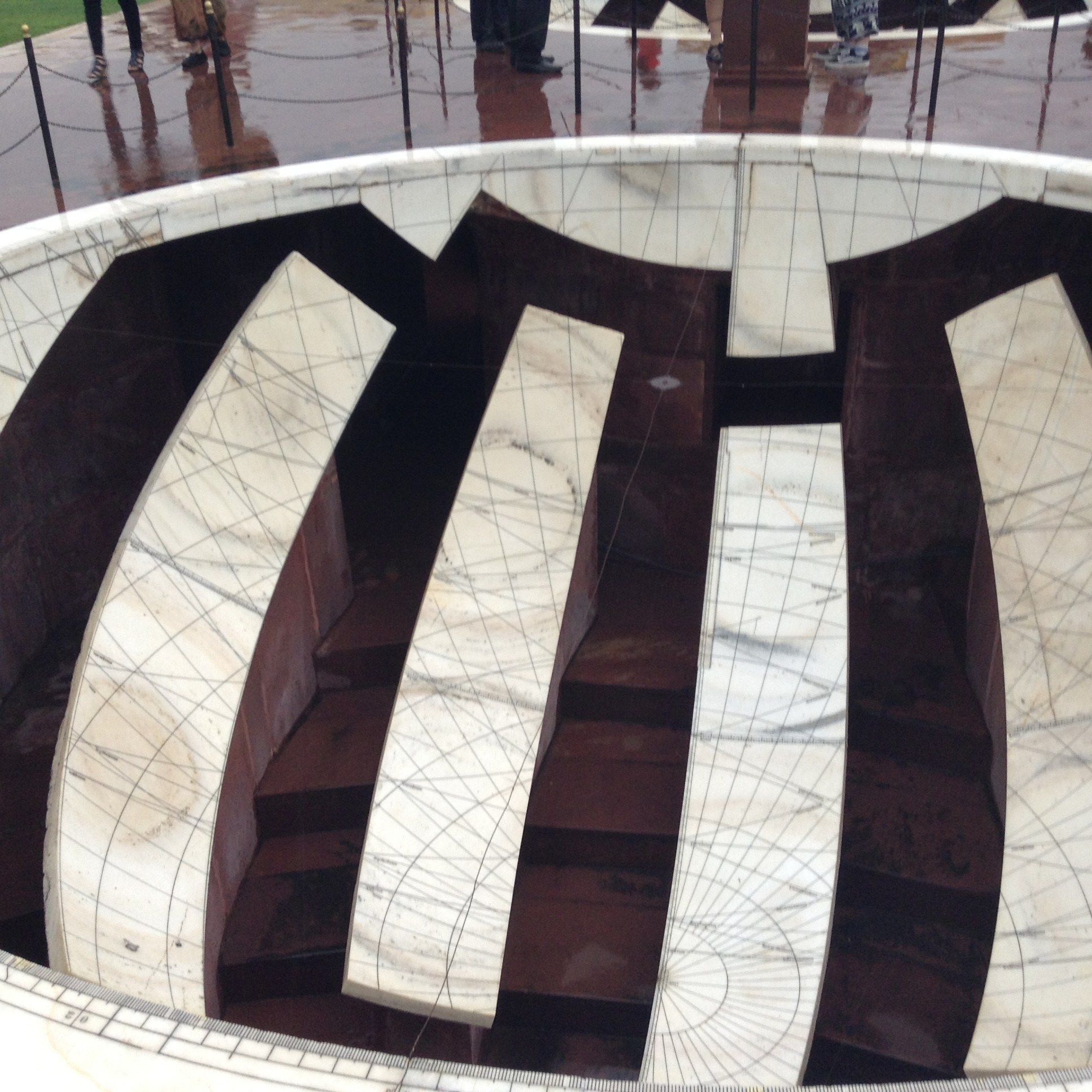
At first glance, the Jantar Mantar is but an open-air park filled with dozens of obscure structures, although once you realise these structures have a purpose its quite incredible to realise you’ve just walked into an enormous observatory, filled with sun-dials and instruments to measure the heavens but on a scale, you can only dream of. Enormous yellow sandstone structures stand high above, measuring the sun and placement of the constellations along the cosmos which is incredible enough before knowing that the observatory was built in 1728 by Jai Singh II. Despite the weather and lack of sun, it was still completely worth the visit wandering around the curved stone dials and impressive concave star map near the centre, in squelching sandals and resembling something not too far fetched to a drowned rat.

Inner Courtyard of the City Palace

Jaipur.

Known as the pink city, thanks to Maharajah Ram Singh’s order to paint it to welcome, the later, King Edward VII in 1876, is a whole other world to step into and should you get the chance; don’t hesitate.

Yes, it comes with its hectic pace, sometimes dangerous traffic and all-consuming atmosphere but it also boasts some of the greatest experiences you can have. Witnessing Fortresses on a scale never seen before, meeting incredible local people that have unforgettable stories to share and wondrous food to try around every corner.

It is truly a place you can’t imagine yourself in until you’re there, in the thrall of the culture and society and people and then you wonder why you didn’t visit sooner.

There’s a reason why they painted the city the colour of hospitality.

To Hannah,

your all days

happy days.

accompanying note to a painting of an elephant in the Jaipur city palace gift shop.
Quote and painting by rayesh 6/8/19

Newness: A cinematic insight into modern love

The hardest thing to do it seems, in film, is to find originality. A new idea. A new vision.

Newness.

When I first started this film, my immediate thought was to wonder why the camera lens brought such a blue hue to the picture. Why was the light dampened in such a way the meant daytime seemed closer to night most often?

Because the night was when the city slept, somewhat, but also signalled a kind of intimacy that only comes between people.

What I liked from the onset was the use of technology and specifically a dating app that allowed anyone and everyone to seek and find the kind of relationship they wanted. Casual. No-strings. Open. In a relationship. Serious.

No fuss. No shuffling around the point. Just simple confidence in the form of technology so it at least broke the, metaphorical, ice of the situation and that the two individuals were on the same page.
Thats what struck me first, was that modern love isn’t anywhere close to the old-film love that we gather from classics such as The Notebook or Love Actually. Instead it’s new, exciting and something that is meant to be explored and not dramatised as something you fall into or out of.

It’s exploring a path you can’t see the end of and following it for the thrill of wondering about the destination.

Thats the impression I got on meeting Martin (Nicholas Hoult) and Gabriella (Laia Costa) in that people can meet this way and its seen as ‘normal’ in the age of phones and social media.

Now with characters, its key to know that only good story telling ends with you questioning either yourself or the characters and deciding whether you unconditionally like their choices or dislike them. The balance is the in-between.

This is what, Director, Drake Doremus and screenplay writer, Ben York Jones, do best. I was thoroughly questioning my own emotions by the time the credits rolled around.

From meeting with a casual hook up in mind, Martin and Gabriella end the night by wanting to know more about the other while wandering past the night lights of LA until the early hours before sleeping together. The intimacy and understanding between these two characters is rare since vulnerability with strangers is hard to act in an age of anonymity and caution.

Then what is harder, still, to understand is the feelings associated with the beginnings of a relationship; one which neither character expected, let alone wanted, but end up wanting as the excitement of more time together beckons and breakfast dates turn into dinner dates and soon its double dates with, already married, friends and meeting parents who expose certain hard truths and secrets that weren’t shared.

The music crescendos at this point and makes you feel as though you aren’t sitting in your living room but instead, are living the lives of the character before you. Every note a moment made, a memory re-lived, a tear cried, a hand held.

This film is in many ways an elegy to modern love because it’s wholly imperfect. Martin: pharmacist by day, dark and melancholy soul by night. Gabriella: physical therapist’s assistant by day, lonely heart seeking a need to be needed by night. The pair are perfect for each other in many ways as Doremus helps us discover by their physical need and emotional necessity to be together, but in other ways shows the flaws, such as their lack of wanting commitment in the age of exploration and want to adventure into new ways to be together since, from the onset, both adults cannot stand the idea of conformity or routine.

I need constant Newness.”

This need for newness is one I believe is within all of us. A hunger for more than what the everyday has to offer and a desire to be different in a world that is trying so hard to make us all the same. This is what this cinematic masterpiece looks into throughout the tensions of new relationships, beginning online to ending when adventure and curiosity goes too far. When Polyamory isn’t seen as a long term solution to finding newness anymore because in reality we all just want someone, one person, to see us differently from the rest. To be in the middle of the street in the middle of a world filled with other you’s that differ only slightly and say “I choose you. I see you. I accept you for who you are.”

The use of blue also seems to highlight the coldness of daylight in exposing the truths of life. The truth that Gabriella doesn’t want to see other people anymore or the Martin wished he’d opened up earlier about his past with his ex-wife and his mothers’ illness. Truths that can only be exposed with time rather than words.

Sometimes it takes falling apart into other people for you to realise that you miss the original person you shared things with. And, it also takes a gentle nudge from observing friends and family to see your own shortcomings in the long term before you unlock the door and see the person you know you can’t live without, in a world that somehow keeps you apart for a while.

Newness‘, is in one word, enrapturing.

It enlightened me to see that love is so much more nowadays than it was or is perceived in films. I know that these aren’t realistic and mostly we realise that in the back of our minds, but once or twice the thought of idealised love is one we long for. Instead we are given works of art such as ‘Newness‘ in depicting what can only be the real love we see today.

No flowers. No large musical numbers. No shouted confessions on doorsteps or rain kisses.

Just two people, in a brick walled apartment in LA on a sunny morning crying and apologising for pushing the other away before hugging and realising that this isn’t someone they want to leave their side.

Ever.

Prague

“Prague changes like a precious stone to reflect the weather, the time of day and the season of the year. “

– Christian norberg-shulz

The summer I visited Prague was one I’ll commit to memory for the rest of my life.

Despite being there for only a few days it was enough to make me realise that this city was one I wanted to visit again and again just to be able to see it in all four of its seasons.

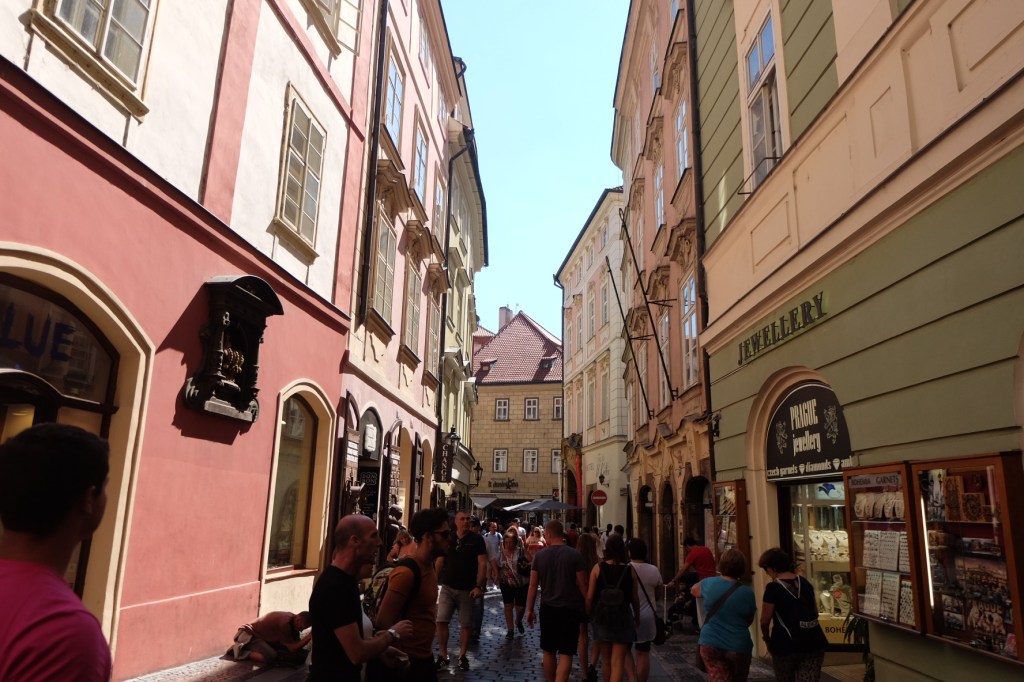
From the wide-laned streets with red-roofed trams gliding away to the narrow, balcony-lined alleys of the Old-Town, Prague is a wondrous mix of old and new that fascinated the beholder with the sheer history and culture packed into those passages.

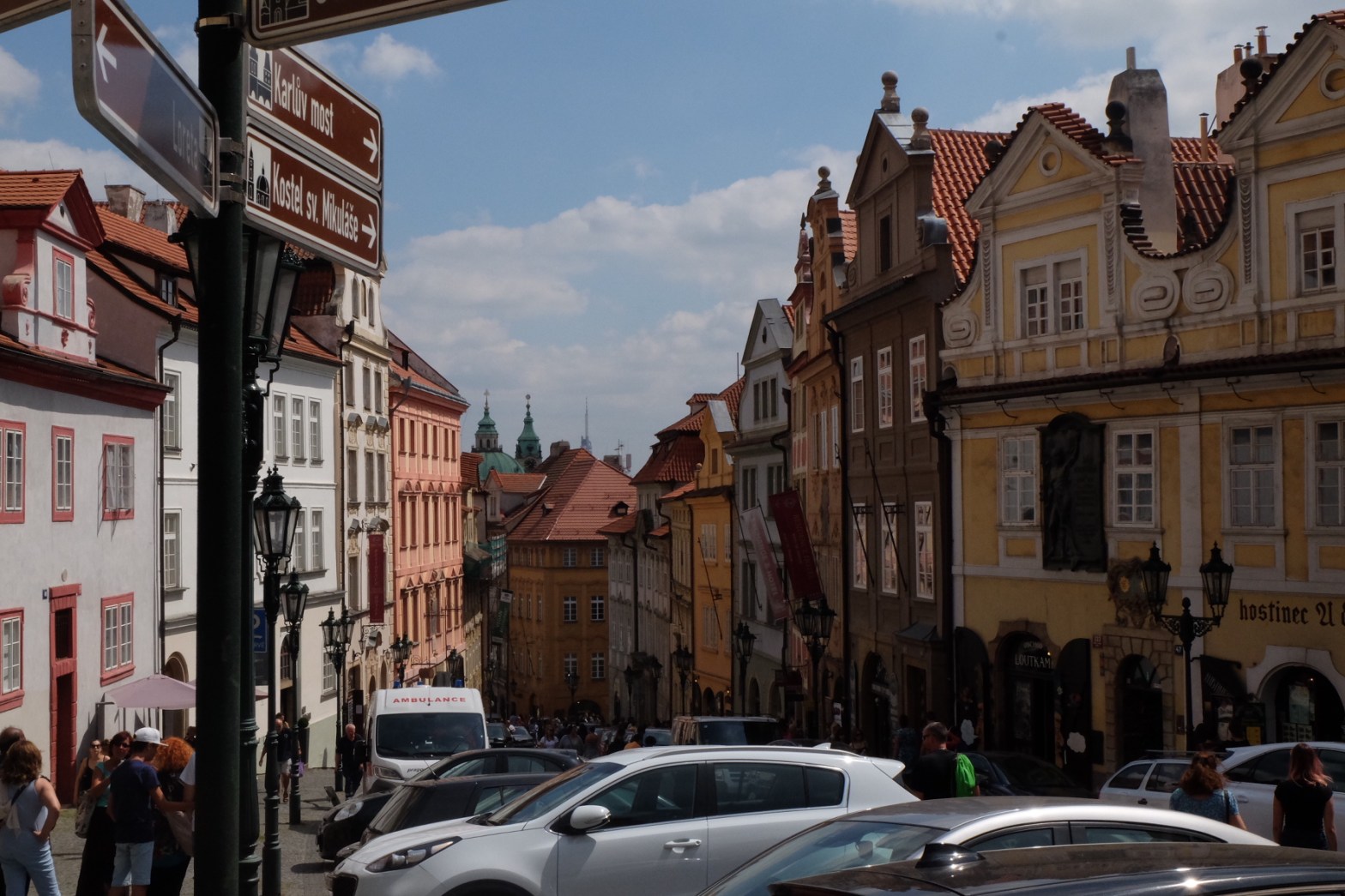
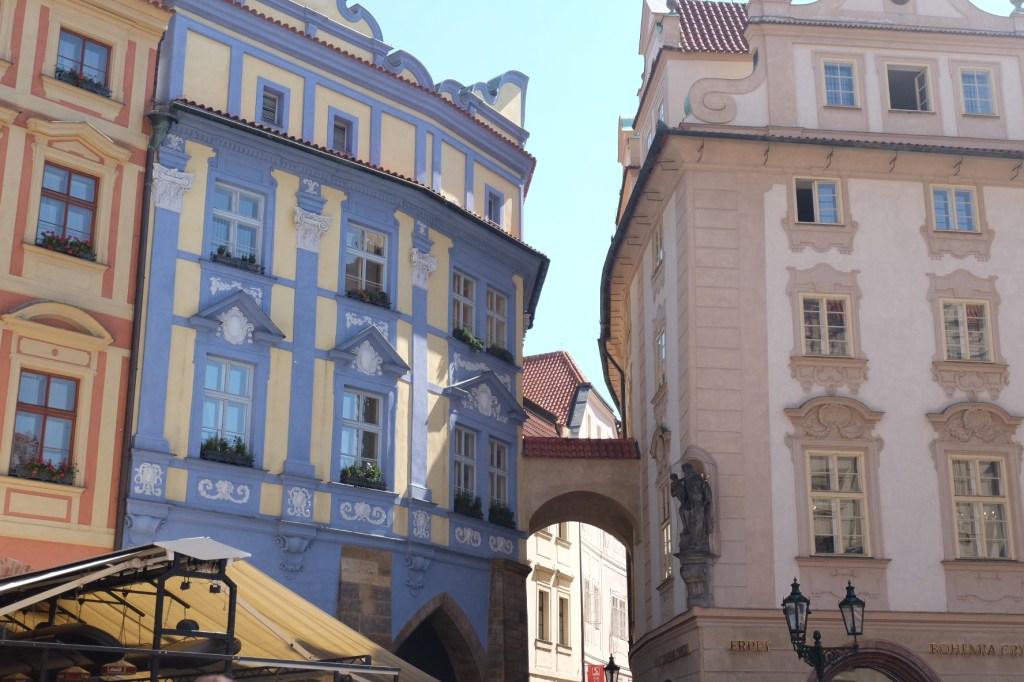
I remember entering the bustling Old-Town where the houses notably change in architecture, from the wide, window-clad office blocks and modern shops to the exposure of wooden beams in the sunshine, carved archways into jewellery shops and incredibly detailed garlands overhanging large French windows looking down onto small plazas where restaurant tables spilled out into the square. On from there, came the slightly grander Prague we see in many-a-picture with its yellow to blue sandstone facades with domed windows sloping up to gleaming earthy-red roofs, that from a bird-eye view would have looked like red poppies dotting a dry-sandy field.

Another thing that surprised me though, as I wandered through the Old-Town into the New was the sheer variety of colours on the buildings. Burgundy sat alongside light green and blue was decorated with pale yellow striped pillars. You’d definitely have reached all the colours of the rainbow and then some by the time you’d reached the banks of the Vltava River in all it’s blue glory; floating restaurants and solar tourist boats dirsupting its flow towards its eventual end in the Elbe.

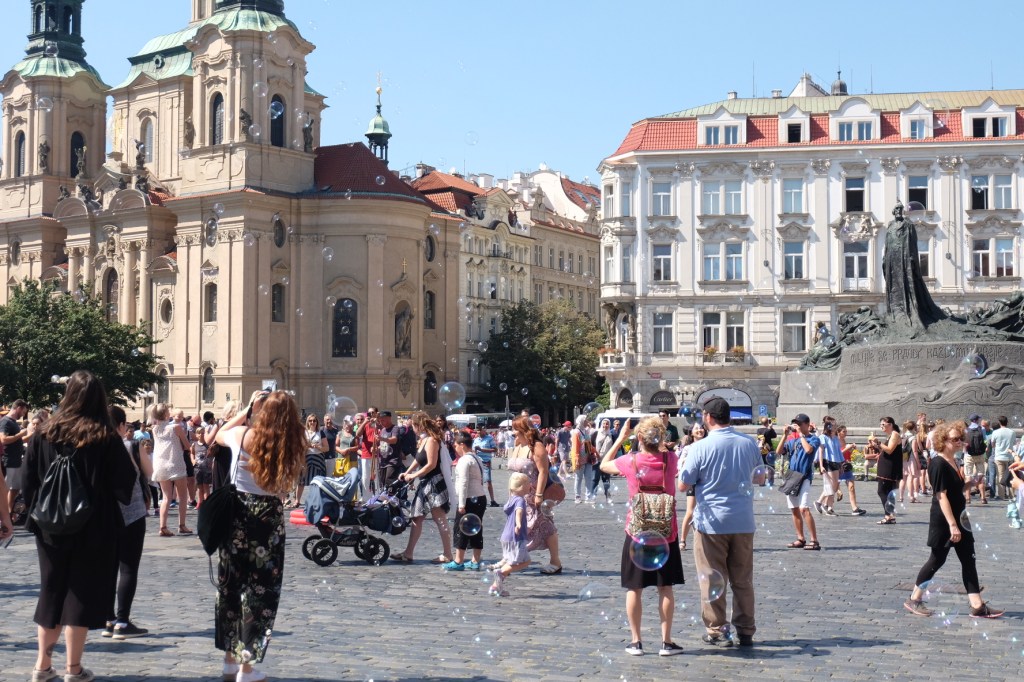
The Old Town square was a sight to behold as I adjusted my sunglasses against the glare of the sun on the paved stones and held tightly to the stick of fried, spiralized Potato I’d bought with the other; this didn’t make taking pictures any easier.

The narrow street gave way to a large expanse of stone surrounded on all sides by the respective Baroque and Renaissance architectural styles of the town houses and some large museums that border the square, while a man with string and a soapy bucket sent bubbles flying across while children ran after them. From the centre of the square the atmosphere was quite something, since I couldn’t point out a single person not having an good time staring up at the Art Noveau curling spires of the upper building windows, overshadowed by the greatly different sharp and dark spires of Prague’s many churches. Maybe that’s the reason why this place is so special, because the city feels as though it is a culmination of many different eras thrown together with only cobbled streets separating the Habsburg influence from the dark, Gothic 13th century church doors and the modern, large-windowed art galleries from the faulty-beamed old town houses with faded tapestries painted across the whole front facade.
Now I could sit here and talk about art for quite a few hours but the next best thing about Prague was the sheer diversity of the people there while I wandered around.
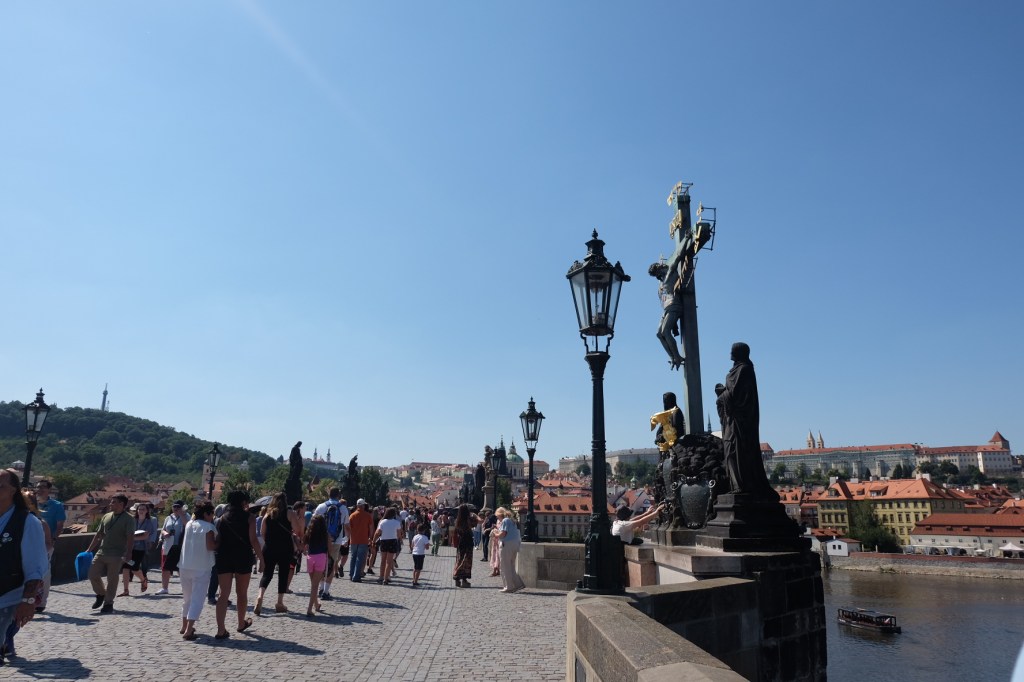
Italian, English, Spanish, French, Polish, Russian, Vietnamese. The languages spoken were endless and all thrown together as a ventured across the impressive Charles Bridge over the Vltava while families stopped to grab pictures and children raced to watch boats pass underneath the arches and emerge in a flurry of red umbrellas and cigarette smoke from the restaurant patrons sat on top deck.

On the Charles Bridge

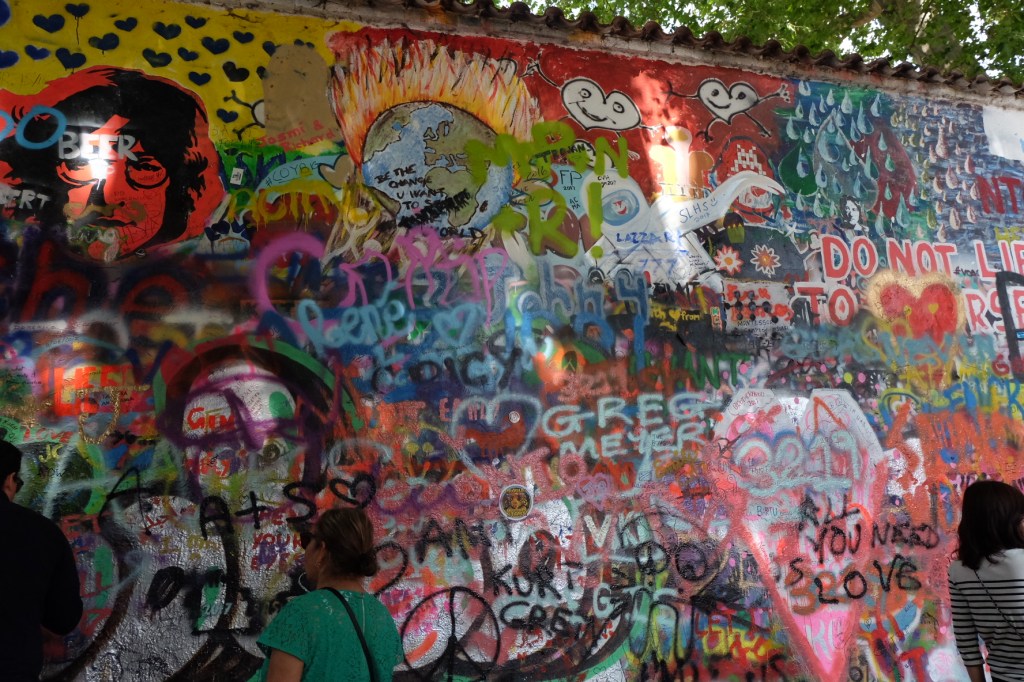
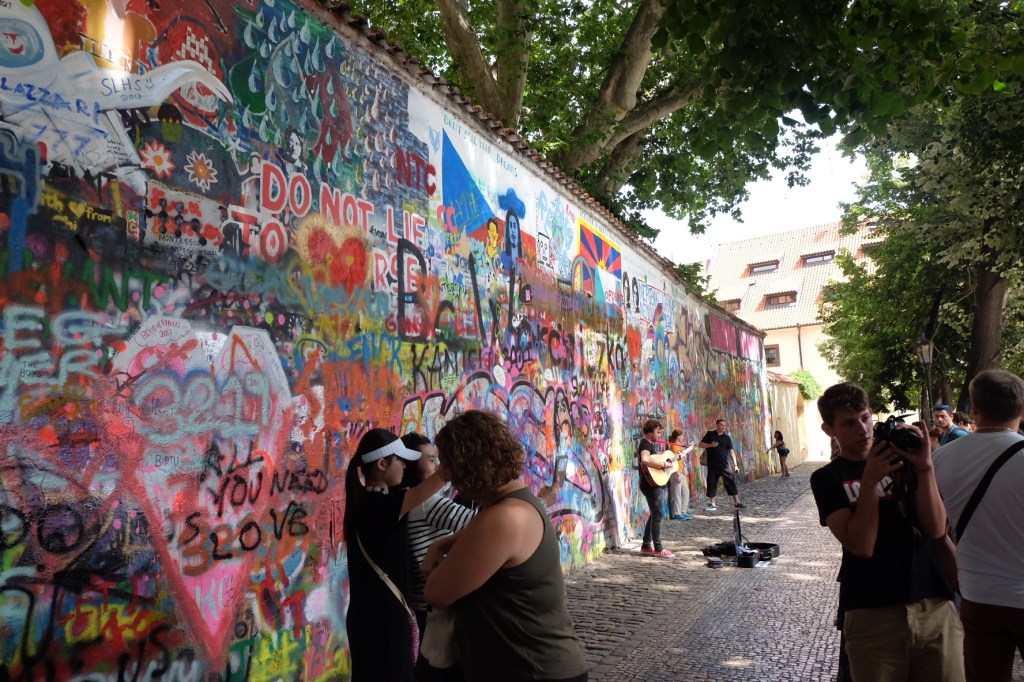
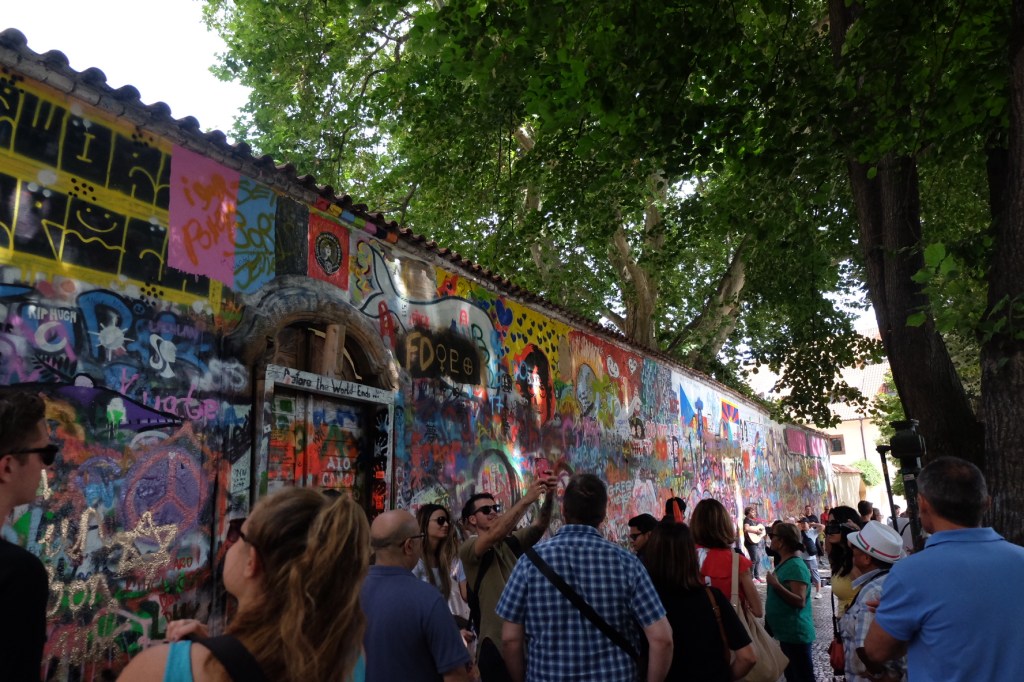
The bridge then gave way to a wider promenade lined with trees, nearby the river, where I then turned right into the first glimpses of the luscious green Petřín Gardens (Petřínské sady) which leads upwards towards a beautiful view of the Old Town side of Prague and beyond. Instead though, I headed back the way I had come towards, what was perhaps my favourite unconventional monument in Prague: the John Lennon Wall.

This wall, having been inspired by John Lennon and the works of the Beatles, has become an unmissable attraction on a tour of Prague. The expanse of stone in covered from head to toe in artwork, quotes, paintings or simply words written by locals and travellers alike since its origin. Sitting in a small square just opposite the French Embassy, the wall first displayed John Lennon in 1988 as a symbol of western culture, freedom and political struggle. Since then it has changed drastically over the years into a mass of colour and life and beauty all bound together representing freedom, life, culture and music of a styles in a way to express creative freedom for everyone.

And to think it all started with one unknown artist creating an image of John Lennon with a few lyrics painted beside was all it needed to start an art revolution.

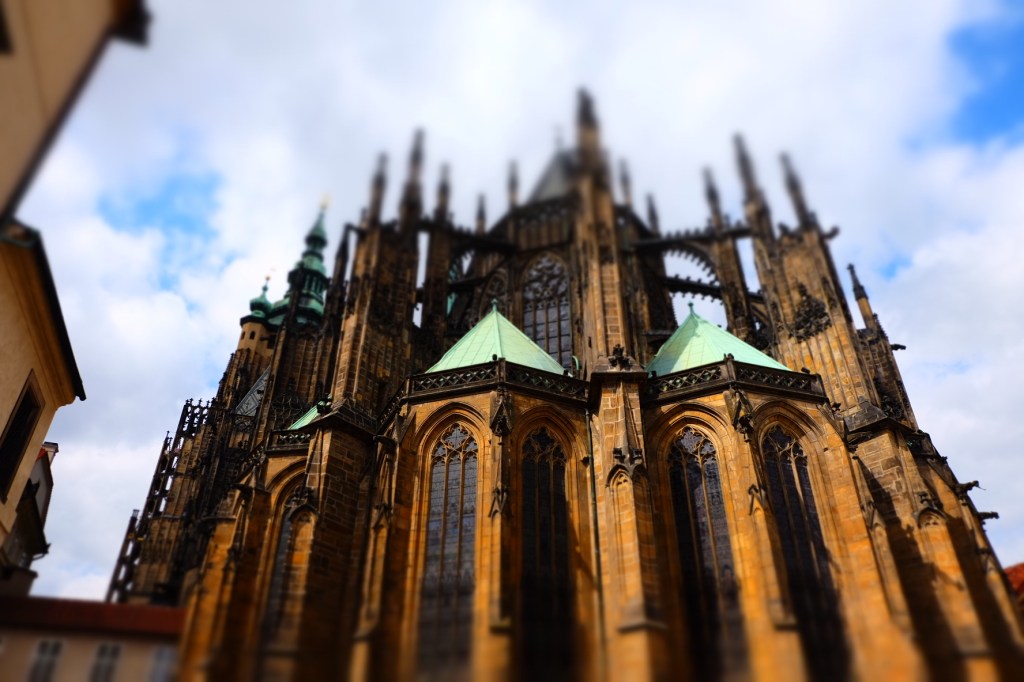
Onto Prague Castle, after a walk up a cobbled street and into the wide open courtyard in which stands another incredible Czech landmark: the St. Vitus Cathedral. This Cathedral (the most important in the country) is home to the tombs of Bohemian Kings and Holy Roman Emperors while showing off its incredible sharp, dark and tall, gothic exterior which stretches high above the plainer sandy-walled castle buildings.

St. Vitus Cathedral

While heading back out the castle entry-way, the view over Prague is one that takes whatever breath you have, away. You can see the large curving Vltava River winding away into the distance, cut-through by Prague’s many bridges and boats while the church spires and multi-coloured houses of the Old and New Towns shine at you from across the water, is a view that is still in my mind now, years later.

View of the Charles Bridge

Prague is a city of different time periods that somehow work in harmony to create a place that emanates both a rich history but also a prosperous future. There are both dark, graffiti’d corners, wide-modern tram roads, new busses, imposing museum structures and old crumbling wooden houses but together it’s something you’ll never grow tired of seeing.

So see it as much as you can with your own eyes.

Because beauty may be in the eye of the beholder, but Prague is beautiful no matter whose eyes you see it through.

Venice

“Venice never quite seems real, but rather an ornate film set suspended on the water.”

-Frida Giannini

Often, the first perception people grasp of this city is that its cliché.

It’s too predictable to visit here or its so tourist-y that there won’t be much left that’s original. So they, ironically, decide to visit places such as Florence or Rome instead.

Mistake, numero uno.

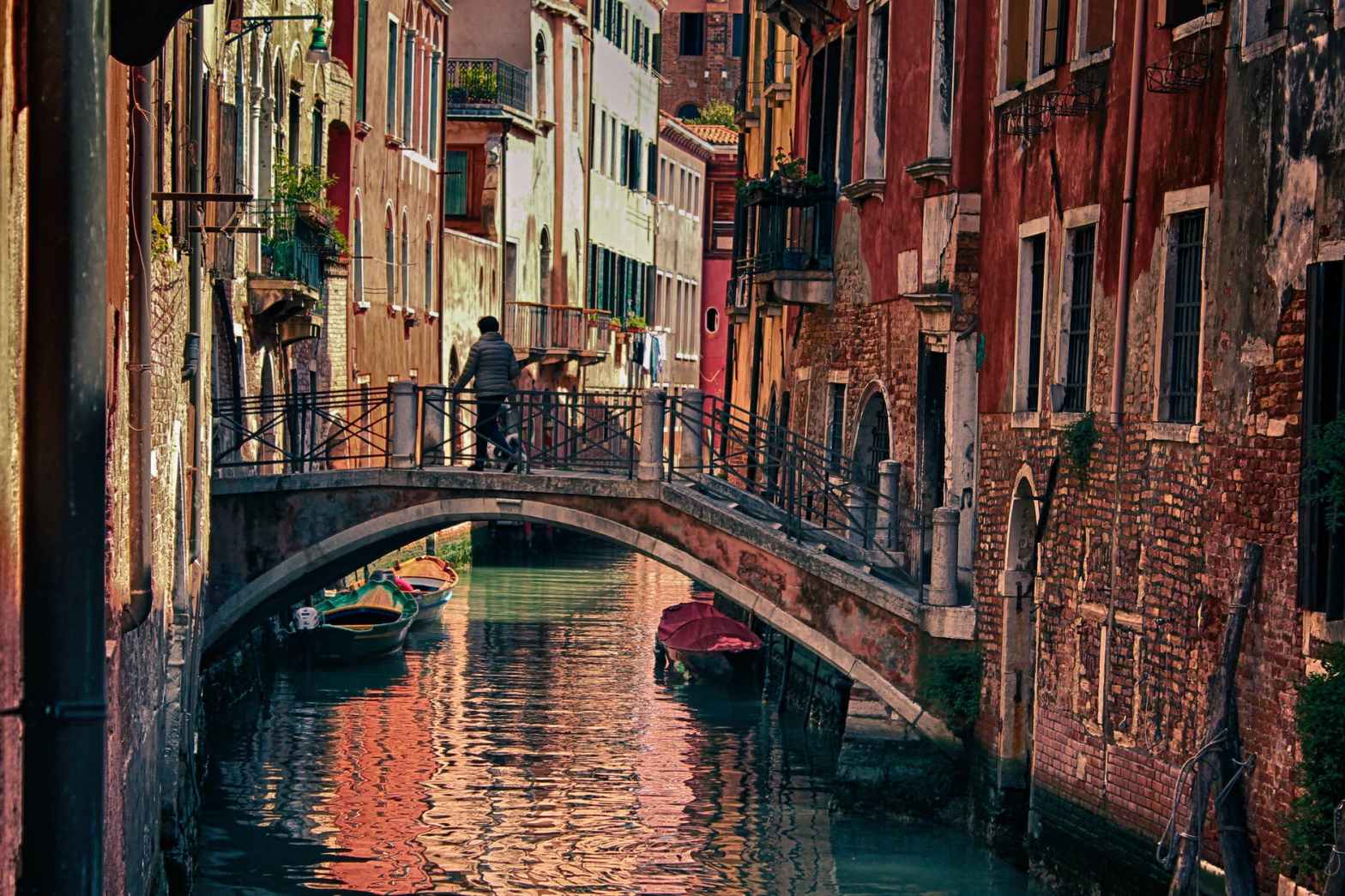
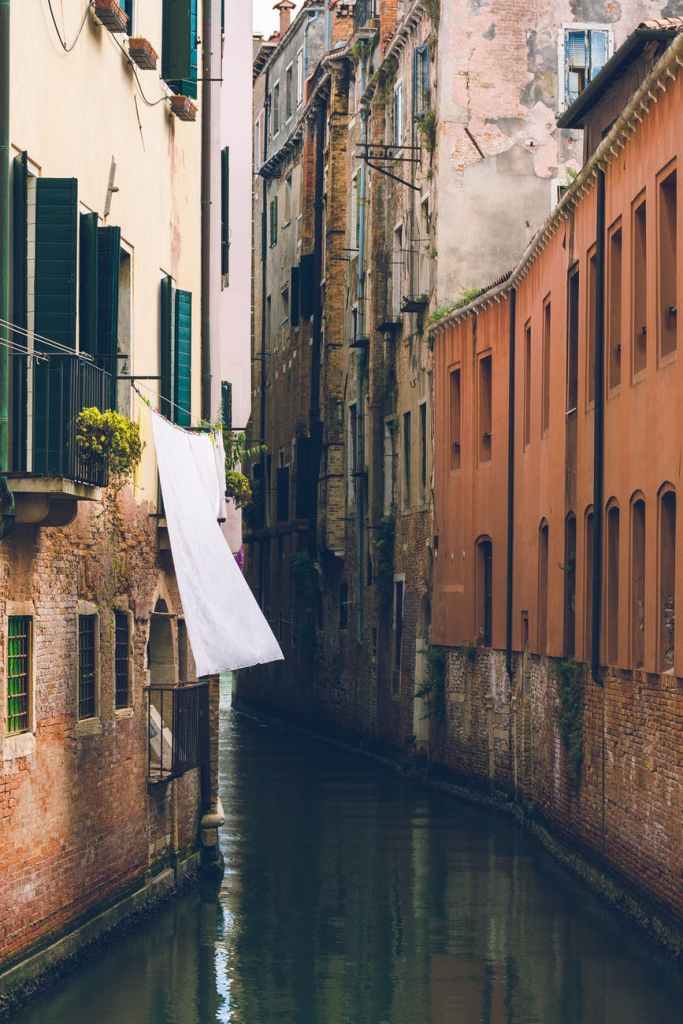
My experience of Venice is one of colour, wonder, incredible people and tastes unlike anywhere else. It is one of awe and incredulity at the beautiful back passageways bordering the canal edges, doorways jutting out into caramel coloured waters where all manner of boats are moored to disnitegrating wooden stakes just waiting to carry their passengers to their everyday errands.

Although, the image you may now have conjured probably includes the likes of the Grand Canal, sleek black Gondolas shining in the summer sun and the nearby splash and chatter of the fountains in the squares you pass by.

This isn’t too far from the truth, except I was blessed with the chance to witness Venice in a thunderstorm. A true, black-skied, rain-soaked, lighting streaked, thunderstorm.

And I wouldn’t have had it any other way.

On arrival in one of the high speed ferries that made it’s way into the mouth of the Grand Canal from Croatia, the sky let out a tremendous clap of thunder as if signalling our arrival to the world. Once on the gangway, you could begin to notice the stillness of the water as the wind was sucked away and replaced with the beginning of a torrential downpour that left me soaking in minutes, all the way through my clothes.

Now I’m not a huge fan of storms or strong weather events, but this was exciting. The initial nervousness about walking around while lightning flashed uncomfortably close was soon washed away as I stood in the pouring rain taking in the sight before me.

The charcoal grey sky above contrasted so greatly with the brightly sandy white and red buildings bordering the edges of the Grand Canal along with the spikes of church spires, which were distantly available to the keen eye, that it became almost comparable to a vivid watercolour painting rather than the violent uproar the sky threw out every few minutes.

On beginning the walk around the city (this still being the height of August) I realised that the only long-sleeved clothing I had brought with me was my hoodie which soon weighed me down and did nothing to quell the downpour or un-dampen my hair. Soon after, I gave up the notion that I was going to stay dry and just stood under one of the many crisp, red, awnings sheltering local cafe-goers, who seemed completely unphased by the weather as evidenced by their expressionless content while they sipped on espressos. The image itself was so lovely that, in the thin hope that the weather would brighten, we sat ourselves into said cafe inside by the open window and ordered hot Venetian Ciocolatta which resembles a hot chocolate but rather than having a milky quality, more closely resembles a small cup of pure melted chocolate.

There are few things better on earth than one of these.

Later it was on to the Piazza San Marco, but this was easier said than done. It is easy enough to see the huge domed towers of the Basilica di San Marco in all their beautiful, pale glory, especially when the sky above helps this to conjure some monchromatic old photo of the domes towering high into a black sky. You’d almost begin to wonder if they’d accidentally get struck by the lightning that still, seamlessly, split the sky in two.

While using a partially soaking, yet brightly coloured, tourist map I set off through many winding roads passing all manner of people. Tourists with brightly coloured hats and mournful voices complaining of the weather; couples queuing outside Gelato stands that were piled high with flavoures from Straciatella to Bubblegum; older locals with tanned, leathery skin using newspapers to shield themselved from the downpour; local shop owners standing underneath awnings that covered the smaller streets from above at odd angles, so as to lure a false sense of safety until a splash or stream of water falling off the end of a brightly coloured pole would land down your neck.

It was such a busy atmosphere, yet the rain numbed the effect of it on the people passing me by. At this point I was thoroughly soaked through and decided it was in my best interests to not catch a cold.

The smaller, winding side streets which were overshadowed by three-to-four storey housing blocks of dusty red and sandy yellow soon opened into a variety of small squares where you might glimpse the odd leafy tree or marble-clad fountain spurting up clear water. In a square such as this I stopped. Fully just stopped to admire the small iron-railing terraces that jutted out into the larger open space, see the colours of clothes left to dry on balconies now thoroughly soaked through and the flashes of lightning glinting off the cobbles. In this square I purchased a cheap umbrella from a tourist stand that sold t-shirts with the slogan ‘I heart Venice’ plastered over them in block letters and sighed at finally having relief from the torrent.

Photo by Philip Ackermann on Pexels.com

At last we arrived on the Piazza San Marco to witness the crowds dispersing, leaving the square somewhat empty in contrast to the crowds it would have drawn on a sunny day. It was truly breathtaking finally seeing the complex, frontal facade of the Basilica di San Marco in all it’s gold leafed and yellow frescoed glory. From the smaller to the larger marbel columns that caught the suddenly emerging sunlight, it practically shone as I stared upwards towards the top of the adjoining belltower (the Campanile) remembering seeing it once I’d first got off the boat, towering high into the dark grey sky. The tendrils and spikes curling high into the sky below the domed heads of the Basilica were so intricate that if you tried, they’d surely snap off with one poke, while the four rearing horses, decorating the top balcony, looked as though they could leap off at a moments notice.

What was even better though was that I was stood, staring at the entire square around me while under an umbrella (which now that I think back was quite dangerous considering the lightning) and I could see that the flooded floor of the vast square created a mirrored effect as though there was two Basilica‘s, only one was upside down. The tourists, like me, stood agape at the scene before us, while the locals stopped briefly before going about their business. This wasn’t a scene many took for granted, no matter how many times a day you saw it.

Many side streets and small, stepped marble and stone bridges later, we reached the infamous Rialto Bridge with its pale stone arch and paler green arched covering. The view of the bustling Gondolas with royal blue covers along with the odd sleek uncovered one leaving the cluster to collect umbrella-clad customers from the opposite bank, gave a sense that this was where the everyday took place. This was a place that was meant to be busy. A place that flowed with activity as much as the water flowed though the bridges archways to all other side canals and underwater systems.

Then, just along from this we encountered a steady stream of tourist shops, jewellers with glistening items lining the windows and bookshops.

Upon entering one such bookshop I realised it was also a place that sold notebooks, pens and paper, all of which were made in Venice. The shop was the kind with low ceilings and paper everywhere with pens piled into neat pots all of which sported brightly coloured covers in all patterns. I ended up leaving with a beautifully bound notebook and an ornate blue and white pen that gave it’s colour from the paper, the main body of the pen, was wrapped in. I still treasure this pen, many years later.

Venice is a place of art, of beauty in the everyday wanderings of the city and in the people that live and work there. There is also something unique that you can only find when walking the cobbles streets and bridge-ended corners where a lone saxophonist plays jazz. Something transformative that feels as though you’ve crossed over into another world entirely.

A world that, while being beautiful, artsy and interesting is also a world that balances on a cliff’s edge – or more fittingly, a wooden beam structure that will be completely be underwater someday.

So before it’s too late.

Attraversare.

– cross over.

To Be Away

Disclaimer: this post was written whilst listening to a playlist of the same title.

“I don’t even remember the season. I just remember walking between them and feeling for the first time that I belonged somewhere.”

– stephen chbosky – The perks of being a wallflower.

As we enter a New Year and, what I’d consider, a new era of culture, music and style of living, we question ourselves again. What is it to truly escape and FEEL?

The feeling of being alive. Of throwing your arms up and shouting meaningless words to the breeze or jumping into freezing ocean water after a sunset.

Maybe its finishing a book or starting one. Or listening to music that matches your mood so perfectly that you start to dance down a street without a care if anyone sees you.

That’s the kind of feeling I’m gasping to find in the new year.

Throughout lockdown, quarantine and a general shut-down of world movement, I’ve found a stagnancy I never wanted to experience. The kind where you find yourself doing meaningless tasks, sat for hours on end in front of the TV or discovering that a lack of motivation is a frustrating as walking all the way to the Post Office with 5 large parcels and finding that it closed 15 minutes ago.

So I’ve vowed to keep searching for the feeling of “being away” more and more as January 1st approached. Realising more than ever that I want to dream as well as live in the moment when some extraordinary experience happens along.

It could be listening to some film score music while sat on a mountaintop with the wind all around, pondering the meaning of life or running full tilt down a mossy hill with the exhilaration that at any moment you could slip.

It could be walking through the streets of a small Bavarian town with colourful shuttered houses surrounding you with the sounds and smells of the bakeries opening for the morning or hugging someone after being apart for a long time.

Whatever gives you the sense of “being away”; it’s a feeling that’s worth chasing.

It’s knowing you are in a unique moment that won’t ever come again but you know that you’ll hold onto the feeling of being inside it long after it’s over until you can find it again somewhere else.

In short: To be away: (wanting to go back to those moments).

Away from reality, from melancholy, from pain and from responsibility.

This doesn’t mean that these things don’t exist. However, it helps to emphasise how incredible the feeling of being away truly is, in balance to the negatives of life.

Being awake before everyone else, to wake up to the sunrise.

Being the first off of a plane.

Being stood in the middle of a bustling crowd and simply standing still and observing.

It’s taking a moment to “be away” from everything going on in life to appreciate the feeling and emotion that is possible to feel in one moment.

I hope you find moments like that as we enter 2021.

Wherever you are, no matter how overwhelming everything feels.

Escapism is a beautiful thing.