Disclaimer: this post was written whilst listening to a playlist of the same title.
“I don’t even remember the season. I just remember walking between them and feeling for the first time that I belonged somewhere.”
– stephen chbosky – The perks of being a wallflower.
As we enter a New Year and, what I’d consider, a new era of culture, music and style of living, we question ourselves again. What is it to truly escape and FEEL?
The feeling of being alive. Of throwing your arms up and shouting meaningless words to the breeze or jumping into freezing ocean water after a sunset.
Maybe its finishing a book or starting one. Or listening to music that matches your mood so perfectly that you start to dance down a street without a care if anyone sees you.
That’s the kind of feeling I’m gasping to find in the new year.
Throughout lockdown, quarantine and a general shut-down of world movement, I’ve found a stagnancy I never wanted to experience. The kind where you find yourself doing meaningless tasks, sat for hours on end in front of the TV or discovering that a lack of motivation is a frustrating as walking all the way to the Post Office with 5 large parcels and finding that it closed 15 minutes ago.
So I’ve vowed to keep searching for the feeling of “being away” more and more as January 1st approached. Realising more than ever that I want to dream as well as live in the moment when some extraordinary experience happens along.
It could be listening to some film score music while sat on a mountaintop with the wind all around, pondering the meaning of life or running full tilt down a mossy hill with the exhilaration that at any moment you could slip.
It could be walking through the streets of a small Bavarian town with colourful shuttered houses surrounding you with the sounds and smells of the bakeries opening for the morning or hugging someone after being apart for a long time.
Whatever gives you the sense of “being away”; it’s a feeling that’s worth chasing.
It’s knowing you are in a unique moment that won’t ever come again but you know that you’ll hold onto the feeling of being inside it long after it’s over until you can find it again somewhere else.
In short: To be away: (wanting to go back to those moments).
Away from reality, from melancholy, from pain and from responsibility.
This doesn’t mean that these things don’t exist. However, it helps to emphasise how incredible the feeling of being away truly is, in balance to the negatives of life.
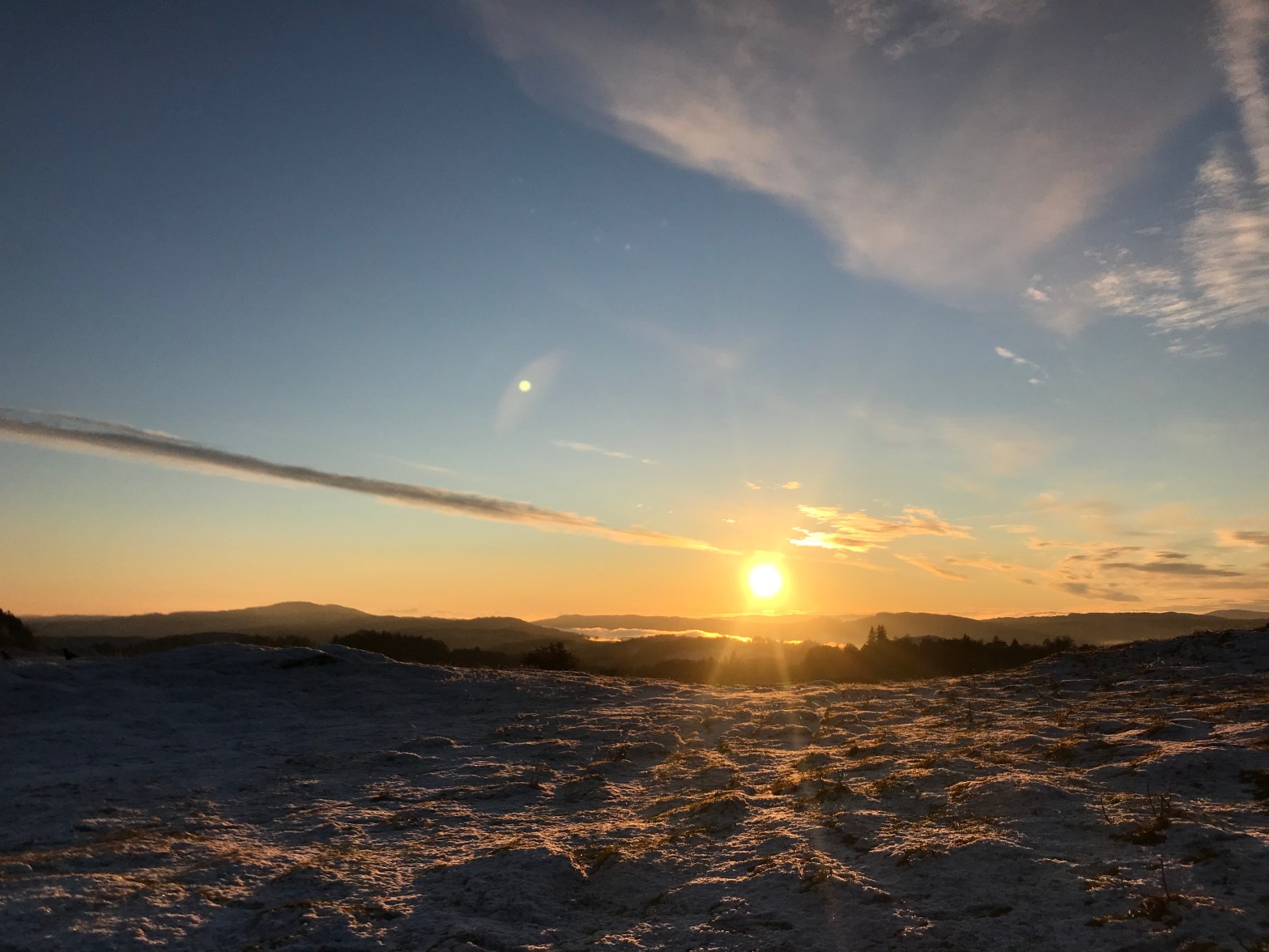
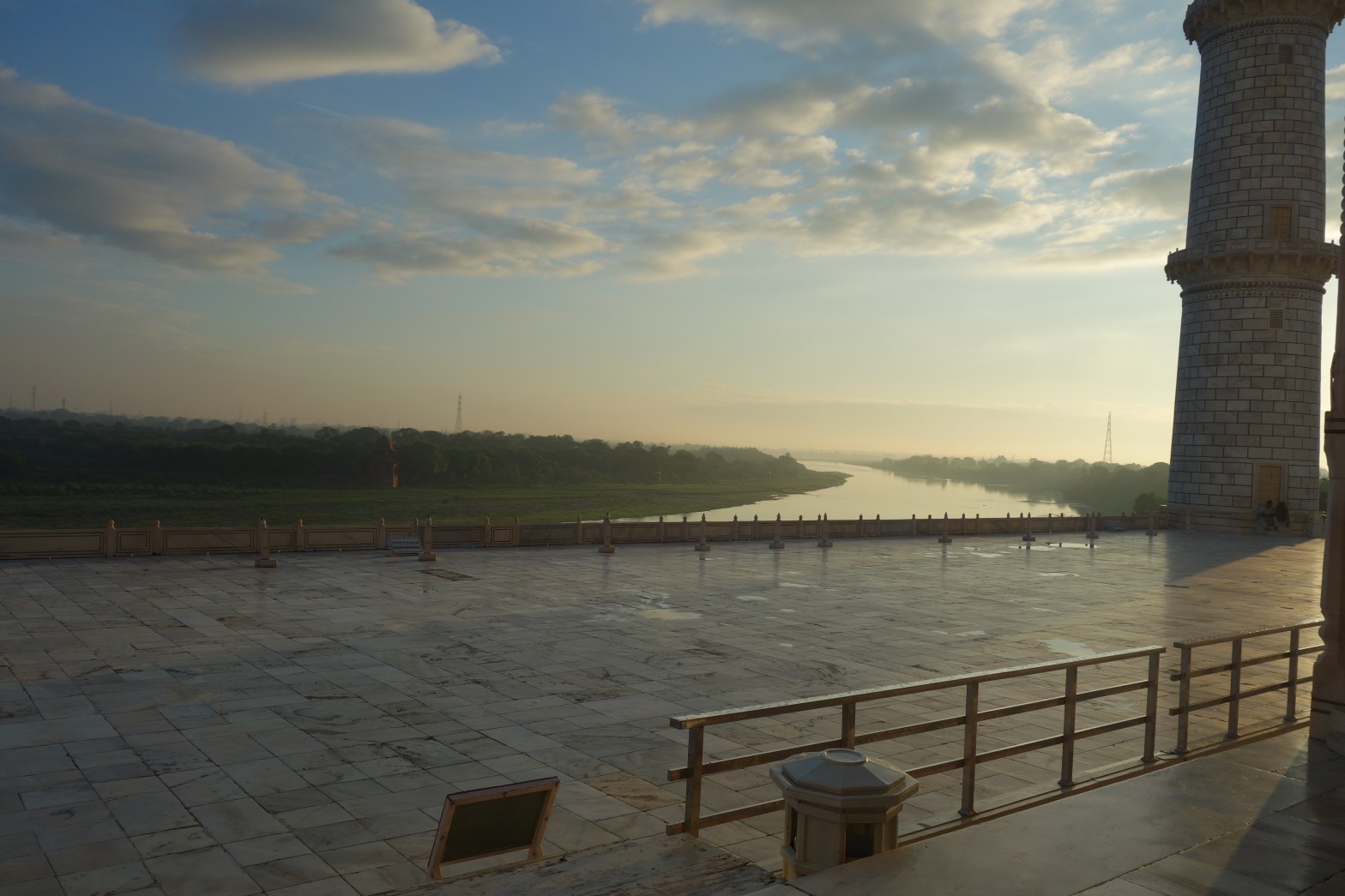
Being awake before everyone else, to wake up to the sunrise.
Being the first off of a plane.
Being stood in the middle of a bustling crowd and simply standing still and observing.
It’s taking a moment to “be away” from everything going on in life to appreciate the feeling and emotion that is possible to feel in one moment.
I hope you find moments like that as we enter 2021.
Wherever you are, no matter how overwhelming everything feels.
“Time spent in India has an extraordinary effect on one. It acts as a barrier that makes the rest of the world seem unreal.”
– Tahir shah
Leh is somewhere you may not know exists if you only focus on the famous names of places around the world. But this makes it no less notable and incredible a destination to visit.
This city, or district as it is sometimes categorised, is the largest in the region of Ladakh, India; home of mountain climbers and culture seekers alike. It is surrounded on all sides by the stunning but dizzyingly tall north-Indian Himalayas which you soon realise are much taller than you think when you find that Leh sits at an altitude of 3500m already. Flying into Leh is another experience entirely, though. Mountains, snowcapped and spikey spread out in all directions, interspersed with glaciers and wide sandy valleys; although until you witness the green oasis of Leh below you, you won’t see any sign of civilisation for miles around.
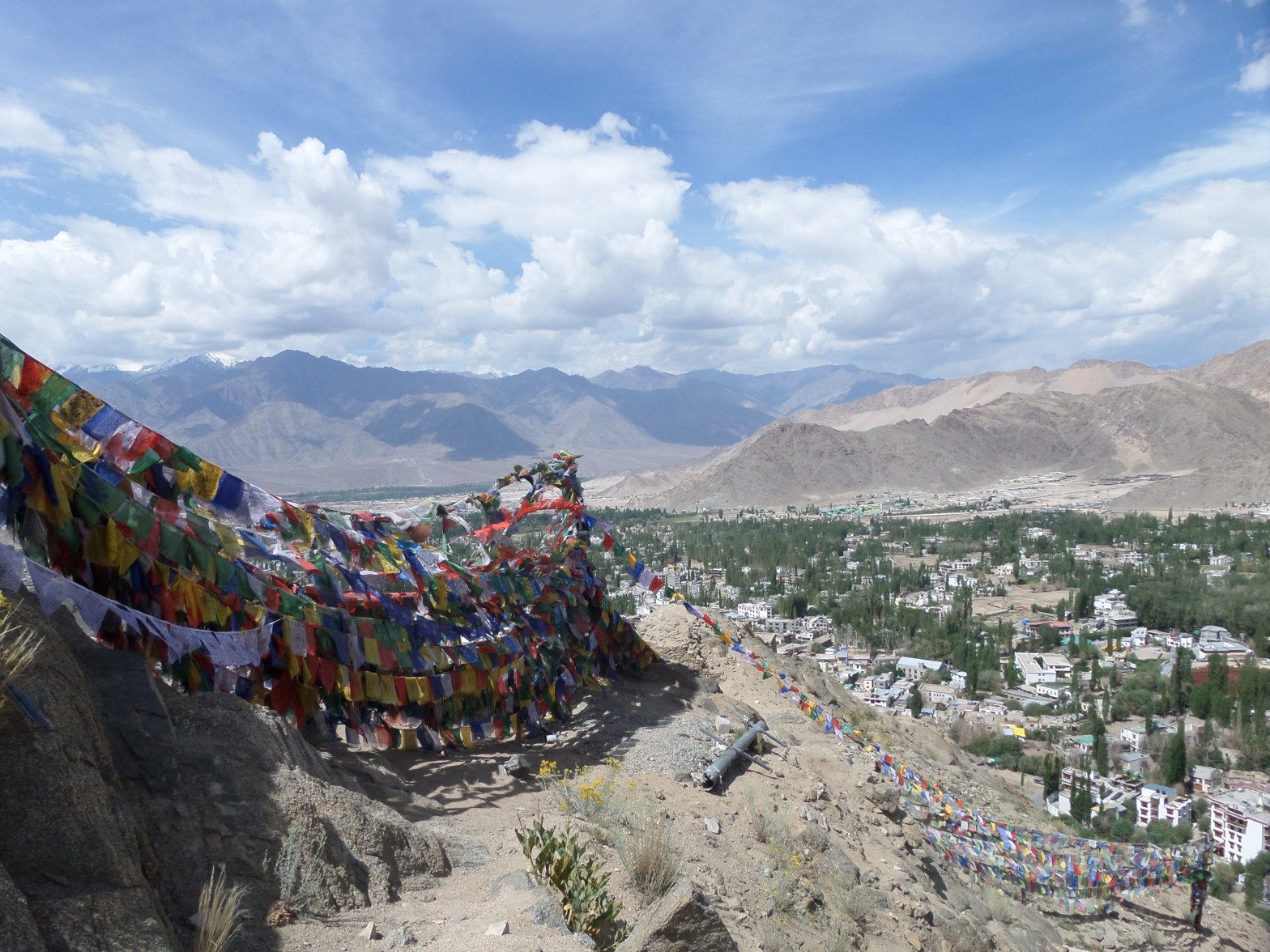
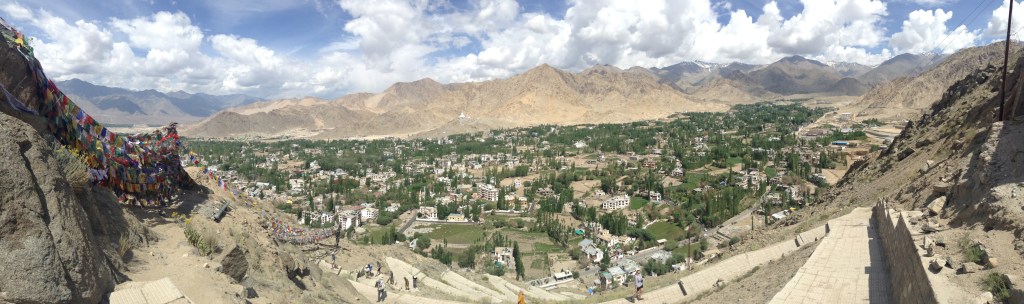
LEH FROM THE SHANTI STUPA
From touchdown on the small airstrip on the valley floor to arrival through the doors of the miniature airport, after filling out visa and details on a small slip of paper in pencil; it’s out the door to greet the first taste of the Ladakhi experience. Small taxis.
India is famous for many things, including the infamous tuk-tuks you may have seen in that one ‘Best Exotic Marigold Hotel‘ film that you may have stumbled onto on TV. These taxis felt similar except they had windows, doors and roof racks that precariously balanced our luggage and were bound only by fraying bungee chords so each twist and turn on the dusty road, we journeyed along, was as exciting as looking out the small windows and seeing bright green trees, bushes and sandy white houses flying past.
It’s the little things here, such as less attention to the regulations we are so enshrined by in western-world lives, the amount of animals roaming free and the friendly calls of “Jule” (joo-ley) welcoming you to this beautiful city that imitates a lush, green Eden in contrast to the surrounding barreness of the mountainsides and river-cut valleys.
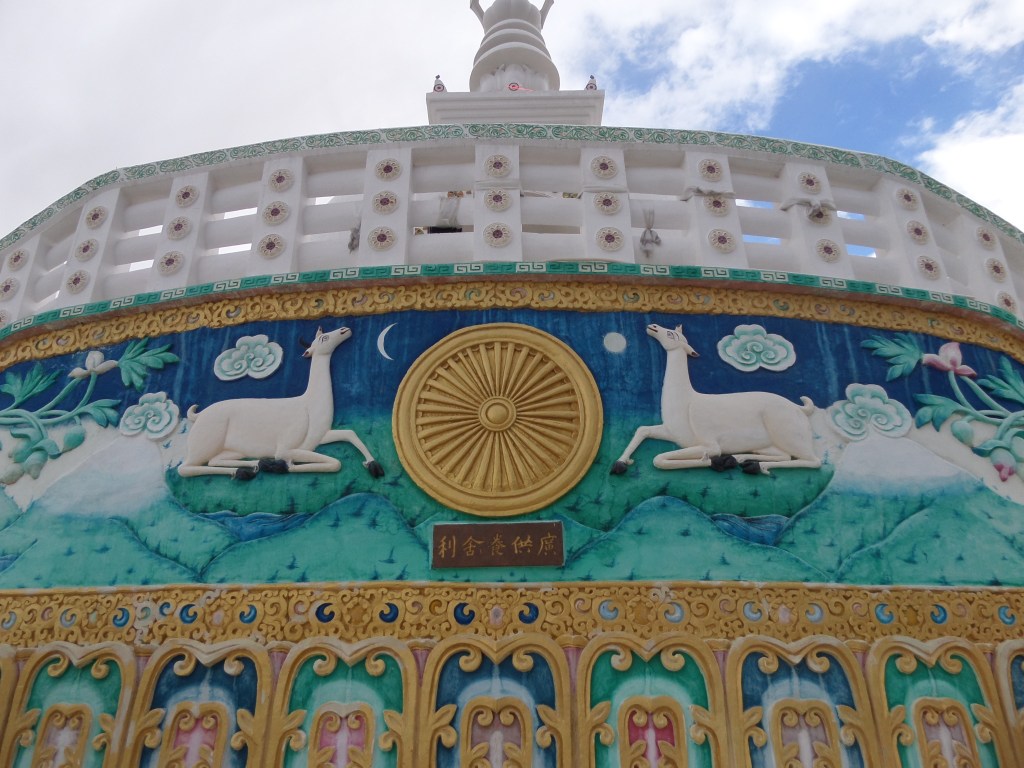
Whitewashed Stupa’s connected by colourful strings of prayer flags share spiritual messages into the mountain breeze as you huff and puff you’re way up the many stone steps to the Stupa’s colourful sides. On arrival you then fully begin to appreciate the view from the top and the sense of completeness you feel walking clockwise around the whitewashed, domed feature with adjoining Gompa (Tibetan Buddhist monastery) and rocky outcrop leading up the jagged mountaintop a few hundered metres up.
Leh is unlike anything you’ve seen before.
As many larger Stupa’s can sit high above the city and offer the best views, especially if you’re willing to get up before sunrise, you start to realise just what life is like in this remote city.
THE BASE OF THE SHANTI STUPA
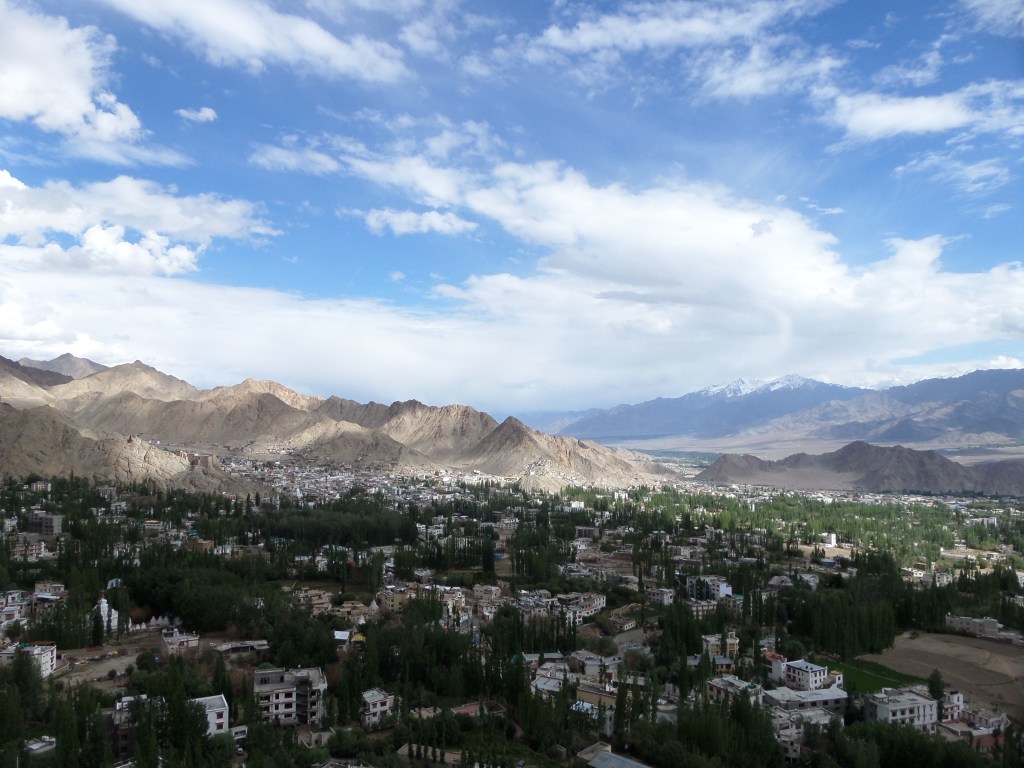
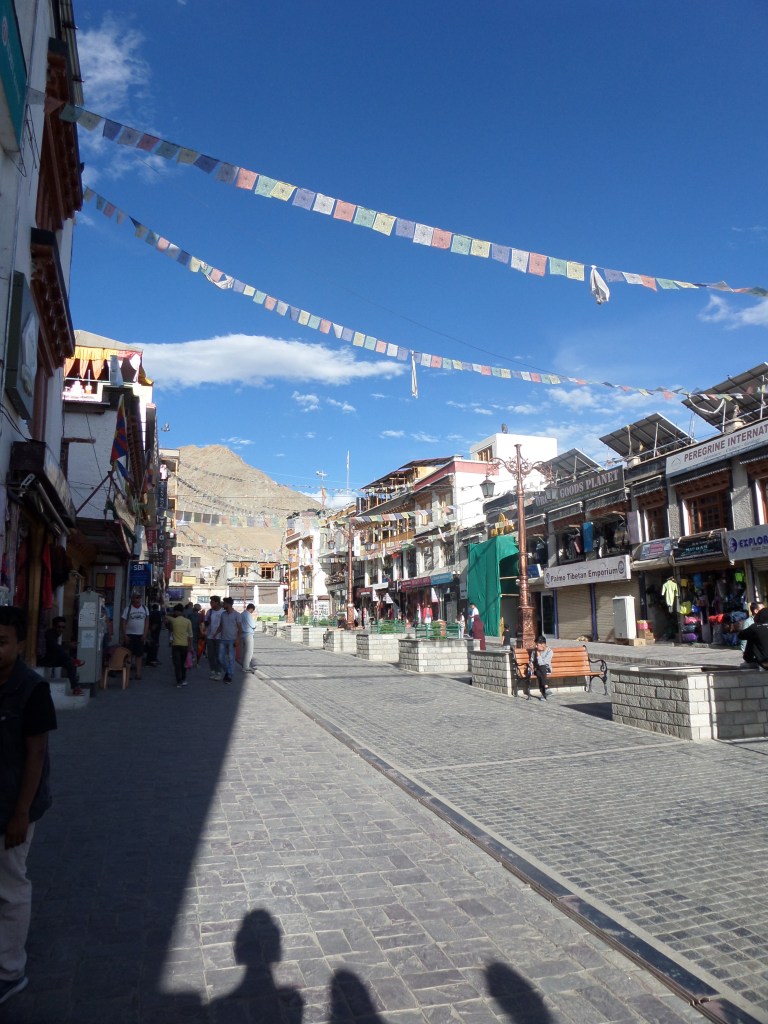
Sandy, crumbling, white houses and buildings lie dotted in-between green trees and shrubbery while water canals direct the river through the city to cleverly irrigate the many barley fields while the distant trundle of taxis, trucks and vans transport goods too and from the markets in the central pedestrian area and the army base located further north of the city. Once you’re adjusted to the altitude here and you find breathing easier, a walk along the streets of Leh reveals shops with all types of clothing, from Kashmir scarves, trinket souvenirs and prayer flag vendors to expert walking shops selling brands from North Face to Berghaus. Buying fresh fruit is a given in Leh if you have a minute to spare looking at the colourful building frontages, rooftop restaurants and people sitting on pavements offering everything from shoe repairs to Henna art.
Around most corners or in front of hotels or guest-houses you’ll find prayer wheels which, when spun clockwise, promise good-luck mantras as you wander the pathways next to the blue-white glacial river that, despite the summer heat, remains as cold as ice.
LEH CENTRAL BAZAAR
Visiting Leh in the summer is the ideal time since the tourist season only lasts from mid-July to early September and most toursits come for the chance to climb the Himalayas that stay snow covered year-round but are only traversable in August.
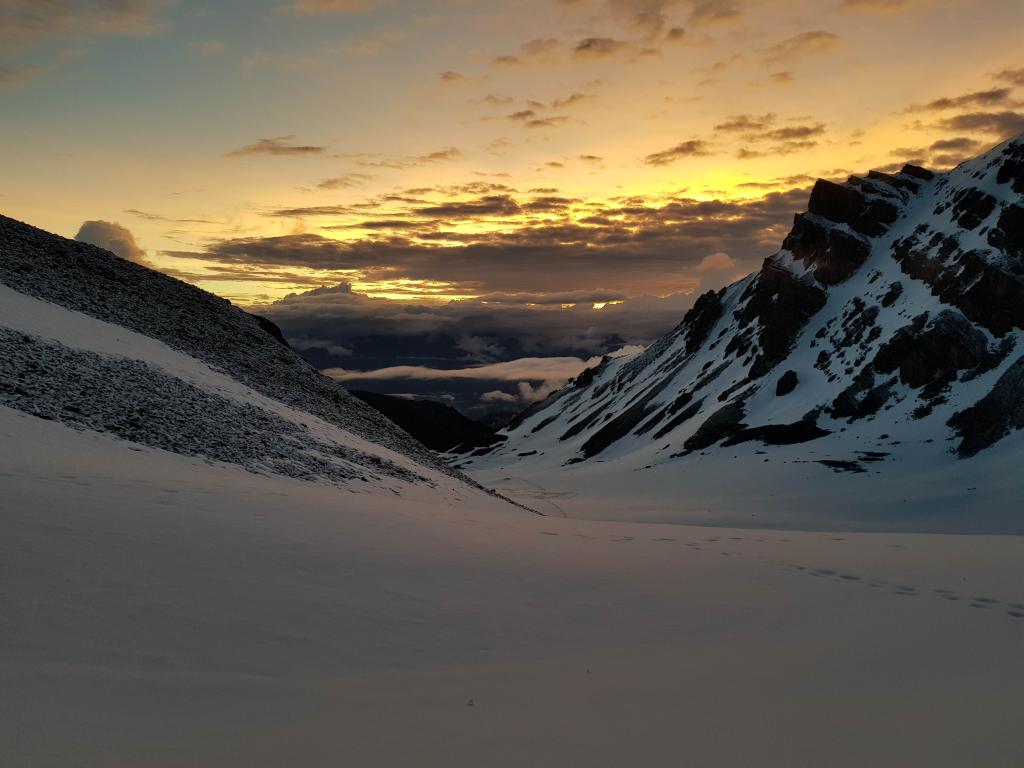
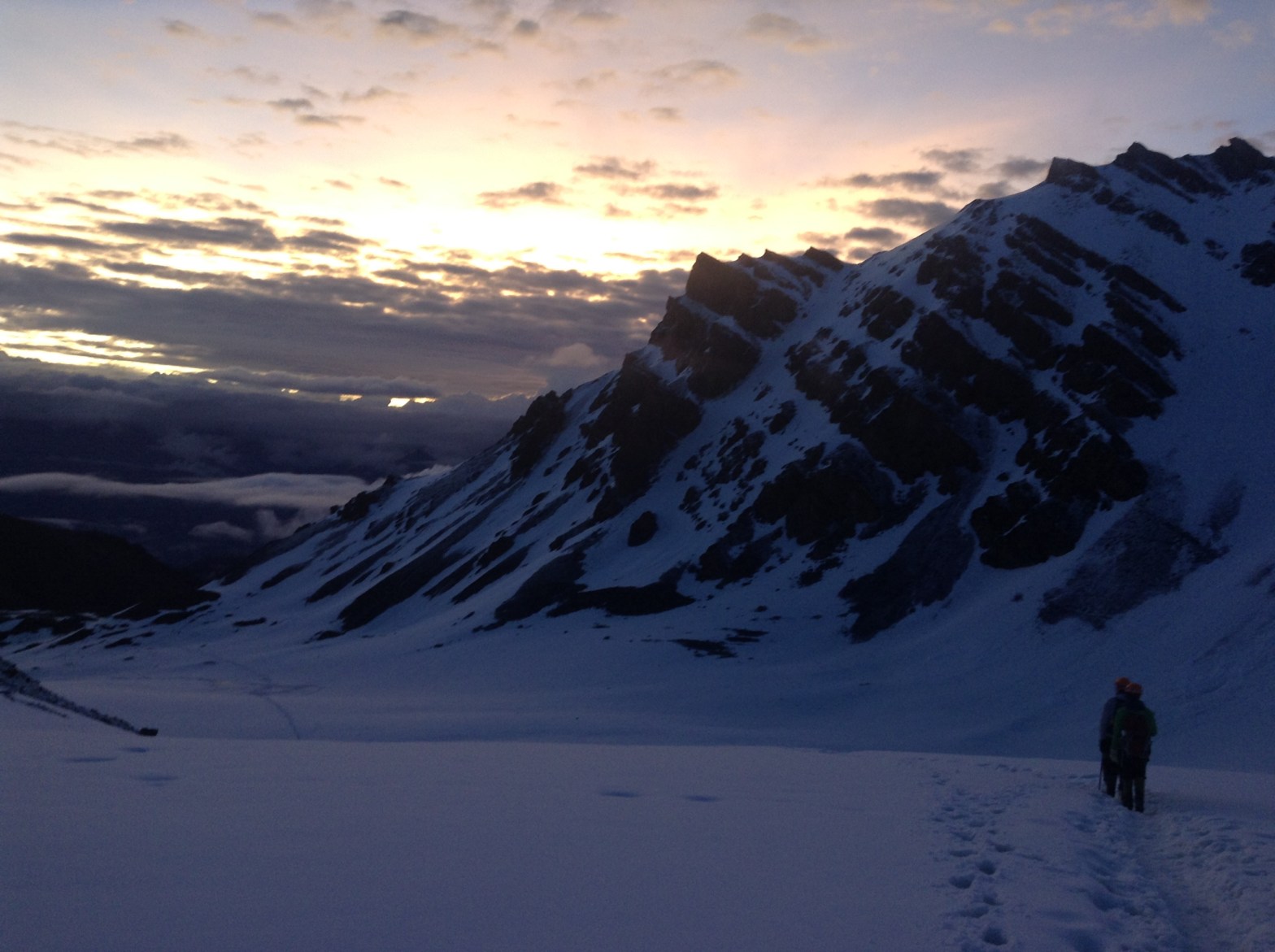
The greatest feeling in the world, from my experience, is being 5000m up on a mountainside and being able to create snow angels in mid-August. It feels so incredibly bizarre but you relish it because you may never get that chance again.
SUNRISE ON THE PATH UP STOK KANGRI (6153m)
One of the best parts of the city, I find, is people-watching.
While sitting on a small table outside an ‘English Bakery” selling traditional Ladakhi chai sweet tea and croissants, you can see men on their way to work on their street stalls, selling prayer flags, candles, miniature singing bowls to tourists or heading to the Tibetan refugee market you can find beautiful stones on chord necklaces or earrings for sale, displayed on colourful cloth tables. You can see bare-footed Europeans and Americans on the search for breakfast after a night out, guitars strung over their shoulders and arms covered in Henna, drawn by women sat on the street a few yards away as you hear all manner of languages: French, Spanish, Italian, German. You might see an older, friendly American couple that ends up joining you for breakfast where you learn their life story and their dream to travel Ladakh by motorbike, since they’re so easy to hire in Leh and motorbike tours are very popular along the twisted mountain roads.
You might even see cows walking by your table as they are considered holy animals and cannot be touched or owned, so they run free, hooves clacking on the cracked tarmac.
Whether you’re an early or a late sleeper, the 5am call to prayer is worth waking up to (a minority of India’s population are Muslim), followed by a sunrise walk up the famous Shanti Stupa to walk around it barefoot before heading into the central pedestrian area of the city to send postcards from the post-office and buy fresh oranges for later in the day when the tempature varies at a comfortable 30 degrees with cooler evenings and nights in the summer.
Food is another reason why Leh is such as incredible place. Local specialities such as chai sweet tea (masala chai) are common alongside the more commercialised tandoori pizza places and European-style restraunts.
Besides food, the people are one of the best things about Leh. Ladakhi people speak their own language which differs a lot from traditional Tibetan and Hindi but is nonetheless friendly when their word “Jule” stands for “hello”, “thank you”, and “goodbye”. Shop owners, especially if you are a tourist, will call out to you as you walk by their shops offering goods and clothes which can be haggled for if you’re willing while children wave and tell you “hello”! if you pass by a school playground. Ladakhi’s are also famous for their ecological lifestyles as they redirect glacial rivers to irrigate crops, save water by having long-drop toilets which help to recycle human waste into compost and provide eco-friendly laundry services.
VIEW OF LEH FROM THE LEH PALACE AND MONASTERY.
There a many reasons to love Leh. From the incredible landscape it sits in, to the local people and the mindset people have when visiting: live sustainably to keep the landscape clean and beautiful, since Leh was untouched by western-consumerism, let alone foreign visitors until the early 1970’s.
This mountain oasis is truly one of the most incredible places I have ever visited as it gives you the perfect sense of escapism once you arrive. People live in a completely different way to the western lifestyle that some are used to, with less worries about the menial things in life and more focus on the spiritual, making sure to retain the cultural and keep alive the magic that the Himalayas, Stupas, along with the Gompas and prayer wheels give to any lucky visitor.
It feels surreal once you arrive and leaves you yearning to return when you depart.
If we were meant to stay in one place, we’d have roots instead of feet.
– Anon
Physically, I’m sat at home in fluffy socks and a large jumper.
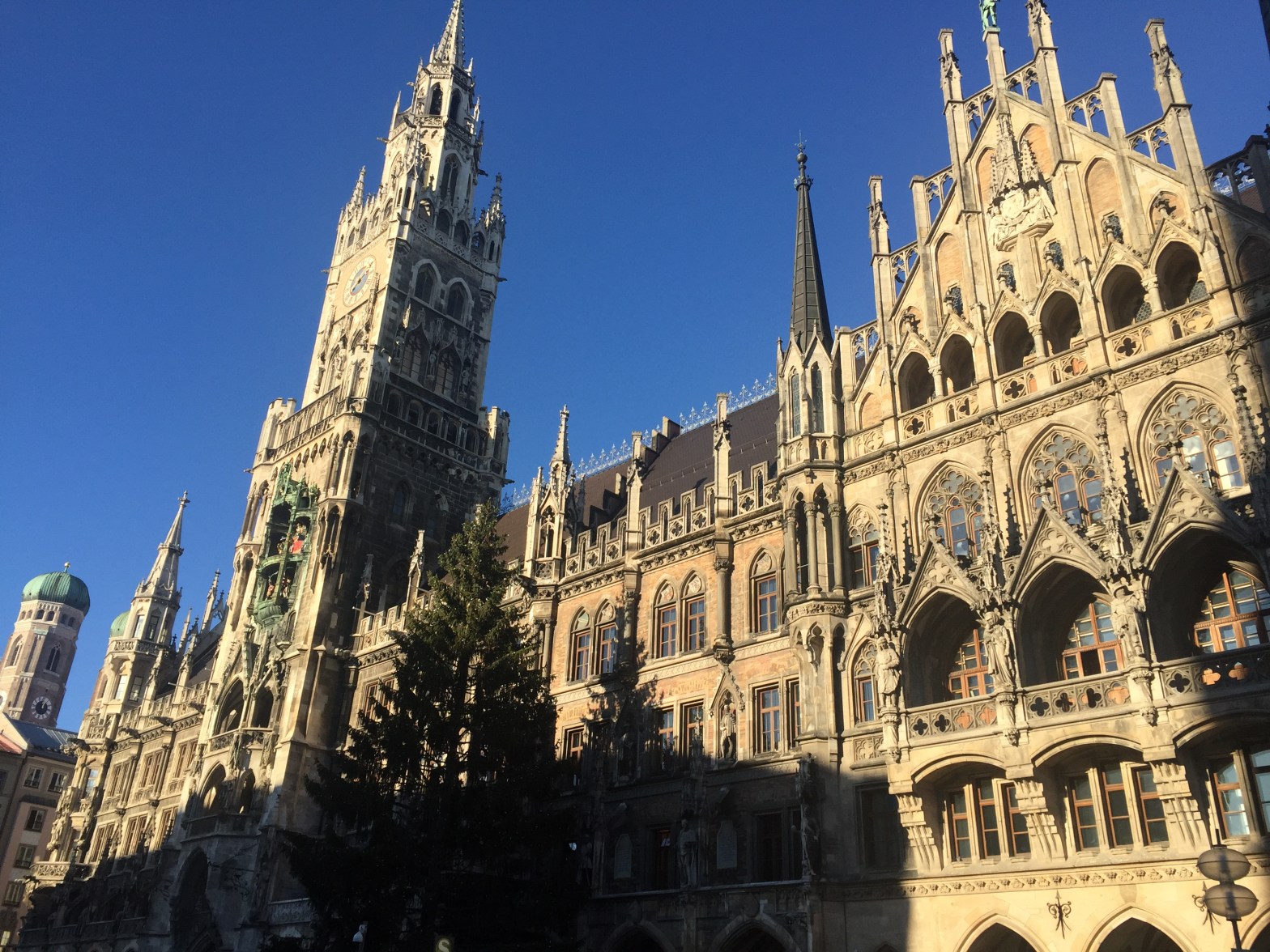
Mentally, I’m stood in the bustling central Munich streets, listening to the chimes of the Rathaus Clocktower in the large open-spaced Marienplatz and looking out for the nearest place to buy a pretzel or a Radler; depending on the time of day.
This city is not one to be ignored.
Sure, if you think of Germany you immediately think of Berlin, or maybe Angela Merkel or maybe the pride taken in their recycling systems or sustainable energy solutions. Maybe you think of some other places such as those with famously foodie names such as Hamburg or Frankfurt, or go for Dresden or Cologne that have more historical significance.
For me, I think of Munich. Bavaria’s Capital.
This city is one of culture and brightness all year round with an endless supply of stunning architecture, beautiful greenery and a plethora of museums that just keep coming.
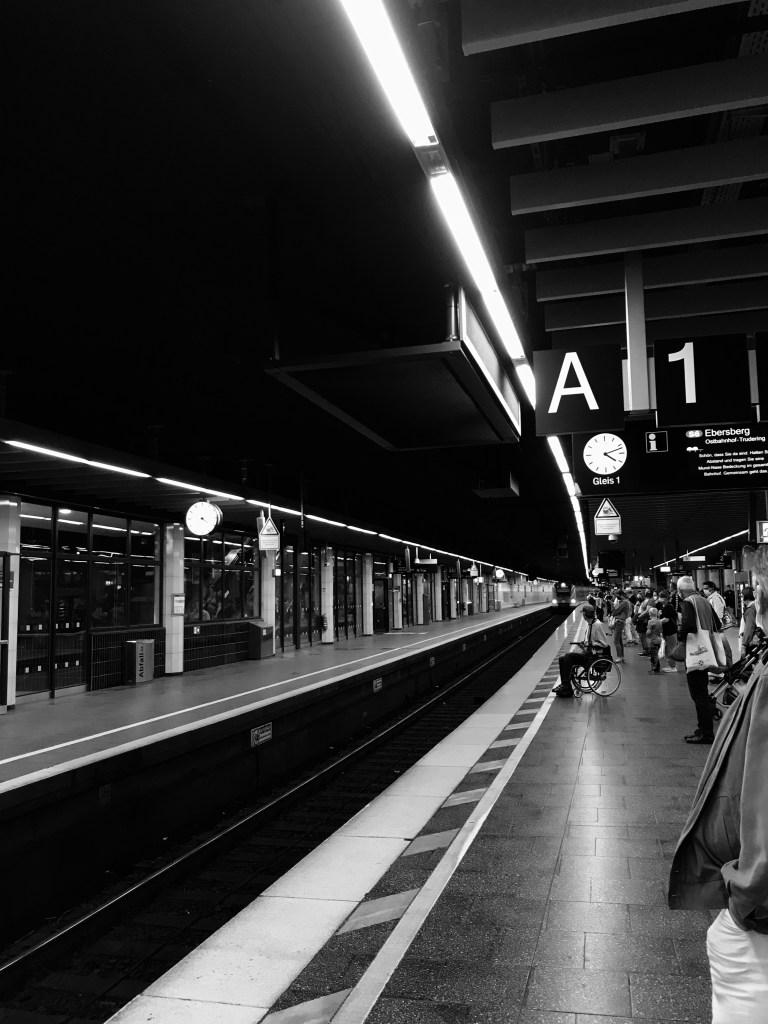
From the very outskirts and farmed fields an hour’s drive from the Austrian Alps comes the ease of travel you find with the S-Bahn that takes roughly 20 minutes to get onto the very central line of the Munich Underground. With a day ticket to all zones, you can travel as many times as you want and even venture to the U-Bahn and the older train cars decorated with varnished wood and benches that remind you of the trams of old; all the while whizzing at speed underneath this incredible city and its Isar river.
Once in the centre, you can travel Ost to West, through the Isartor and the Deutsches Museum, housing all manner of artefacts from bi-planes to visible electricity demonstrations, to astrology and a planetarium, to the earliest examples of medical and engineering tools used in Munich’s rich history. Then maybe onto the Marienplatz and the infamous gothic style Rathaus that houses the renowned turning clock figures when the clock sounds at midday or into the side streets to visit the hidden high ceilings of the Peterskirche or the incredible Michaelskirche – the largest renaissance church north of the Alps.
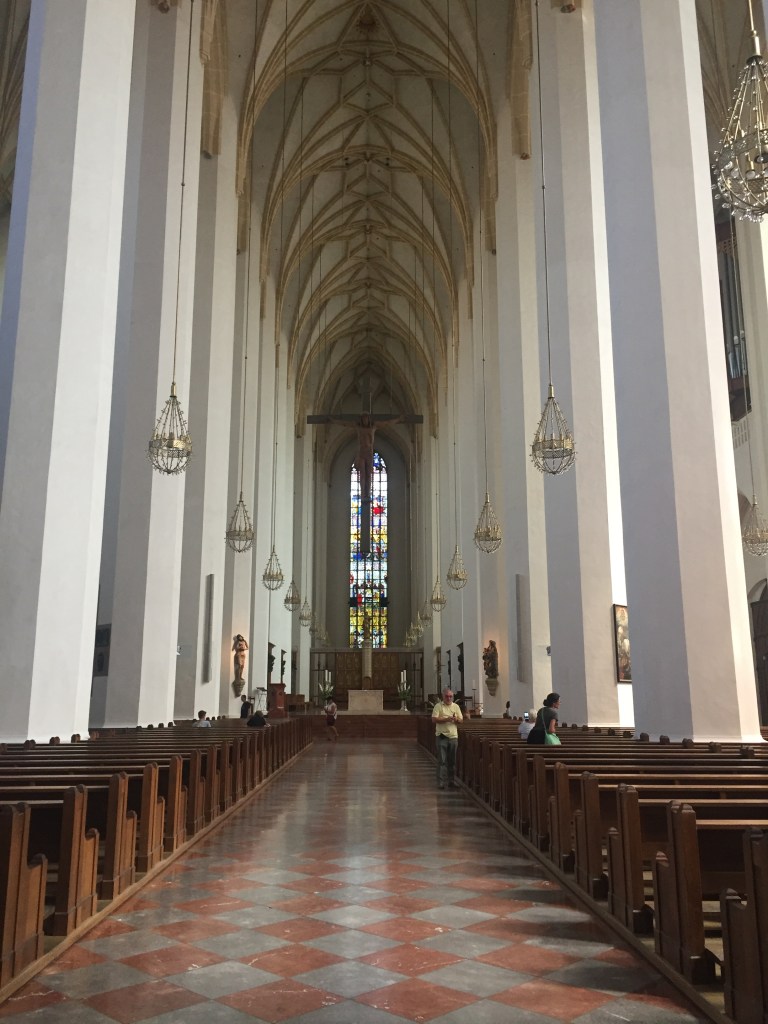
Just a short walk from here is also one of Munich’s most famous sky-line defining structures; The Frauenkirche. Known for it’s two tall towers, it’s Munich’s tallest monument and is a deliberate staple ensuring that no building may be built higher that it’s two steeples (109m). It’s well worth the possible neck pain from looking up at the arches high above to understand it’s sheer size.
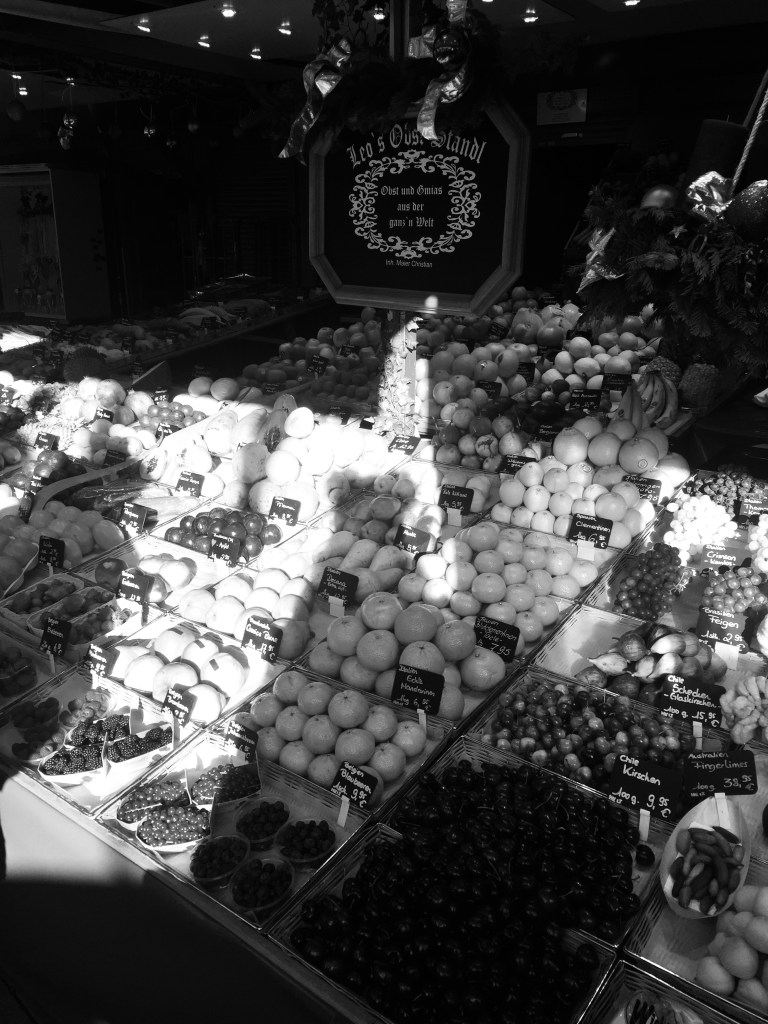
From there, along the road, is the beautiful and often bustling Viktualienmarkt (just off the Marienplatz) which hosts a vast array of pop up restaurants, street food sellers and markets selling all from silverware to Bavarian sausages, fresh bread to tables filled with fresh fruit. Any chance you may have during the day is worth spending here, in the company of friendly sellers and tourists alike who are out early collecting groceries for the day ahead, to flowers, to out a night in search for the finest local beer you can buy – Munich is the Oktoberfest capital after all.
If Museums and Churches aren’t your vibe, then a gander along the U-bahn to the Universität Station leads you out into beautiful open streets surrounded by large pale white buildings filled with students and ground floor bookshops and artists cafes that leave you wanting to explore more. The bookshops cater to all student types and most languages while the cafe’s can be from the most simple chains to independent internet cafe’s with abstract art decorating the walls and piles of books and magazines lying around to read at your leisure while you sip your coffee. Along this route you may bumb into several intersting clothes shops too, some of which may intrigue you more than others.
Pick ‘N’ Weight is a chain of vintage kilo sale – type shops that house all manner of styles but has the exception that with a colour coded system, you pay for clothes by weight and material type. What’s even better is that none of the clothes are ordered by size but rather by colour so you always know which section to check. Coming in from the street, it feels a little like entering hipster Narnia.
Munich’s beauty isn’t only in it’s inhabitants (37.7% of which are foreign) and buildings but also in it’s greenspace and nature.
The Englishen Garten – yes that is it’s name – is one of the world’s largest urban parks and is the perfect place to escape the busy streets while never actually leaving the centre of the city. From the pristine Japanese Tea House to the multitiered Chinese Tower, this park is split in two by the man-made Eisbach (Ice River) which flows rapidly in one end and out the other. In summer it’s common for people to jump in and be happily swept downstream as the river flows out into the open meadows of the park which are often flanked by dozens of sunbathers – some nude and some not. At the southern end of the Park, though, is one of the best and certainly coolest attractions the English Garden offers.
Surfing.
Yes, you heard right. Due to designing the river with an underwater curve, a constant surfing wave flows at the base of the entrance of the Eisbach to the Park and in summer, you’ll find dozens of experienced to beginner surfers waiting for their chance to jump onto the wave before wiping out and drifting downstream; their multi-coloured boards bobbing up and down.
I’m not sure if you’ve ever seen a German cyclist with a surfboard strapped to their bike, cycling in the centre of a large landlocked European city before, but I couldn’t help but laugh the first time I saw it. Then I realised that Munich was exactly that kind of city.
A city of unexpected things. You’ll be caught out. Don’t worry.
Once outside of the centre, though, Munich still doesn’t disappoint. The Olympic Park still hosts a multitude of activities from open-air cinema nights to the largest open-air flea market Europe has to offer. From there, since it is Bavaria, you can find beer-gardens on most corners across Munich and the smaller towns and hamlets you enter as you near the Bavarian Alps and then Austria.
Munich may be a city of the past in many respects, from the part in played in the Nazi Party beginnings to the Bavarian sovereignty and palaces of the southern kings; it is now a city of rich culture, modern ideas and architecture, research universtities, museums and galleries.
There’s a reason why so many people who choose to visit, end up staying, because despite it’s rapidly growing size and progress in all things finance, IT and engineering, it’s the kind of place you go to visit for the history and the beautiful things people have created living there. The art and music, the parks and cycle routes, the vintage bookshops and clothes you won’t find elsewhere and the monuments that inspired so many works of poetry and literature.
I’m writing this from the perspective of someone who has been to other countries and seen first-hand the differences between people’s experience of place vs. people’s perception of place.
And also because the first question people always asked me after I visited India was “Was there a lot of poverty and people living on the streets?”
“What you see and what you hear depend a great deal on where you are standing. It also depends what sort of person you are. “
– C.S. Lewis – the magician’s Nephew
The world view on Asia, Africa and much of the Middle East is outdated.
People are unaware that these incredible countries are no longer the war-ridden, famine-rife, unhygienic places that documentaries from the 1990s to early 2000s painted them as, or relief aid organisations generalised as being. They are places of rich culture, rich economies and rich landscapes. Although, all it has taken is negative news portrayals and these places have become prime examples of countries people shove under the umbrella term ‘third-world country’ – as if this deems them as lesser or less evolved in comparison to the more financially wealthy countries of the western hemisphere.
For example, India has often been perceived from the perspective of the ways films, such as ‘Slumdog Millionaire’, have portrayed it as a dirty, famine, slum-rife country where the quality of life is far lesser than the quality of life others have.
This is where the problem starts.
Simply because a country has a different quality/style of life to yours does, by no means mean, that it is any worse off. A different lifestyle or quality of life could mean that one community or region lives a simpler version of the life you’re used to, however, this doesn’t make it wrong or make the people there poor for not having the same elements to everyday life that you have. Often it is the opposite.
The Ladakhis up near Leh in northern India lived a fully sustainable lifestyle and had an incredibly high quality of life due to the fact that no one went hungry, no one was ‘poor’ and everyone had enough food/land to live off. Then, when western consumerism came to the area in the 1970s, this lifestyle changed drastically and people began viewing their own culture and living standards as poor because western media and consumerism labelled it as such since the quality of life was different. The Ladakhis began to view their own lifestyles as poorer and thereby bought into the western idea by selling western products on the idea that this would make them richer, when in fact their earlier lifestyle was fully sustainable, without hunger or drought or inequality or plastic landfills – which now exist because, as usual, the western lifestyle is idealised to the point that it harms people who were previously much better off without it.
With this, often comes the loss of language as well, since knowing how to speak English is also a requirement for living a westernised lifestyle – which is ridiculous. Language is an enormous part of cultures all over the world as it gives an identity that cannot be taken away but rather instils an exclusivity to the culture that means that identity remains sacred to that particular culture.
This is why Perception of Place is so important in today’s society because as humans we have a nasty habit of instantly comparing our lifestyles to those in other cultures or countries and if it doesn’t match up, see it as lesser or problematic.
What would you think when I say ‘Africa’ to you?
Would you think of starving children or mothers carrying water jugs on their heads for miles or malnourished individuals sat on the pale green sheets of hospital beds in pain due to the life-threatening effects of malaria?
Yes, these have been and still are realities.
But let me tell you what I also think of, when I think ‘Africa’.
A rich, diverse range of countries that span from the great peaks of the Atlas Mountains to the beige-brown sands of the Sahara, to the great green Congo River Basin, the immense East African Rift Valley and all the way south to the Cape of Good Hope and the waters where the Atlantic and Indian Oceans meet. I think of rich economies and farmland initiatives that are investing more into agroforestry in rainforest basins to preserve wildlife and agricultural practices, cities that are pioneering new technology to reduce slum dwellings and increase sustainable living, growing, waste removal and learning in places that are at risk from rising sea levels.
That is what I think of.
But I’m not you. And for me there is still so much to discover as there is for you too.
So it is time to educate ourselves more on the goings-on in the world and the things we may be missing out on because the mindset that suggests that the western lifestyle is the ideal lifestyle is outdated and wrong. Why would you want to aspire to a style of life that threatens any hint of culture, originality or sustainability?
That’s like believing in an updated version of ‘The American Dream’ from the 1930s which essentially helped us discover that the only lifestyle to live is the one you make for yourself based on your beliefs, that furthers your own happiness and isn’t copying or influenced by the white-washed, on-the-surface-perfect lives that 0.001% of people on earth live.
It’s time to learn to look for solutions in unlikely places.
Learn to be tolerant and even embrace the idea that we can learn from other countries and cultures as they can offer different insights and don’t let outdated media norms affect the way you view countries, communities or individuals.
You’ll enjoy discovering more of what the world has to offer that way.
“Some tourists think Amsterdam is a city of sin, but in truth it is a city of freedom. And in freedom, most people find sin.”
– John Green
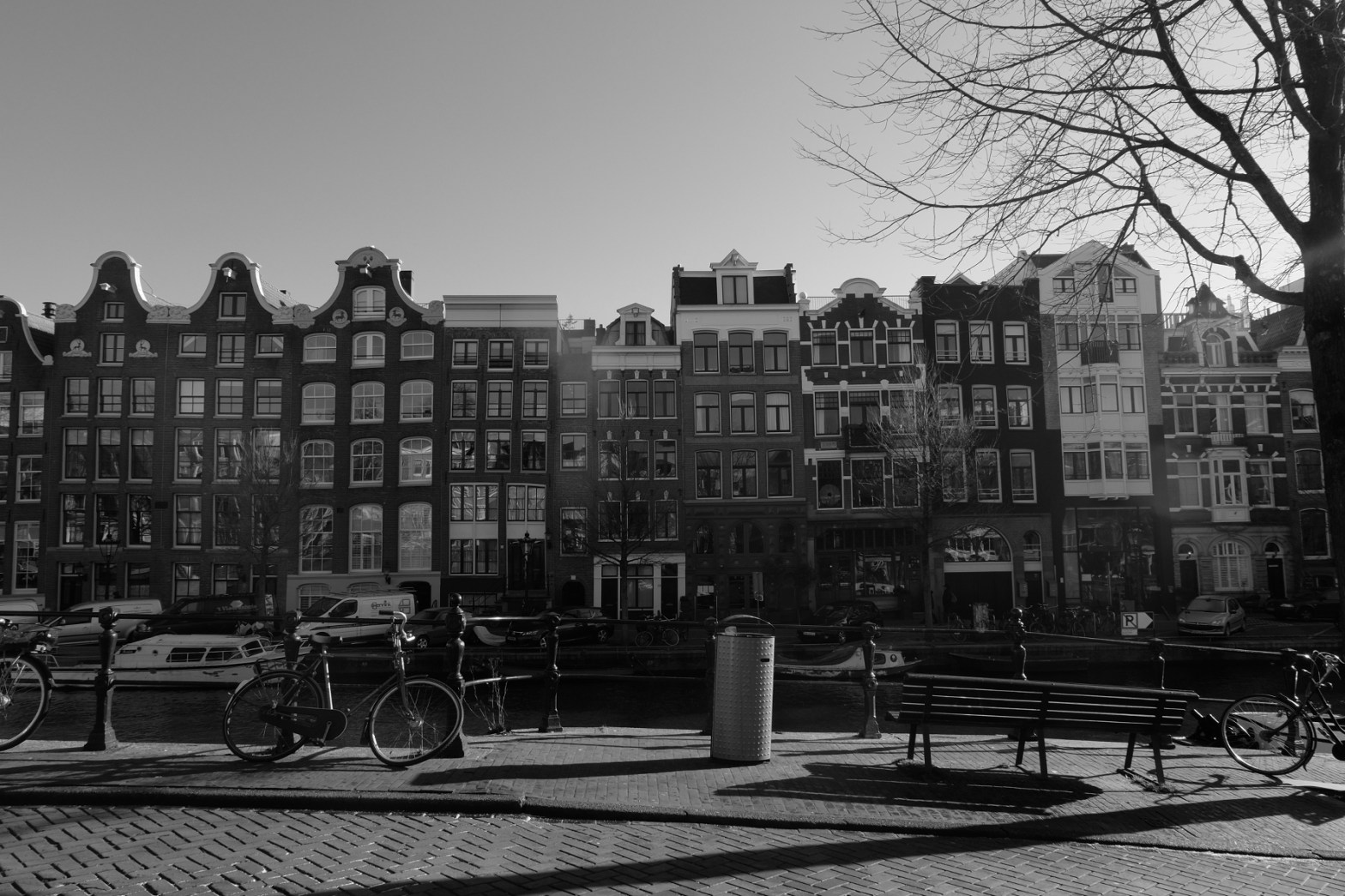
From the narrow canal walkways to the busy, bustling, bike filled streets of the Museumkwartier; Amsterdam is one of the places you may have always wished to visit or may have witnessed from the images printed on a film plotline but have always wanted more of.
From the first visit, the whole aesthetic of the normalcy of cycling everywhere and stopping into small, independent coffee shops or less renowned ‘coffee shops’ to walking the dimly lit, paved streets of the Speigelkwartier looking into crooked shop windows filled with smaller blue and white painted versions of the same houses you walk past, is one of the greatest feelings.
Feeling like an observer to a way of life you’re not used to, yet at the same time a participator in a lifestyle you want to live.
On my way to the Stedelijk Museum, I passed the Museumplein which hosted the world-renowned ‘I amsterdam’ structure which was emboldened by the dozen or so people hanging off the red and white 3D letters and taking pictures surrounded by the bare but beautiful skeletons of the trees in Febraury that lined the central promenade. Those letters and behind them, the imposing yet powerful structure of the Rijksmusem, reflected the winter sunlight.
Although, despite the infamous nature of the museums inside Amsterdam’s central canal network, the less confining quarters of the buildings and institutions on the banks of the Oosterdok are a sight to behold.
After hiring bikes for a number of days, I decided that avoiding the busy lanes of the Red Light District and Museum Quarter warranted a search further afield to the cycle lanes bordering the larger flows of water of the outflowing Noordseekanaal to visit the immense, glistening glass panes of the Amsterdam Conservatory and Amsterdam Openbare Library, next door.
We left our bikes on the stainless, stone promenade overlooking the impressively sloping roof of the Nemo Science Museum and along the Oosterdok to the large Amsterdam Centraal Train Station. Inside the library, we ascended to the top floor cafe and grabbed a drink before hastily catching a window table overlooking, what seemed to be, the whole city.
It was magnificent.
The day wore on then into a sun-setted evening spent cycling and sampling the best canal side streets Amsterdam had to offer. With some quaint flower baskets hanging from the old – now repainted – pully hooks used in the hoisting of grain from the boats to the third floor grain stores back in the day, the streets held an endless supply of sights to see. Some streets varied from the old, red-shuttered beauty associated with old Amsterdam and the trade that defined many of the houses functions to the more commercial streets, bustling with pedestrians and cyclists alike, looking for presents or souvenirs or beverages from modern, white-painted coffee shops that seem to have been pulled straight from the pages of a housing catalogue showing rooms that have yet to be furnished. All white, lacking furniture but no less off in character since the walls are simply decorated in pictures and art, thus giving many places the loose term ‘gallery’ rather than coffee shop.
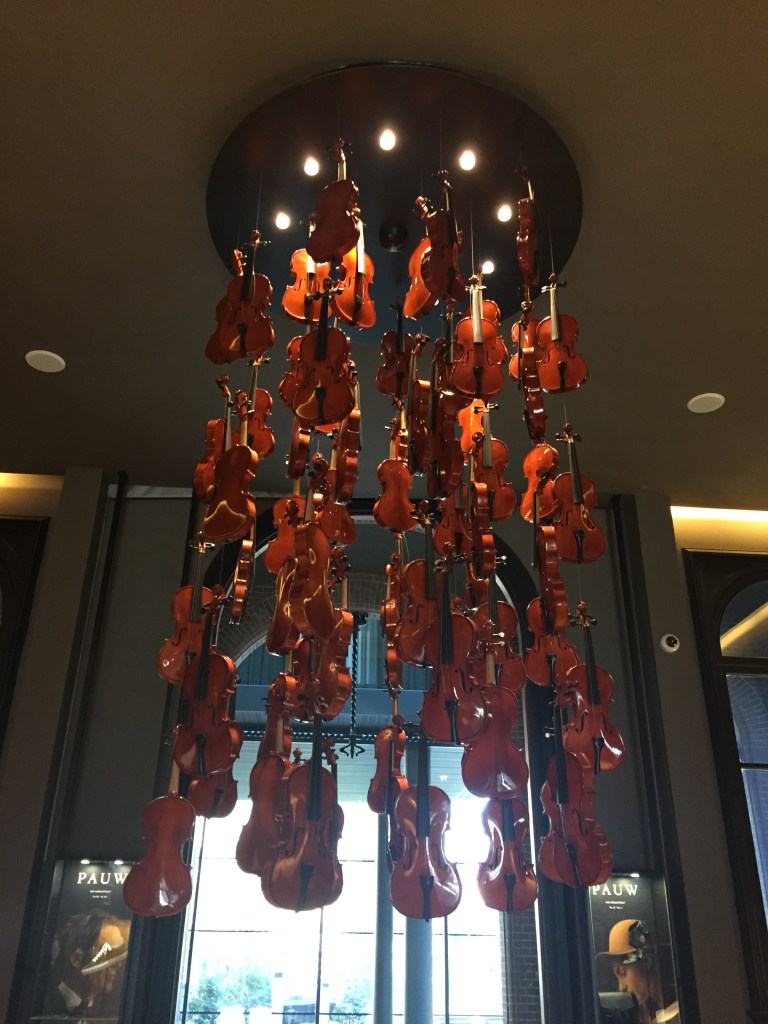
On this journey we ducked into a few hotel lobbies, not only to see what kind of hotels our money couldn’t afford a stay in but also the effortless style that goes into the setting up of window displays and hanging chandeliers through circular staircase spirals.
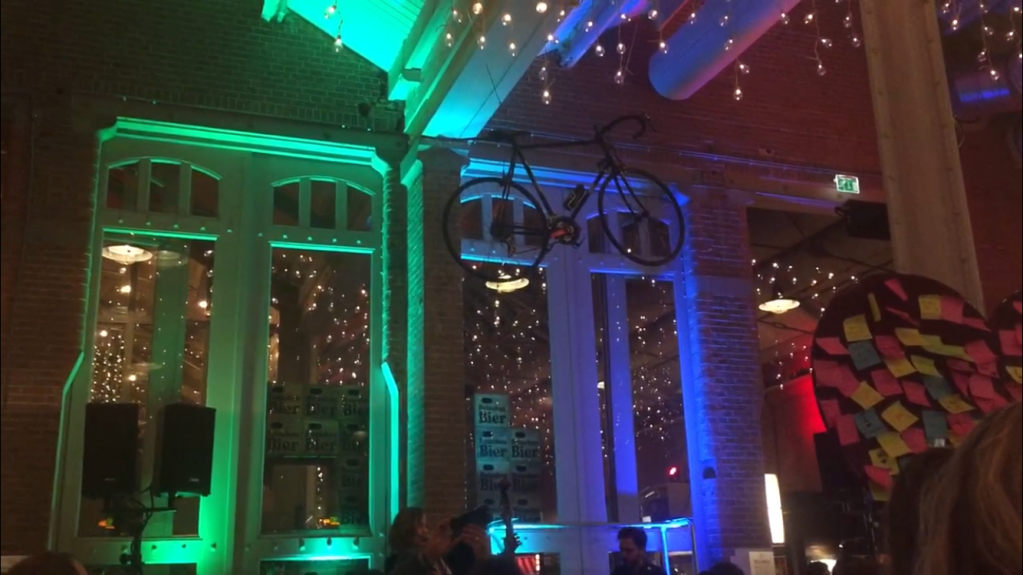
The evening was then spent in the Oud-West and the multi-coloured walls of De Hallen, a series of halls unlike any other. This large, repurposed factory building, rennovated in 2013 after a years of developing Amsterdam’s tram network and then a few years spent in dilapidated status, is a hub of creativity, mulit-culturalism and the arts all collected into one. As we entered the food hall section, we were immediately engulfed by the colour of the lights, criss-crossing the ceiling and the chatter of people seated at a dozen different bars surrounded by four-by-four metre restaurants in blocks scattered across the hall, each cooking dishes from different regions of the world.
After finding a seat near the curved glass windows at one end, we settled into a Vietnamese meal while listening to the sultry tones of a female jazz singer, singing songs from Ella Fitzgerald to Gershwin.
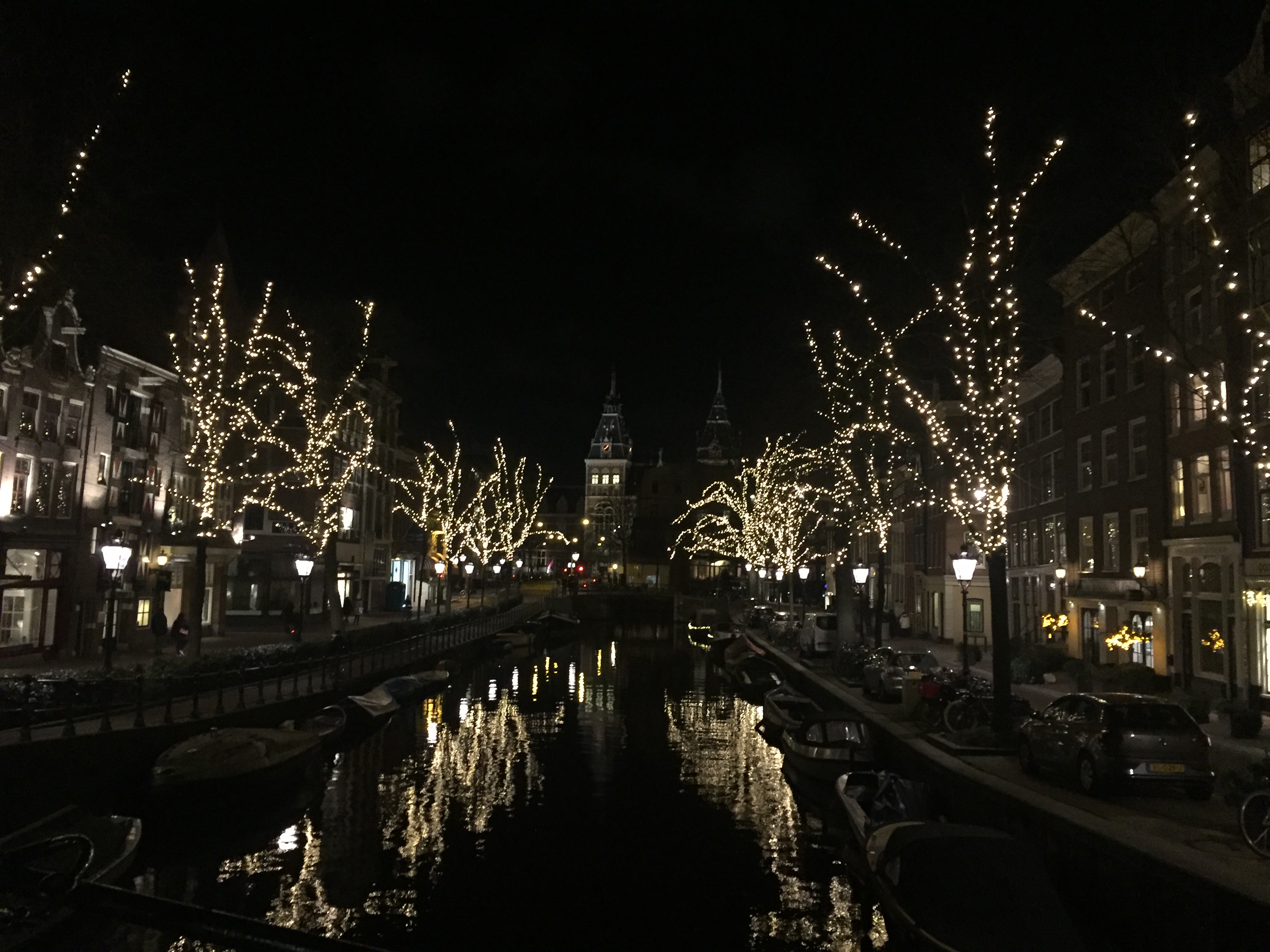
The whole experience felt surreal as we unlocked our bikes from outside, switched on our headlights and buttoned our coats against the clear-skied chill of the evening to then cycle up the road and back into the Nieuwmarkt and the repetitive dips and hills of the canal bridges and tree-rooted streets. Then, upon turing a corner, the street was no longer dim, but overshadowed by millions of fairy lights that clung to the trees overlooking the canalpath.
Millions of tiny stars more visible than the ones in the inky black above.
Amsterdam is a city of people as much as it is a city of structures, each with their own history. You may choose to go for the sights others all want to see, such as the Anne Frank House or the Van Gogh Museum – both of which are still worth a visit. But take a second or an hour to look deeper and find the smaller, less noticeable parts of this canal city to see the beauty in the normal and seemingly unspectacular. A beautifully painted canal boat, a house that is especially crooked or a bookshop dedicated to selling old books on architecture and nature.
You might just find the best things where no one bothers to look.
And hate is a strong word. Not to be used lightly.
Although, I’m sure many people share this ‘fear of missing out’ mentality, it rarely can come to a point where a genuine fear develops that can leave you feeling like you’re missing out on possible life-changing opportunities as a result.
Whenever I have an opportunity as small as going to hang out with friends to something as large as being able to travel across the world, this fear kicks it up a gear and puts them on the same level or importance, with each missed opportunity being equivalent to the next.
Not good.
This can often then have the further effect of ruining the experience when you end up actually pursuing said opportunity since the process of getting there was so stressful.
So is there a light at the end of the tunnel?
Maybe.
I’m still navigating my way using a faulty, heavy and clunky torch that are often associated with cheesy 80’s horror films where they go out leaving you plunged into sudden darkness at a moments notice.
There’s also a need to embrace the moment and learn to enjoy missing out on things since ‘missing out’ on one thing doesn’t mean missing out on everything else. You could pass up one opportunity for another or just take a minute to relax after a busy day because trying to pursue every opportunity at every minute of the day leaves you tired and constantly wondering if it’s possible to cover up the dark circles hanging under your eyes – hence the ‘joyousness’ of missing out.
I don’t want to wonder when my next good nights sleep might be.
I want to be happier with myself taking time off and not seeing it as ‘slacking off’ or ‘being lazy when you could be doing so much more’.
I know that certainly in my latter school years I could’ve listened better to the advice I was giving others: “Go home! You’ve got free’s the rest of the day!” or “If you’re tired, take a nap. Here’s my bag if you want it as a pillow.”
Yep. I was terrible at taking my own words as something I should apply to myself. Instead I spent hours doing homework that should’ve taken one, took on every extra commitment I could as a way to help out and/or guarantee that I had a glowing personal statement to show Universities and didn’t sleep longer than 6 hours a night when 8 was the recommended amount.
So when a global pandemic rolled around the corner, my brain probably collapsed in a metaphorical heap and breathed a sigh of relief that I wasn’t about to burn out; I would’ve if I’d kept going at the rate I was.
However these are the times I can’t ever get back. The time spent working so hard that it wasn’t doing me any good to then proceed to ‘miss out’ on time with friends, going out, having fun, watching films or going walking.
So in a roundabout way, my fear of missing out, academically, caused me to miss out on the other, more important side of my life. Having fun with family and friends.
This fear can either control you, or you can choose to commit to yourself over wondering what could have been.
I know I still need some major self-guidance but it’s getting better.
I’m getting used to saying no more often, or for those (like me) who hate to be direct, I’ll say “maybe later” or “we’ll see”.
It’s an improvement.
Because wondering (too much) about what direction your life will take can leave you, ironically, feeling directionless.
“You have power over your mind – not outside events. Realise this, and you will find strength.
It’s up to us to break generational norms. When they say, “It runs in the family”, you tell them “this is where it runs out”.
– Anon
I’m part of what some would call Generation Z.
To some it is a generation of misguided, unemployed, useless know-it-alls but to others it means revolution, tolerance, acceptance and inclusivity on a scale yet to be understood.
As biased as it may seem, I agree slightly more with the latter.
However, as much as some people won’t want to admit it today, my generation has done so much good in a world that wasn’t wholly great to begin with. So now we have to work with what we’ve got:
A climate emergency
Unaffordable housing
Pretty awful world leadership
Forest fires
Oceanic Pollution
Stereotyping an entire generation of individuals
Fast fashion
Racial and gender and income inequality
…the list could go on.
Now I’m not saying that we’re the generation to fix everything, because from what I can gather from that wondrous place called ‘the internet’ is that Gen Z kids can go from protesting human rights and calling out racism to spending a week in bed watching Youtube.
Despite this, change never occurred by simply continuing with the norms of life and ignoring the hard tasks we have yet to handle. Or being ignorant of the hard, sometimes damaging ‘norms’ that need challenging.
Do you think the American Civil Rights Movement began with someone simply going about their day and hoping for change? Do you think the Suffragettes simply sat idle by their husbands or fathers sides and kept all their fears, thoughts and dreams inside?
No.
Change is necessary for growth and the world needs to do a hell of a lot more of that.
Now when it comes to a Generational Divide such as that between my generation and what some might call ‘the boomers’ or older generations of this world, I believe it’s a case of misunderstanding. Misunderstanding that goes so deep it becomes perceived as ignorance on the older side and improper, radical behaviour on the younger.
Neither is true.
In the 60s and 70s, that generation was similar due to them being the start of their own generational revolution which brought about movements such as Rock and Roll, the beginning of the Pride parades and Civil Rights Movements as well as unfair wage strikes and people protesting the environment.
Yes, it was a great time to be born in the golden age of music too (my opinion).
However, the institutions run by these exact members of these generations fail to see the good and ideas that young people wish to instil on the world due to their age. A prime example being Greta Thunberg, who endured vast criticism and belief that her parents were the ones truly pulling the strings behind the scenes – thus a lack of trust, by the media and others, due to age.
I’ve noticed as well, that children are generally treated as lesser, not in importance, but in their views and opinions until society deems them ‘legally’ adults. This can be incredibly frustrating to confident and well-versed individuals who want to be heard but are limited to child status simply because of age constraints. Someone who’s 16 or even 11 can feel like an adult but society labels them otherwise.
This is by no means a reflection on entire older generations but simply the few that make it hard to be heard as both a young person and as someone actively wanting to bring about change.
Another example of a lack of trust in youth judgement is that governments or institutions have a rule to refuse students to leave school premises or even punish them for attending climate strikes. This premise of fear that these ruling powers have, that students will use this time irresponsibly and thereby slowly stop turning up to school altogether if they support this global movement to save the planet, is based on a few individuals but offers group punishment as an answer.
This isn’t right.
Students and young people shouldn’t have to prove their reliability or endure punishment simply because of a generalisation of a generation when the vast majority genuinely want to protest climate injustice and hope for a better future that these governments and institutions made worse in the first place.
A positive feedback loop that ensures no one wins.
Younger generations are left to the a system that treats them as a single entity (forces them to wear the same clothes etc.) and the system continues to oppress a fight for justice that should concern all involved.
But it doesn’t.
So when I talk of my generation and the movements some of us have pioneered (Greta Thunberg and the Fridays for Future campaign) or taken part in (the age group with the greatest participance in the Black Lives Matter Movement is under 35s or students protesting the extortionate fees to get into University) I say that there is a serious power and likemindedness in these generations that wasn’t there before. Many people with one goal, which is precisely what our world needs.
So what really needs resolving is this crisis of understanding between generations. An understanding that ensures phrases such as “Phone-obsessed” and “Are young people to blame for new surges in the Coronavirus?” aren’t being tied to an entire generation of individuals and that older generations understand fully the weight of their responsibility to the younger generation and their treatment of them as intelligent people they could learn from and not the other way around.
We have so much to give and so much to learn either way.
Conscious travel, as I find myself in an airport, is now an increasing reality and topic that needs more discussion down to the finer details. It is also necessary, not only due to the enormous environmental impacts but also the risks now associated with travel in a post-COVID 19 (or more realistically a current-COVID 19) world.
It’s scary; it’s okay to admit that. But it’s also right to be conscious, aware and knowledgable of travel in all its forms.
(Also, believe me when I say that I am still learning and am actively trying to consciously cut my travel time despite having family elsewhere in the world, so this is something I know a little about.)
“The world is changed by your example, not by your opinion.”
– Paulo Coelho
Travel is slowly becoming a part of everyday life again (in Europe – I can’t speak for other countries) however, this brings a whole host of new challenges with it. And for that a whole host of attitudes which can create significant conflict among people of different views.
For example, I imagine that the viewpoint of successful businessman who travels regularly to attend valuable conferences and meetings regarding financial statistics has a juxtaposing viewpoint to a remote village fisherman living in the Philippines who has never travelled outside of a few miles from his home.
Hence the need for awareness of cause and effect.
The businessman, with his substantial income, modest job and airline benefits does not realise the impact he has on the fisherman who has likely endured more than a lifetime’s worth of earthquakes, hurricanes and tsunami’s as a result of the businessman’s air travel. This attitude contributes to the greenhouse gases already impacting our atmosphere, warming ocean temperatures and directly resulting in increased storm activity and destructive natural disasters.
Now that may seem a lot to process from one person’s involvement in one mode of transport but this is the truth of the situation, and since the two individuals aren’t known to each other, the positive feedback loop continues.
Every action counts when you travel and nearly every mode of transport produces some form of pollution, be it CO2 related or particulate related: both are severely damaging to environmental and human health.
So what can we do?
I propose the concept of universal awareness, AKA ‘Conscious Travel’.
Check, next time you use transport, the impacts you might be having on the environment or others (at the time of COVID 19). Are you wearing a mask? – if not I have a separate blog post about that.
Are you aware of how polluting your mode of transport is?
Flying produces twice the warming effect of CO2 alone, which significantly damages and warms the atmosphere, leading to more threatening secondary impacts such as Ocean Acidification, Forest Fires and smog build up in urban areas.
So how can we implement ‘Conscious Travel’? Well…
It’s all about awareness and understanding of the impacts you, as a human, have. Realise that you may have a desire to see the world but this can only be done sustainably and with minimum environmental impact. By understanding this you can consciously question your need and/or desire to travel more by think about necessity vs. want.
Do you need to travel to Spain this year or could you just as easily go to the coast somewhere nearby? Do you need to visit family in far away places as often as possible or would regular Skype calls suffice?
It is fast becoming the reality that we need to really THINK about our travel needs and drastically cut them down to reduce carbon footprints and thus far the impacts of our interaction with others during a pandemic. Furthermore it is our duty to call out others not doing the same, such as large TNC’s and other international corporations that profit from travel related industries or logistics.
Less travel = more beautiful places stay beautiful for longer and less danger to human health and wellbeing.
And since we are at the centre of a climate emergency and a pandemic (wow, 2020 really has given us the best year yet) it is more important now, more than ever, to consciously travel.
Learn to find happiness in the place you’re in, or find somewhere nearby to get away.
It shouldn’t take crossing an ocean for you to clear your head.
For those that may not know me, as the majority don’t since I haven’t made that much of an impact on the world being 18 an’ all, I’m bilingual.
Specifically bilingual in German, which in hindsight isn’t the most helpful language to be fluent in, in comparison to other languages such as Spanish or Mandarin which are more universally spoken in more places.
However being bilingual has many positives (don’t get me wrong, this isn’t going to be a rant about the shortcomings of speaking two languages) because there are many things I loved about growing up bilingually:
Being able to communicate and understand two different cultures.
Knowing how to conversationally ask for things while in the other country.
Being able to take GCSE’s and A-levels earlier due to more knowledge of the language.
Having two passports (in some cases).
These are a few in the list and I’m glad I grew up with the prospects of being German and simultaneouly British.
However I’ve noticed, especially when you are born into a bilingual household, that there are certain pressures and expectations placed on you, not only by family members but also by those in society around you that you suddenly understand all there is to know about your second language.
That’s not always true and can be damaging to confidence levels as people grow up.
Commonly, after the initial animosity that can come with someone from abroad coming into a school environment, I was always asked to prove that I was bilingual; that I could speak German by classmates that would ask me to “prove it” or “say something”. More often than not I would simply entertain and say something like “hello” or “my name is” and that would be that. But it still bothered me that there was this mentality that I needed to prove something. Was there really this distrust lurking around about my origin because I looked ‘british’ or was it more that people believed that those from abroad must look or seem different from the ‘norm’ for them to single them out of a crowd and brand them as ‘foreign’ and I wasn’t immediately brandable?
As a 6-year-old, I had no idea. So I just went along with it.
By the time secondary school came around, I had experienced the odd offensive slur about being German (highlighting certain aspects of history) but none had really had much of an impact because being German wasn’t quite as unheard of as those from further afield and as a fluent English speaker without an accent people didn’t notice any different.
Then exam season rolled around and I soon realised that doing German exams was something I could do earlier than the rest of my year (again, something I found wholly positive) but soon realised that, since I had never been taught structured German in a classroom, it was very different to the German I had learned whilst growing up. So the questions turned from “can you prove it?” to “Well, you should find those easy, right?”
Cue the plummet of confidence in my abilities.
Instead of this idea of doing exams early being this big, exciting thing that could help me with future jobs or possible work abroad, it turned into this need to prove myself all over again. Prove that my auditory language learning was enough to breeze through an intitutionally organised syllabus and ensuing exams that don’t actually teach you how to speak the language but rather how to teach it.
Forgive me, but I don’t think knowing the Pluperfect tense constitutes on the list of things I think of when ordering a coffee and a muffin.
After a while it became expected that people thought I wouldn’t have any trouble with the language exams.
The first set went well but weren’t the top marks. That was okay.
Then came the second set and I got a grade I wasn’t entirely happy about but could live with considering I’d taught myself the syllabus that year with some help from a tutor.
When it then came to the time that I wanted to happily share my success, I was met with “Oh, that’s still really good!” or “Well, don’t feel bad: the paper must’ve been hard”.
I was hurt, to say the least, but most of all I felt as thought those who were saying these, less than helpful, comments were voicing my thoughts aloud.
“You should have done better because you already know the language.”
“You should find this easy, why didn’t you study harder?”
And thus, my confidence plummeted further until it affected my other subjects, I started properly doubting my own abilities and the work ethic I was so proud of was reduced to the mindset that there always something I could do to improve myself.
Nothing was ever enough.
Now in the present, I would like to state that this mindset is neither healthy nor good for productivity and easily leads to regular burnouts. I kept convicing myself it worth it, but then found that I had become too consumed with this need to be perfect at something I had never been taught before, simply because I knew the basics. I’d turned my success at passing a major exam with a pretty good grade into a failure. A failure at grasping the language that I had grown up with.
People shouldn’t get to dictate what you see as success or failure and there should be an ability to remove the stigma that being bilingual means you are perfect on both sides.
Being perfect in itself is a flawed concept so why aspire to be it?
I’m happy that I have the ability to speak two languages enough to relate culturally and physically to the country while also knowing that I am my own person and am not defined by either country or my ability to speak the language.
Also, a country’s stereotypes or past shouldn’t define you as an individual and I believe more people need to be reminded of that.
Normal isn’t a concept but more likely an idealistic structure on life that maybe fits closer to the view propaganda had in the 1950’s on ‘the perfect normal life’. With a pastel coloured car, straight white children and a house with a picket fence.
Of course, this is outdated and generally dumb, however this need and desperate longing for normal never seems to be satisfied.
A ‘normal’ person to me means someone who has gone through the ups and downs of life, someone who has endured suffering but seen equal amounts and joy and likely not suffered from panic attacks or mental health conditions of any kind.
I don’t think there are many ‘normal’ people.
So why do we try and become a part of this miniscule minority in the population when the vast majority aren’t normal?
No. Now the thing to be is ‘original’. Sell your own brand, except that term is no longer limited to retail but now as a label to an identity. You must become one in 7 billion and try your hardest not to become like everyone else.
As someone who’s still growing up, this is something I’ve noticed in that process. We’ve reversed the principles we learned from our first social steps of school and are now told to express ourselves to the extent that it’s shamed upon when you don’t. Be different, be bold – well what if I don’t want to be bold? What if I don’t want to be seen or heard every minute of my life just to prove to those around me that I am individual, I am special.
Its exhausting. Frankly.
After a lifetime in commitment to a system where ‘fitting in’ seems to be the ‘norm’, it is frowned upon to ‘act out’ yet we are told to develop ourselves individually in a place where we all wear the same clothes and told to abide by the same rules as if we all fit into the same pair of shoes.
Society teaches us to want to be normal but reprimands us for trying.
You must wear black socks to school but continue to ask interesting questions on topics relating to history, religion and science.
Why do my socks need to be black for that to happen?
Why must I have sensibly coloured hair for people to take me seriously?
Why is the standard of work I do, not enough to earn recognition or praise for the hours put in?
Instead someone who’s done the bare minimum is rewarded for the smallest effort but those who continually perform and try and cry over the near-impossible work are given a simple “well done” for just handing it in.
Are we only valued on the work we do (or the work we don’t) and not the people we are? School teaches us as such. Work over identity. Being who you are isn’t enough.
So we try hard to do both (work to be valued and establish our identites) and find that this takes us away from ‘normal’ even more by throwing mental health issues our way further stating that ‘you’re not normal’.
But not being normal is actually the good thing to be. You don’t inherently want to be like everyone else but it should also mean that you shouldn’t have to prove it all the time.
We may wish to escape our struggles or our pain or our pasts but it is all in greater pursuit of a better future. Seeking to individualise, take control and become original, unique and incredible versions of ourselves.
So that’s why I often find the need to write things down. It’s something to leave behind.
An entirely original mark on the world that is inherently not normal and true to myself.
So here it is.
Make the mark you want but don’t feel that you need a triple strength permanent marker to do it.
If it’s true to you and who you are, then the mark you make will matter no matter the size.




 For Wanderers and Wonderers